Latest
  • visit www.artsghana.net for information on the arts
  • visit www.artsghana.net for information on the arts

Arts Ghana

MENU
  • Home
  • About Us
  • Upcoming Events
  • Latest News
  • Artistes Database
  • Archives
  • Links
  • Contact Us
  • Music
  • Dance
  • Theatre
  • Literature
  • Visual Arts
  • Film
  • Fashion
  • You Tube
  • Facebook
  • April 28, 2026 • 123

    Festival reaffirms Togo as a jazz hub

  • April 24, 2026 • 285

    Music shaped by ancestry, improvisation, and transcendence

  • April 23, 2026 • 263

    Brass bands showcase tradition and experimentation

  • April 21, 2026 • 190

    Set design mirrors dynamism of contemporary African performance

  • April 17, 2026 • 229

    Shifting portraits of the complexities of male identity

  • April 17, 2026 • 220

    Rhythmic footwork and grounded movements

  • April 16, 2026 • 511

    Raw physicality with spiritual introspection  

  • April 16, 2026 • 260

    Imposition, interruption, and provocation by LED screen

  • April 15, 2026 • 173

    Sonic meditation on tradition and transformation

  • April 15, 2026 • 291

    Subtle exposure of constraints that shape female identity

  • Ayi Solomon / Esinam Dogbatse captivate Jazz fans in Copenhagen

    July 30, 2016 • FeaturedArticle, News • 2720

    By John Owoo

    (In Copenhagen – Denmark)

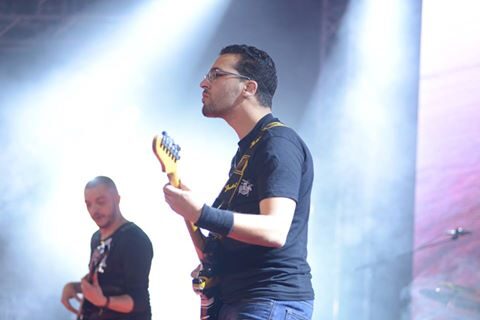
    Ace Ghanaian drummer Ayi Solomon and the Ghanaian-Belgian flutist Esinam Dogbatse took turns at the just ended Copenhagen Jazz festival with a magnetic show that charmed patrons at the Music Cafe in Copenhagen.

    Alongside Danish guitarist John Sund, the duo sent the audience at one of the World Scene Platforms on a cool musical journey that terminated with brilliantly shaped original material laced with Ghanaian rhythms.

    With a crafty ability to play diverse percussive instruments on stage, Solomon and Sund varied their repertoire and style with a subtle / clear progression – individually and collectively.

    The two musicians allowed themselves to break loose with short but dramatic solos that are full of finesse and force while making a strong point that an exceptional drummer or saxophonist can provide a unique and expansive vision on stage.

    “Ayi Solomon never ceases to amaze me – he is without doubt an innovative artist with imaginative rhythms that ensure constant energy on stage. It was a memorable night”, said Lene Merethe Jacobsen, a social worker in Copenhagen.

    Earlier Belgium based flutist Esinam Dogbatse rocked the audience with a stimulating flute work that tended to reflect the echo of an open landscape while digging deep into Ghanaian traditional rhythms.

    Employing the loop, flute and percussive instruments, Dogbatse went into her own world and dished out tunes that captured the imagination of the audience, who cheered and applauded in response.

    Undeniably, she appears as an exceptional improviser as she employs local Ghanaian drums and shakers thereby creating a close awareness of the deep connections between her music and her Ghanaian heritage.

    “Esinam is set to hit the world music scene by storm – she displayed a monumental sense of dedication and stagecraft – she was having a great time on stage and managed to transfer it to the audience”, added Klaus Christiansen, a music promoter in Albertslund, near Copenhagen.

    Dogbatse is expected to arrive in Ghana in the next few months for a number of workshops and performances.


    Read More »
  • BOEMI musicians rock Palermo

    July 21, 2016 • FeaturedArticle, News • 2974

    By John Owoo

    (In Palermo – Italy)

    Hip Hop / Afro Blues star Trigmatic together with musicians from Denmark, Spain, Portugal, Italy and Ghana last week showcased the beauty and power of cross cultural collaboration during a concert in the Italian city of Palermo.

    Performing at Sanlorenzo Marcato, during the final seminar of Project BOEMI, the group through a dynamic interplay of auditory and visual modalities, showcased how music moves through emotional and perceptive responses as they flowed freely with each other.

    With Mavis Sintim-Aboagye (vocals), Fatima Pérez Robledo (piano), Miguel Almeida (bass), Miguel Ruiz de Elvira (guitar), Helene Tungelund (vocals), Cecilia Begueria (violin) Iris Jugo (cello), Peter Suwalski (drums) and Pablo Barianga Blanquez (keyboard), the multi national group swayed the audience with its culturally linked style as cheers erupted among the evening revellers.

    Comprising Blues/Hiphop tunes from Trigmatic, Highlife / traditional Ghanaian songs from Sintim-Aboagye, traditional Danish ballads from Tungelund as well as improvised rhythms from the Portuguese and Spanish musicians, the group attested that lyrics and beats from diverse cultures can tightly fit into each other.

    The seminar, among other things dilated on media skills and their diffusion among the youth as well as cultivating and valorising the practice of Reciprocal Maieutic Approach in the field of music – which would be employed as a technique for youth empowerment and social transformation.

    Moderated by Antonella Alessi, Giovanni Barbieri, Paula Litez, Florian Giraudo and Giulia Tarantino, the seminar equally touched on building employment skills and its subsequent dissemination to young people with limited opportunities.

    BOEMI (Building Our Employment skills through Music Investigations and New Media) is an innovative capacity building project involving five partners – Centro per lo Sviluppo Creativo “Danilo Dolci” (Italy), Crossing Borders (Denmark), IYEC (Ghana), Jeunesse En Action “GNO FAR” (Senegal) and Asociación para la Integración y Progreso de las Culturas Pandora (Spain).

    The project aims at promoting transnational non-formal learning mobility activities between different countries, targeting less privileged youth / youth workers in a bid to increase their competences and active participation in society.

    BOEMI aims particularly at growing youth self-esteem and feeling of belonging to society, increasing the confidence in their “unique selling points” and transforming their interest in music into employable skills.

    The project also intends to empower organizations working for the youth, developing new working methods, tools and materials based on non-formal education and experimenting music as an educational pedagogical tool.


    Read More »
  • Jazzy Highlife at Copenhagen Festival

    July 16, 2016 • FeaturedArticle, News • 2888


    By John Owoo

    (In Copenhagen – Denmark)

    Brekete Sounds, a group comprising Ghanaian musicians based in Denmark last week made a bold appearance at the Copenhagen Jazz festival with a gripping performance.

    With a cool blend of highlife and jazz, the group filled Café Cadeau, which is located in the Frederiksberg area of Copenhagen, with graceful highlife rhythms thereby turning the concert into a mini Ghanaian festival.

    Employing compositions from bandleader and percussionist Sam Tachie, the group sent the audience on a smooth journey to a village where traditional Ghanaian rhythms, beats, songs and proverbs flowed in a constant stream.

    Alongside talking drums, kpanlogo, donno, bells, rattles, guitar/bass guitars, trumpet and keyboard, Brekete Sounds proved the fact that Ghanaian highlife is making a strong revival in this era of electronica, as the audience simply immersed themselves in the refined rhythms emanating from the stage.

    “It’s great to hear highlife dramatically fused with jazz and other rhythms – there appears to be some kind of a renaissance with highlife – it’s been a great evening and I look forward to seeing the band on stage soon”, said Fredrik Larsen, a lawyer in Copenhagen.

    “It was a memorable concert – I am delighted to see a Ghanaian band performing at the jazz festival. I enjoyed the rhythms from the percussive instruments”, continued Merethe Larsen, a retired nurse from Albertslund, near Copenhagen.

    With songs unfolding in strikingly paced arrangements with controlled intensity, the Brekete guys churned out iconic dance sounds that equally caught the attention of the crowd who responded with steps on the dance floor.

    Also on stage was the Belgian / Ghanaian flutist, Esinam Dogbatse who enchanted the audience with a variety of sounds laced with Ghanaian traditional rhythms.

    Brekete Sounds is an Afropop ensemble that digs deep into the roots of Highlife music while fusing Ghanaian traditional rhythms with elements of Afro-Jazz, Afro Beat and Afro Reggae to create a new synthesis.

    The 38th edition of Copenhagen Jazz Festival presented1,300 concerts spread throughout 120 venues in Copenhagen and Frederiksberg. Once again, this lovely city has proved that it can live up to its reputation as a diverse and progressive jazz

    Read More »
  • Digital dimensions – Ghanaian illustrators test boundaries in modern art

    July 8, 2016 • FeaturedArticle, News • 4190

    By Kirsty Osei-Bempong

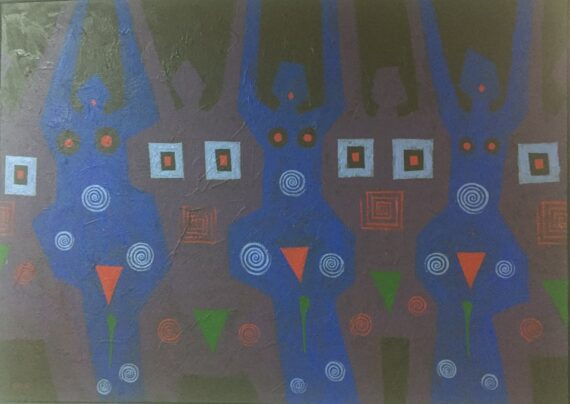
    Ghanaian artists can face an uphill struggle attaining national recognition for their work. Although there is a visual appreciation of the craft, often art in Ghana is viewed as indulgent, expensive and not an acceptable career choice.

    As a result, some artists leave the country in order to further their careers, while others opt to find more stable job alternatives. But there is a new wave of Ghanaian talent that is helping to popularize and change attitudes to art in Ghana – all from the comfort of their homes.

    Ghanaian digital illustrator heavyweights such as Ray Styles and Bright Ackwerh, are combining drawing skills, digital techniques and social media to target audiences with global influence, money and a love of art.

    This relatively recent trend has helped popularize celebrity caricatures that use satirical pieces to highlight social and political commentary. Digital illustration has been around in Ghana for at least a decade.

    But developments in graphic design tablets such as Japanese-made Wacom and Canadian illustration software such as Corel, are helping to improve the quality of digital art. The more recent growth of social media and android handset usage has also helped to propel emerging artists into the public domain.

    According to online data source Internet World Stats, Ghana’s Internet usage jumped from 30,000 by 31 December 2000 to 5.2million by 30 November 2015. Facebook usage in Ghana was 2.9m, making the country the 7th most active user out of the 58 countries and territories classed under the African continent.

    But does this increased exposure translate into better public appreciation of Ghanaian art? And is there a greater willingness from the public to pay for it? MisBeee speaks to some emerging and established artists to find out their views.

    Twenty-two year-old Takoradi Polytechnic graduate Daniel Arthur-Baidoo is a qualified graphic designer, who branched into digital illustration two years. He specialises in caricatures and portraits and was motivated to draw more after receiving positive feedback on Facebook from friends and family.

    Being on social media exposed him to a burgeoning network of local Ghanaian artists. In this forum, he can share ideas and learn from other artists. It is through these associations that he secured a design contract with London-based company Zipped Multimedia UK.

    But Arthur-Baidoo is not alone. Graphic design students Etornam Qwame, and Kobby Andrew – also from the same polytechnic – credit Facebook, Twitter and Instagram for helping them to market and sell their work.

    Digital illustration offers obvious appeal as artists can produce pieces quickly. Even though Qwame can create illustrations using the traditional paper and pencil format, he prefers the convenience that digital illustration offers him.

    “It is good to know the digital aspect because the world is moving on,” the 21-year-old said. “I was finding that after using pencil and paper to illustrate something, people would want to receive it in a digital format, which meant I ended up scanning it. So it was easier to use a pen tool – like a pressure sensitive tablet – that allows you to draw straight on to the computer and print it straight onto a canvas.”

    Arthur-Baidoo, Qwame and Andrew credit YouTube in helping to boost their illustration skills. “We don’t learn digital illustration at my polytechnic,” said Qwame. “In my class, we group together and practice using YouTube. A high proportion of youth nowadays learn faster from using the Internet.”

    But some of these benefits also come with their disadvantages. “It leads people to think that you are just scanning images and adding effects,” said Arthur-Baidoo, who is also trained in traditional pencil and paper illustration.

    “You still need to have mastered the foundations of traditional drawing to be able to do digital illustration,” said 25-year-old Akwasi Boateng aka SarBoat. – a graduate from Kwame Nkrumah University of Science and Technology (KNUST). “If you don’t have those foundations, you’ll struggle to get it right”. Boateng has six years of illustration experience and in 2015 was nominated in the artist extraordinaire category of the Ghana UK Based Achievement (GUBA) Awards.

    Some illustrators such as Kwartelai aka Daniel Tawia Quartey, believe the digital form has helped to enhance their skill set. The 21-year-old, who is studying graphic design at Radford University College, Accra, describes his art style as a combination of manga and African art.

    “I used to do a lot of pen drawing and less painting,” he said,” but when I went digital, I was forced to start working with colours and learned a lot from that. I am still learning”. Qwame believes this assumption about the skill and effort used in digital art affects how much illustrators are able to charge. “Some do not realise the amount of work involved and then don’t want to pay you as a result,” he said.

    But these attitudes are not just the preserve of digital illustrators. Raphael Tetteh, who paints oil portraits of people and animals, started his art career in Ghana 15 years ago. Tetteh works full time as a painter under the company name Magicstix Art. He chose to leave for the UK in the last few years partly because although people liked what he did, they would complain about the price.

    Since moving abroad, issues of price have been less of a challenge, which begs the question…. how is art perceived by the average Ghanaian? “From my perspective, Ghanaians are more attracted to art that relates to real life situations or things they can relate to,” said Kwartelai. “So if you are an artist who does this kind of art they will recognise you. Then again, if you are the type that illustrates based on personal inspiration, just a few people and art lovers in your field are able to relate.”

    For Elikem Nutifafa Kuenyehia, the popularity of digital illustration is largely because this type of art resonates with the artist’s primary audience – “the tech savvy cartoon and comics generation that grew up watching cartoons such as Captain Planet, Dexter’s Laboratory, Johnny Bravo and Batman,” he said. Kuenyehia is the founder of annual Ghanaian art competition the Kuenyehia Prize.

    Social media has helped to extend that audience but the ease with which digital illustrations can be copied and shared raises issues of authenticity, which in Kuenyehia’s view could further devalue the art. “Social media reinforces the notion that art [digital art in this case] is/should be free and that is one of the manifestations of the “lack of appreciation,” he said.

    Improving perceptions of Ghanaian art and its value is something that Kuenyehia is pushing for. He established the Kuenyehia Prize in 2014 in a bid to identify, reward and help develop Ghana’s most outstanding artists aged between 25 and 40.

    One of its most recent winners in April 2016 was KNUST graduate Bright Ackwerh. Ackwerh uses both traditional and digital forms of illustration and “found a huge audience, especially on social media, where he uses his art to push discussion on delicate issues”, the Prize’s website says.

    Among the Prize’s advocates is world-renowned Ghanaian sculptor Professor Emeritus El Anatsui who was part of the jury. Ackwerh’s affiliation to the Prize, is likely to support the other essential side of promoting Ghanaian art. That being boosting the appreciation aspect and turning that appreciation into monetary sales.

    The hope is that Ghanaian audiences and artists alike will capitalize on this current trend and support emerging talent – keen to pursue careers in animation, or establish their own art galleries – the means to do so.

    Read More »
  • Pat Thomas hypnotizes fans in Sweden / Denmark

    July 4, 2016 • FeaturedArticle, News • 2669

    By John Owoo
    (In Malmo – Sweden)

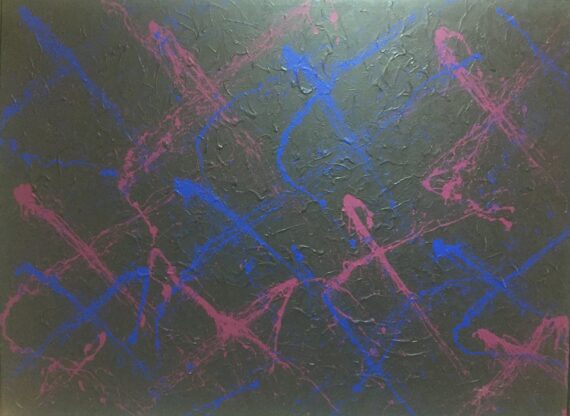
    Sunrays filter through the gentle breeze at the Pildamms Amphitheatre in the Swedish city of Malmo as an over capacity crowd eagerly await a concert by the Ghanaian highlife legend Pat Thomas.

    As the musicians emerge from the back stage, the audience shows appreciation with an applause, which culminates with a loud roar as the highlife maestro walks on stage in a colourful yellow and blue costume.

    The amphitheater gradually turns into a kind of health spa as intense energy from the seventy-five year old Thomas and his musicians including percussionist Eric Owusu, Berlin based saxophonist Ben Abarbanel-Wolff and guitarist / keyboardist Kwame Yeboah inundate the venue

    Reworked evergreen highlife tunes like “Mewo Akoma”, Gyae Su”, “Odo Be Ba” and “Me Ho Asem” noticeably fused with Sikyi, Osode, Afrobeat, jazzy brass lines and interweaving electric guitars gradually move their way into the hearts of members of the audience – and they react with cheers and applause as they hit the dance floor.

    “This is the original groove that reminds mankind to be in cohesion – indeed, the concert is full of joy and it’s undeniably contagious – all the young people here are dancing”, says Karen V. Rasmussen, a guitarist who is working towards distinctive and global consciousness.

    “It’s a tremendous feeling to see Pat Thomas perform in Malmo with additional inflections to his original compositions – I have not seen him on stage for nearly thirty years. This is an unforgettable evening”, continues Kwaku Boateng, a Ghanaian resident in Malmo.

    In a good way, Thomas, who is known as the golden voice of Africa, is able to pull from these musicians, who are known collectively as the Kwashiebu Area Band, while crafting an aesthetic appeal that is uniquely his. He takes on a director’s role as he steps aside vocally thereby allowing his features to shine.

    Alongside a compelling stage presence, the musicians seem to be having fun with each other as they crisscross the stage in near choreographic movements while sporadic solos and duets calmly add up to the sheer exuberance of the crowd.

    Pat Thomas and the Kwashiebu Area Band is currently on tour of several cities in Europe – and is set to perform to a huge crowd at the Roskilde Festival, which is held annually in the Danish town of Roskilde.

    The performance in Malmo, forms part of Summer Scene festival, a three-month long event, which takes place in diverse venues throughout the city, which is noted as the cultural capital of Southern Sweden.

    Read More »
  • Wiyaala, Footprint Legends, Shasha captivate Danish audience

    June 16, 2016 • FeaturedArticle, News • 2787

    By John Owoo
    (At large in Aarhus – Denmark)

    Afro Pop singer Noella Wiyaala last week mesmerized fans at the Danish city of Aarhus with a magnetic stagecraft during the 2016 edition of the Pan African Arts Festival (PANAFEST).

    Clothed in a charming costume made from African fabrics, she engaged the audience at the Aarhus Botanical Garden with a dramatic fusion of sounds that sent them on a journey through some distinct but very closely-knit territories, which they are without doubt familiar with.

    Alongside elements of tribal folk music, the concert was fittingly firm, trickily woven and tranquilly penetrating – and provided a solid platform for the promotion of rhythms and a soulful voice from the Upper West Region of Ghana.

    African Footprint Legends (AFL) took the stage by storm with a curious blending of ritualistic rhythms with highlife. Employing a combination of Western and traditional instruments from Ghana and Burkina Faso, the group surprised the audience with music that is contemporary, but with it’s heart firmly embedded in traditional Africa.

    With musicians and dancers from Denmark, Ghana and Burkina Faso, AFL turned the stage into a music groove – and elation suddenly became an infectious commodity – moving from artists to the audience, audience to the artists and eventually from musician to musician.

    In a related concert at NY V 58, a performance hall in downtown Aarhus, Ghanaian reggae star Shasha Marley – who is noted for his Franciscan Friar-like costumes – swayed the cheering crowd with his charismatic voice and an incredible stage presence.

    Full of energy, Marley who was joined by Ghanaian and Danish musicians, displayed a real sense of creativity and absolute skill as reggae fans among the audience applauded, danced and joined in the singing.

    Also on stage at NY V 58 were the Rasta Mizizi Family (Kenya) and Shungu Afro Beat (Denmark) while the Botanical Garden also hosted DJs, acrobats, poets, storytellers, art, crafts and food exhibitions as well as fashion shows.

    Yves Afro Events organized and presented the festival, which was supported by Aarhus Kommune, Goodness Photo, Reach Out For A Child, House of Kente, Little Sir & Madam and AVANU.

    Read More »
  • Sharp, stimulating and stirring voices at Goethe-Institut

    May 22, 2016 • FeaturedArticle, News • 3604

    By John Owoo

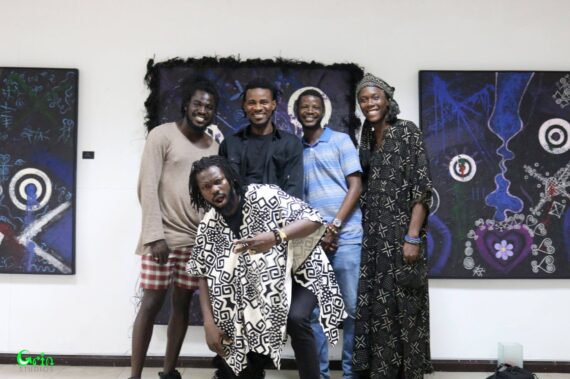
    Polyversal Souls, a Berlin based band last week made manifest the power and attractiveness of cross-cultural collaborations with a compelling performance at the Goethe-Institut in Accra.

    Performing to a near capacity audience alongside Bolgatanga based kologo virtuoso Guy One and high pitch singers; they managed to turn the venue into a music groove with diverse rhythms and songs full of tremendous emotional power.

    With a distinct blend of instrumentation that appeared flawless – the group put together saxophones, trombones, keyboards and drum sets alongside kologo, which they dramatically blended into a greater whole.

    As sharp, stimulating and stirring voices from Florence Adooni and Jonas Alo-Ohotoho as well as brisk rhythms from the Germans and Guy One, the audience was coolly transferred to the savannah highlands of Northern Ghana together with the kologo rhythms.

    Fascinated by the wild rhythms from the Kologo, a two-stringed lute that can produce great tempos and delightful sound effects, the audience appeared to be at the edge of their seats as flutes, baritone / tenor saxophones and trombones equally blasted sweet sounds in to the cool night air.

    A fusion of several musical cultures, the concert was truly tight, intricately woven and quietly intense. It provided a platform for fruitful collaboration that ensured a dramatic fusion of soul, rock and jazz with indigenous beats, sounds and voices from the Upper East region.

    An apostle of collaborations, Weissenfeldt, who is the leader, has toured Europe and various parts of Africa well as South Eastern Asia, where he studied classical Burmese Saing Waing music. He later decided to start a label and formed Polyversal Souls in order to play and record with local Ghanaian talent.

    Organized by the Goethe-Institut, the group is scheduled to perform in Nigeria, Benin, Togo and La Côte d’Ivoire. Further performances and recording sessions will take place in Germany later this year.

    Read More »
  • Artist presents naked body as provocative tool

    May 8, 2016 • FeaturedArticle, News • 4931


    By John Owoo
    (At large in Kumasi)

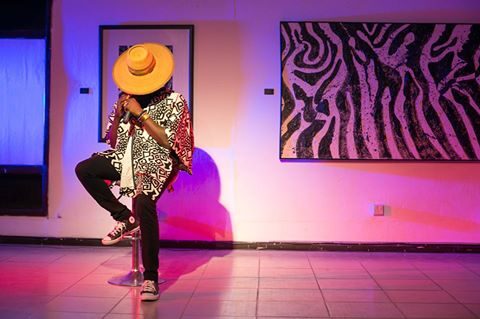
    A recent work by the Ghanaian performance artist Va-Bene Elikem Fiatsi (crazinisT artisT) that made the familiar intensely political and the peculiar eccentric ended recently in the Ashanti regional capital Kumasi.

    Tapping deep into potentially traumatic subjects, Fiatsi exploits the “aesthetics” of human rights violations, sexism, gender violence, political injustice, xenophobia and religious extremism as a social process within the global community and powerfully comments on them.

    Using his naked body alongside braided hair and painted nails, the artist lays motionless on a mounted table covered in red and white sheets splashed with his own blood. In the midst of an eerie silence, he engages the audience with conflicting emotions of desire and revulsion, fear and fascination as well as provocation and irritation.

    Merging iconographic imageries of funerary rituals with an appropriation of the last supper from the Bible, the performance made bold comments on “pleasuring and commodification” of marginalised citizens while showing then off as victims of “freak shows”.

    Fiatsi sought to re-examine the paradoxical relationship between human rights and international political structures that claim to protect marginalised individuals and groups – and he largely succeeds as he challenges the vision of the world while exposing its contradictions and complexities.

    Through a multi layered performance that lasted five hours, Fiatsi managed to reduce the human body to an exotic product as though to be bargained, purchased and consumed. Indeed, he stimulates an open-ended dialogue on degradations of voiceless citizens and violations of human rights by presenting his naked body as a provocative tool.

    In a near cryptic performance, Fiasti calls on his audience (who graciously take part) and indeed the world at large, to re-examine the issue of humanity while coolly urging them to see beyond his nakedness and begin a soul-searching exercise.

    Currently an MFA student at the College of Art & Design, Kwame Nkrumah University of Science and Technology (Kumasi), Fiatsi is a multimedia performance artist. His works investigate the socio-cultural supremacy of dominant groups by questioning the relationship between “right wing” groups and marginalised citizens within “civilised” societies.

    He explores the hybridity of forms, spaces and structures as “inherent” components of performance art and therefore decontextualizing the relationship of the human body to society and its normative cultures. Indeed, he perceives the human body as a colony of societal norms, codes, taboos and doctrines striving against oppressive prejudices.

    Pictures by Anwar Sadat Mohammed & Justice Amoh

    Read More »
  • Art works loaded with artistic energy / expressive resonance at Nubuke

    April 23, 2016 • FeaturedArticle, News • 3192

    By John Owoo
    (At the Nubuke Foundation)

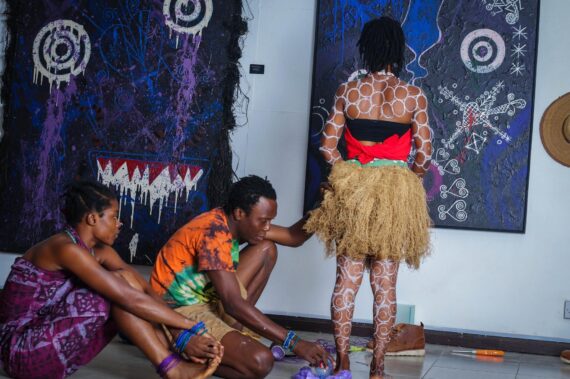
    Ghanaian artist Fatric Bewong has without doubt succeeded in employing items used in daily activities to convey complex narratives.

    Her current exhibition, which is on-going at the Nubuke Foundation in Accra, comprise discarded pieces of fabrics and plastics that have been placed on boards, wrapped around tubes in concentric rings, attached to canvasses and installed on mannequins.

    She makes a successful foray into our management of the environment by handing over to us various discarded items that she has precariously thrown on (and around) a faceless mannequin thereby reminding us of the harm been perpetuated against the environment.

    Loaded with artistic energy and expressive resonance, the works are characterized by obsessive quality and neatly interspersed with grid-like boards covered in colourful fabrics that are equally laden with social commentaries and memories.

    Rolled around long tubes, they appear like stalagmites and stalactites in ancient caves. Unquestionably, the artist who perceives the works as four-dimensional pieces suspended in time and space, mimics the chaos, contours and contortions of our environment.

    Undeniably, discarded plastic bags appear to have found a “home” on the streets, alleys drains and fields of the city instead of garbage bins and are often carried into the ocean by torrential rains thereby harming marine life – and the artist makes a bold attempt at reconstructing this scenario.

    Bewong is noted for highly abstract pieces that are characterized by little or no corporeal indication. Indeed, her new series of canvases, characterized by deliberate or incidental colour splish-splashes and splatters, embody an inspiring view on diverse issues.

    For the past several years, she has explored sounds and African proverbs, through paintings, installations and collage. Bewong has equally accessed and assessed the ancient traditions of abstraction that are encoded within proverbs, Adinkra symbols and other narratives to tell her personal and our collective stories.

    The exhibition ends on Sunday May 29.

    Read More »
  • “My Mother’s Wardrobe” as a symbol of grief and irreversible loss

    April 9, 2016 • FeaturedArticle, News • 4058

    By John Owoo
    (At the Kempinski Hotel Gold Coast City – Accra)

    Young artist Serge Attukwei Clottey is indeed a wild maverick – he seems to re-invent himself for each new performance – and undeniably, he is daringly brilliant.

    His latest performance, dubbed “My Mother’s Wardrobe”, marked the formal opening of Gallery 1957. Located within the Kempinski Hotel Gold Coast City in Accra, it is set to stimulate the art scene with refreshing installations, works and performances.

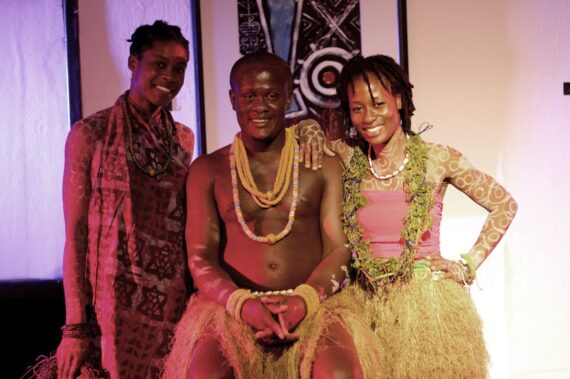
    “My Mother’s Wardrobe”, which comprised male and female models wearing clothes of Clottey’s late mother, is a symbolic testament to his mother while exploring the narratives of personal, family and collective histories.

    Grieving for his late mother, Clottey alongside other muscular young men and women, arrive at the premises of the hotel in a wooden “trotro” loaded with discarded plastic gallons. Fully clad in colourful clothes left by his mother, they promptly move in well-coordinated movements and gestures alongside the plastic gallons.

    With his mother’s death, Clottey came to realize the numerous sacrifices his mother had made and paid tribute through her copious Kaba clothes as he dealt with the issue of mortality, while considering them as a tangible expression of an irreversible loss.

    Indeed, the cross dressing equally symbolizes a subtle protest of gender imbalances that is largely inherent in some traditional forms and societies. As the models move in unison, one can feel some form of activism bordering on politics and religion.

    With powdered faces / chests and huge plastic bags known locally as “Ghana Must Go” hanging on their shoulders, they pose alongside the gallons, which he employs in large-scale installations to draw attention to the issue of preserving and protecting the environment.

    Clottey has over the years been engaged with “Afrogallonism” – a term he explains as an artistic concept aimed at exploring the relationship between the prevalence of yellow oil gallons as regards to consumption and necessity in the life of the modern African.

    “My Mother’s Wardrobe” is a result of Clottey’s residency with ANO Cultural Research Platform in Accra, whose remit is to uncover hidden, alternative, personal and collective histories, which make up what is now known as Ghana.

    He has participated in several group and solo exhibitions including, The Kampnagel, Hamburg (2015), Intelligentsia Gallery, Beijing (2015), The Mistake Room, Los Angeles (2015), 27th Festival Les Instants Vidéo, Marseille (2014), WUK, Wien (2014), Mohr-Villa, Munich (2014), Ozwald Boateng, London (2014) and 11th Dak Art, Dakar (2014).

    The rest are Nubuke Foundation, Accra (2014), Stedelijk Museum, Amsterdam (2012), The Drum Ace Café, Birmingham (2010) and AfriCAM, Napoli (2009). Clottey has also been an artist in residencies at ANO Centre for Cultural Research Accra (2015–2016) and Kunsthalle Exnergasse, Vienna (2013).

    Gallery 1957 has evolved from over fifteen years of private collecting by construction entrepreneur Marwan Zakhem. With an initial curatorial focus on contemporary Ghanaian art, the gallery will present a programme of exhibitions, installations and performances by the region’s most significant artists.

    Pictures by Regula Tschumi

    Read More »
« 1 … 35 36 37 38 39 … 44 »
Subscribe to Arts Ghana News

Enter your email address to subscribe. Receive notifications of new posts by email.

RECENT VIDEOS

Simple Slideshow

  • Goethe Institut
  • Alliance Française
  • Arterial Network

© 2026 Arts Ghana™

Website Managed by DelTin Technologies