Latest
  • visit www.artsghana.net for information on the arts
  • visit www.artsghana.net for information on the arts

Arts Ghana

MENU
  • Home
  • About Us
  • Upcoming Events
  • Latest News
  • Artistes Database
  • Archives
  • Links
  • Contact Us
  • Music
  • Dance
  • Theatre
  • Literature
  • Visual Arts
  • Film
  • Fashion
  • You Tube
  • Facebook
  • May 1, 2026 • 121

    Poems by Dr. Anas Atakora in retrospect

  • April 28, 2026 • 234

    Festival reaffirms Togo as a jazz hub

  • April 24, 2026 • 347

    Music shaped by ancestry, improvisation, and transcendence

  • April 23, 2026 • 313

    Brass bands showcase tradition and experimentation

  • April 21, 2026 • 215

    Set design mirrors dynamism of contemporary African performance

  • April 17, 2026 • 252

    Shifting portraits of the complexities of male identity

  • April 17, 2026 • 235

    Rhythmic footwork and grounded movements

  • April 16, 2026 • 565

    Raw physicality with spiritual introspection  

  • April 16, 2026 • 291

    Imposition, interruption, and provocation by LED screen

  • April 15, 2026 • 189

    Sonic meditation on tradition and transformation

  • Technological objects / organisms at Goethe-Institut

    July 17, 2022 • FeaturedArticle, News • 1065

    By John Owoo

    (In Accra – Ghana)

    It is no surprise that certain types of bacteria can clean up and inhabit troublesome metallurgical waste from smelting industries, abandoned vehicles and discarded automobile engines – but what is surprising is the incorporation of this process into the artworks of young Ghanaian artist Martin Cudjoe.

    Indeed, the Kwame Nkrumah University of Science and Technology (Kumasi) graduate has embarked on an expedition to explore the relationship between small living organisms and mechanized objects, which have been discarded and left at the mercy of the weather.

    Curated by Ato Jackson, selected works on display at the Goethe-Institut in Accra, reveal an imaginary world where decaying automobile parts harbor organisms like insects, reptiles, amphibians, rodents, cats and birds that communicate through a dystopian imagery.

    Employing technological and architectural interventions as a basis for reference – he comments on the destruction of natural environments through human activities – which have exacerbated the issue of climate change, thereby resulting in droughts, storms, floods, heat waves, rising sea levels, melting glaciers and warming oceans.

    With mixed-media techniques, Cudjoe utilizes imaginative and fanciful characters that he created through illusory alterations while amalgamating them with diverse organic forms, engines and various geometric figures.

    Undeniably, his paintings are the result of photographs he takes from discarded vehicle engines, which he transforms into what he calls “characters in a fictional story” of modification and co-existence due to habitat loss and reduction in biodiversity / species abundance.

    Titled “Evolution into Unknown”, the exhibition, which was supported by the Goethe-Institut, ends on Tuesday August 2, 2022.

    Read More »
  • Epitome of dance movements at Nubuke

    July 11, 2022 • FeaturedArticle, News • 1130

    By John Owoo

    (In Accra – Ghana)

    Paintings by Cecilia Lamptey Botchway, which comprise diverse human figures in striking poses are currently on show at the Nubuke Foundation in Accra.

    Titled “Make We Dance”, she explores the idea of dance as a form of movement by painting figures that reveal impermanent and fluid movements through space and time while incorporating batik motifs.  

    Botchway, who was trained at the School of Art, Design and Printing at the Yaba College of Technology (Nigeria), creates relative calmness in her paintings despite the swift and subtle movements that are easily noticeable.

    Her backgrounds – which are characterized by cloth stamping and batik patterns – are specifically layered on canvases as they are normally placed on fabrics, although they are unrestricted by the constraints of textile design and layout.

    The largely figurative paintings by Botchway also comprise striking illustrations of scenes from real dance performances that remind viewers of the power of dance while prompting views the proficiencies of choreographers and dancers.  

    Painted dark skin characterized by shades of blue, yellow, green and silver backgrounds are embellished with mopping wool and diverse hairstyles alongside facial expressions and clothes that promote the local textile industry.

    The paintings equally contest and defy stereotypes surrounding black people while portraying extraordinary talent through delicate and rapid body movements, which largely remind viewers of the power and diversity of Ghanaian traditional dance forms.  

    Titled “Make We Dance”, the exhibition ends on Wednesday August 31, 2022.

    Read More »
  • Four African masters end exhibition in Accra

    June 18, 2022 • FeaturedArticle, News • 940

    By John Owoo

    (In Accra – Ghana)

    An exhibition of artworks by four West and Central African masters – Abdoulaye Konaté (Mali), Soly Cissé (Senegal), Ky Siriki (Côte d’Ivoire) and Barthélémy Toguo (Cameroon) ended last week at Gallery 1957 in Accra.

    A dramatic blend of mixed media presentation where textiles, sculptures, oil paintings and watercolors meet and shine – the works are juxtaposed to one another thereby leaving them in an open dialogue. 

    Indeed, these creative men produce works that are intensely embedded in their traditions and culture. They engulf these works with auto-biographical contents thereby resulting in fantastic landscapes where figures emerge from consistency and inconsistency.  

    Konaté, who was recently honored at the ongoing Dak Art Biennial in the Senegalese capital Dakar, is noted for his large scale works that are meticulously weaved from dyed clothes, which explore socio-political, cultural and environmental issues.

    Employing material from his native Mali and beyond, which he turns into figurative compositions, Konate questions the way in which societies and individuals have been touched by war, power, religion, globalization, conservation, HIV AIDS and more recently the ravaging corona virus.

    Captivated by transparencies, Soly Cissé allows light to intrude on darkness as he showcases the substance of colours while abhorring imitation and illustration. Undeniably, each painting brings to the fore a new world, indeed new creatures, which are neither fully human or animal.

    Also known as a sculptor, his works are characterized by spontaneous painterly movements, textured accents and neo-expressionistic techniques. Indeed, distorted human figures turn into humanlike shadows alongside abstract lines and bold brush strokes.

    Acclaimed Ivorian sculptor Siriki interprets the world through stone, wood and bronze while touching on the known and unknown. He emphasizes the real and the unreal, tradition and modernity, sacred and profane as he transmits messages from his canvass.

    Noted for his emphasis on mythology, natural forces and metamorphosis, which are perceptible in his works, he employs the use of bronze and quite often a traditional furnace while maintaining the work’s intent.

    Noted for his paintings, drawings, sculptures, photography, performance and installations, Toguo addresses persistent and contemporary issues of borders, exile and displacement, which have in recent years escalated to unbelievable levels.

    Through poetic and often figurative gestures that link nature with the human body, his foregrounds underline ecological and societal implications. In recent years, his works have been informed by political and social movements and humanitarian tragedies around the globe.

    Read More »
  • Dak Art 2022 – emotive performance on sound restitution

    June 16, 2022 • FeaturedArticle, News • 1238

    By John Owoo

    (In Dakar – Senegal)

    Namibian artist Nashilongweshipwe Mushaandja recently raised the issue of African restitution of sound at the IFAN Museum of African Art in Dakar (Senegal) as part of events marking Dak Art 2022.

    In a solo performance informed by archival research at the International Library of African Music (South Africa) and the Basler Afrika Bibliographien (Switzerland), the artist made strong representations on the notion of borderless states in the area of musical explication.

    Titled “Zilin” and originally performed by his music group Tschuku Tschuku, Mushaandja who was clad in a rolled-up white pants with traditional paintings on his body, proceeded to literarily re-distribute musical resources, which he represented by various items to the audience.

    He vividly exposed the frustration of African youth owing to the inaccessibility of some of the African musical resources – which they can easily fall on for inspiration and research purposes – but are virtually locked up in institutional archives.

    Easily recognizable as a ritual performance, he made offerings to effectively ensure the healing and unity of Africa and its diaspora while highlighting the power of music as a migrating, mapping and mobile force.

    Inspired by an expressive and experimental vocal technique from the Republic of Benin and often employed by leading African musician Angelique Kidjo, “Zilin” as musical style is also used in voodoo rituals and practices.

    The performance formed part of a group exhibition by Nolan Oswald Dennis, Bronwyn Katz, Zayan Khan and Mushaandja, which collectively intend to address past and present traumas that resulted from the colonial invasion of Africa.

    The exhibition equally explores the material and metaphysical conditions of decolonization while offering meditations on what has been lost and what is yet to be reclaimed. It further draws attention to notions of place and space as a lived experience.

    Mushaandja is a performer, educator and writer with practice-research interests in performance, archives and public culture. His research on Oudano – an African concept of performance – looks at its mobilizations of queer praxis, sonic and movement formation – as well as critical pedagogies and spatialities.

    Read More »
  • “Nkabom” on display at Dakar Biennial 2022

    June 15, 2022 • FeaturedArticle, News • 1231

    By John Owoo

    (In Dakar – Senegal)

    Creative works by three Ghanaian artists, Rita Mawuena Benissan, Kuukua Eshun and Kwasi Darko are currently on show at the IFAN Museum of African Arts in the Senegalese capital, Dakar.

    Dubbed “Nkabom” and curated by the award-winning Ghanaian filmmaker / historian Nana Oforiatta Ayim, the show explored diverse facets of community and association through royal umbrellas, a film on black diasporans and installations on the involvement of people in public places.

    Loosely translated as “to come together”, “Nkabom” forms an integral part of the indigenous knowledge system and ontologies that have historically emphasized the importance of coming together in community and collectivity, rather than individuality and separation.

    Giant and colourful umbrellas installed by Benissan are replete with history, symbolism and elegance.  Touched with adinkra symbols, drums and human figures, their presence in the museum created an aura that was topped up by their majestic presence.  

    Obviously more than a sun sheltering device, the adornments that perch on top of the umbrellas are the most intricate and grandiose on the African continent. Often crafted in wood and depicting various totemic animals, they are covered and embellished with gold. 

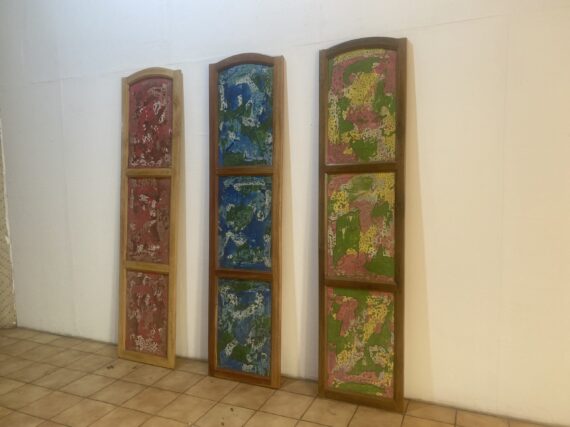
    Installations of brightly painted car doors by Darko comment on how people engage in public urban spaces in Ghana. The doors, which are in multiple colours are set against walls painted in the colours of the Ghanaian flag.

    He pastes images from the streets of people engaged in diverse activities on the windows of these discarded doors while including texts he equally finds in communal spaces, which have become diverse and widespread owing to the fact that most cities are progressing into megapolises. 

    Eshun, an award winning Ghanaian / American artist, explored the reconnection of women of African descent with the earth through a new film titled “Born of the Earth”, which highlights scenes of beauty and susceptibility in relation to womanhood.

    Noted for a dramatic use of colour and light in her work – Eshun, who is also a writer / poet, has also raised awareness on social and mental health through her writings and films, which have been widely published.

    The exhibition, which forms part of the 14th edition of Dak Art Biennial, ends on Tuesday June 21, 2022.

    Read More »
  • Dak Art Biennial 2022 opens in Dakar

    May 29, 2022 • FeaturedArticle, News • 1079

    By John Owoo

    (In Dakar – Senegal)

    Following a two-year delay due to the ravages of Covid 19 – the 14th edition of Dak Art Biennial opened on Thursday May 19 with pomp and majesty – as Senegal proved that it is still the art capital of Africa and the diaspora.

    Opened by President Macky Sall, the biennial, which remains the most important spot in Africa for artists, curators and collectors, is showcasing 59 artists and collectives from the continent and diaspora.

    With Dr. El Hadji Malick Ndiaye as the artistic director, West Africa is represented by 14 artists, Southern Africa 12, North Africa 6 and East / Central Africa 6. The Indian Ocean is represented by a Seychellois artist and the diaspora by 19 artists.

    Noticeable countries in the international selection with artistic creations, which are largely on display at the “Ancien Palais de Justice” are South Africa (8), Senegal (7), Cuba (5), France (4), United States (4), Benin (3), Cameroon (3), Kingdom of Morocco (2) and Tunisia (2).

    Without doubt, this is a huge celebration of the visual arts in Africa – there is so much to see and too much to process for a single visit. Nevertheless, there was an overwhelming feeling even on the busy streets of Dakar, which is noted for its continuous sea breezes from the Atlantic Ocean.

    Dubbed I NDAFFA, the 2022 Biennale rediscovers unknown powers, energies and sciences while exhuming riches and shaping archives. Furthermore, it draws on African sources and knowledge and negotiates diverse representations of the world in order to forge new cognitions.

    Indeed, paintings, sculptures and installations on show at the “Ancien Palais de Justice” is an open banquet for visitors. Undeniably, the exhibits tend to call for new protocols with attention to creative work and curatorial activism.

    Installation by France based artist Emmanuel Tussore, which comprise various species of tree stumps upended by steel stakes, which make subtle comments on identity, is inspired by the 16th century treatise “De Cruce de Libri Tres” by the famous Belgian philologist and humanist Justice Lipsius.

    Gigantic works by Ethiopian artist Senbeto Tegene Kunbi, who won the highest prize of the Biennial (Léopold Sédar Senghor Grand Prize), are colorful and portray his homeland through rhythmic compositions layered with geometric shapes and blocks.

    Large-scale eggs fabricated out of metal sheets by the Egyptian artist Karem Ibrahim has both theoretical and tangible meanings and relate to how issues are viewed and used as well as how items are priced, consumed and discarded.

    Collage pieces by the Haitian-American artist Florine Demosthene portray dystopian characteristics, which consider the black female body as a myriad of collective experiences beyond immediate interpretations when based on sensuality.   

    Nigerian artist Ngozi Ezema’s huge tea cup, which was configured with thousands of tiny cups, saucers and tea pots, captures the moment of vulnerability when it comes to failure thereby highlighting rise and fall in various activities.

    Paintings comprising transcriptions of ancestral rites by Cameroonian artist Gaston Hako adorn one of the walls. Undeniably, his frescoes abound with images that substitute the spoken word while exhibiting a real didactic function.  

    Cameroonian artist Jeanne Kamptchoung questioned the condition of humanity as regards to the place of the individual. He equally demands whether one shapes his life or is shaped by the society through an installation of items arranged in straight lines while lamenting on how culture, values, conflicts and traumas affect our lives.

    Extremely huge works by Kenyan painter Dickson Kaloki Nyamai capture the history of his lineage through stories told by his grandmother while exploring the effects of colonization in contrast with the contemporary situation.

    The Dakar Biennale of African Contemporary Art, which was founded in 1992, is a most influential contemporary art event in sub-Saharan Africa. It is scheduled to end on Tuesday June 21, 2022.

    Read More »
  • “Neo-Highlife” captivates audience in Accra

    May 23, 2022 • FeaturedArticle, News • 1329

    By John Owoo

    (In Accra – Ghana)

    A group of talented musicians led by bassist Emmanuel Ofori recently proved the revitalization of Ghanaian highlife is firmly on course as they progressively exhibited what may be termed as “neo-highlife”.

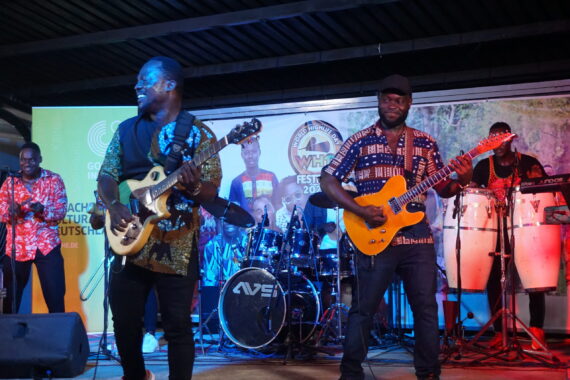
    Performing at the Goethe-Institut in Accra, the band showcased highlife with swift and skipping rhythms alongside a pristine sound quality that revealed a tight and stretched stage coordination.

    With rigorous rehearsals for an impeding Europe tour, the group offered the audience a topic for discussion on the future of Ghanaian Highlife as they showcased a massive display of raw talent, which is fueled by a passion to preserve Ghanaian musical heritage.

    Comprising multi-instrumentalists who alternate in their arrangements during recording and live performances, the band exposed some sort of a musical liberation as they waxed from diverse genres with Highlife as a foundation.

    With Dominic Quarchie (guitar), Prince Larbi (drums), Emmanuel Agyeman (keyboard), Robert Koomson (lead vocals), Norbet Arthur (trumpet), Bernard Gyamfi (trombone) and Emmanuel Kuntu-Blankson (percussion), the band did put up a robust show that elicited constant applause.

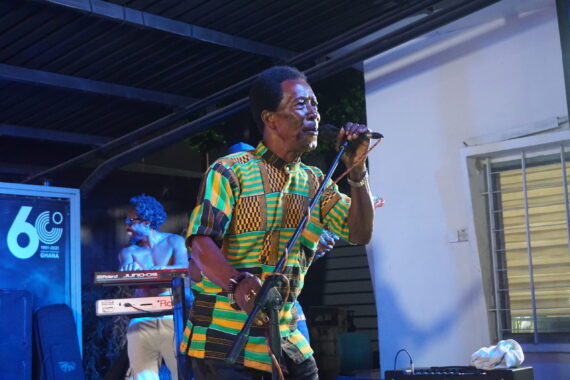
    Also on stage was the veteran highlife musician Anthony Kobina Yeboah (A.K. Yeboah), who brought nostalgic feelings to the elderly members of the crowd with a brilliant rendition of classic highlife tunes from the 1950s and 60s.

    Full of energy, the 80-year-old living legend surprised the audience with his dancing skills while interspersing his performance with anecdotes of life in Ghana prior to independence.

    Santrofi has an album “Alewa” to its credit – indeed, it reveals a great deal of influences from diverse sources while interweaving the compositions with highlife from different eras.

    Goethe-Institut Ghana supported the pre-tour concert, which will take place in five European countries.

    Read More »
  • Illusional / philosophical drawings at Goethe-Institut

    May 15, 2022 • FeaturedArticle, News • 844

    By John Owoo

    (In Accra – Ghana)

    Abstract drawings by Isaac Yeboah that are profoundly inspired by tradition, illusion, environment, philosophy and powered by supernatural and enigmatic elements are currently on display at the Goethe-Institut in Accra.

    Employing the sole use of a black ball point pen, he takes the viewer on a rather mute journey that follow a thread of experiences, which encompass objective and subjective ideas that tend to breathe life into his works.

    Noted for his particular attention to detail, the artist narrates daily occurrences through elaborate abstract forms while appropriating stylized human / animal figures, geometric shapes and vestiges that enable the eye to freely explore layers within his works while re-discovering their own lives.

    Trained at the Kwame Nkrumah University of Science and Technology (Kumasi), Yeboah leaves a great deal of white space in his works thereby allowing them to sparkle despite an uninterrupted use of black ink.

    These inspiring pieces possess mystical qualities that tend to transport the viewer to magical places – undeniably, they evoke calm and intriguing feelings at the same time while creating an incredible ambiance.

    With delicate lines and dots, the artist has produced a body of work that enter the realm of the sublime, meditation and timelessness, as he takes viewers on a path that enable them to discover his pieces through their own interpretations.

    Yeboah, who was shortlisted for the 2017 edition of the Kuenyehia Prize for Contemporary Art and Barclays L’Atelier Art Respectively, lives and works in the Ghanaian port city of Takoradi. Titled “Mere Reminiscence”, the exhibition was sponsored by Goethe-Institut Ghana. It ends on Monday June 6, 2022.

    Read More »
  • Accra marks International Jazz Day with varied concerts

    May 8, 2022 • FeaturedArticle, News • 1279

    By John Owoo

    (In Accra – Ghana)

    The city of Accra was over the weekend turned into a jazz groove with performances in diverse venues during the celebration of International Jazz Day.

    Goethe-Institut, Alliance Française, +233 Jazz Bar & Grill, Virtual Hub and Gallery Jazz Lounge among others, hosted magnetic shows that affirmed the unifying power of jazz while highlighting the growing interest in jazz among Ghanaians.

    Ghanaian bassist Bright Osei alongside Anthony Ansah, David Miyilor and Nicholas Mettle turned the Goethe-Institut into a jazz den with a brilliant mix of standard jazz, traditional and modern sounds as well as pop and funk that provided patrons with a new interpretation of jazz music.

    They charmed the near capacity crowd with solos that were remarkable and formidable – indeed, they proved the fact that they are fully in love with music through effective communication and coordination while sustaining the attention of the audience.

    With a remarkable positive energy, Osei who has just returned from a performance tour of Europe, dished out intimate and focused bass lines that resulted in unforced natural sounds and rhythms inundating the stage at the Institut.

    Employing old analogue and modern soft synthesizers, drum pads and some local percussions, the “Three O” band led by multi-instrumentalist Kwame Yeboah, mesmerized another capacity audience at the Alliance Française in a concert that formed part of the Société Général Jazz Festival.  

    Showcasing his brand of ethno-jazz vividly blended with highlife and electronic music, Yeboah and the trio equally surprised the audience with Yeboah’s peculiar arrangements that definitely brought a new tang and evolution to jazz music.

    Confident and focused on stage, the group proved the fact that jazz is not an intellectual theorem but rather a feeling that was clearly indicated by the capacity audience, which included a good number of young Ghanaian and foreign nationals.

    GH Jazz Collective, which comprise piano maestro Victor Dey among others, lighted up + 233 Jazz Bar & Grill while singer Yomi Sower as well as the Accra String Quartet enchanted patrons at the Virtual Hub. Gallery Jazz Lounge equally treated jazz lovers with tunes from the jazz collection of its founder Yaw Safori alongside an art exhibition.

    Established by UNESCO in 2011 at the initiative of Goodwill Ambassador Herbie Hancock, and recognized by the United Nations General Assembly, International Jazz Day brings together countries and communities worldwide every April 30.

    Read More »
  • Dance piece venerates womanhood

    April 6, 2022 • FeaturedArticle, News • 1114

    By John Owoo

    (In Accra – Ghana)

    W.O.M.B. – a dance piece choreographed by Julienne Doko that reflect on various issues relating to the female body was recently performed in a number of venues in the Danish capital, Copenhagen.

    Monitored online by www.artsghana.org, the piece, which involved two other female dancers – Naa Ayele (Ghana) and Meire Santos (Brazil), explored the female creative force and how it manifests itself through movement.

    Employing subtle body movements, W.O.M.B. equally touched on the subject of acceptance – indeed, accepting pain, altered body shapes, changes in skin elasticity and the inner / outer transformation of women as they paid glowing tribute to parenthood and the ability to create life. 

    Interspersed with agitated movements, the trio interrogated stereotypes through the piece, which was strewn with highly effective imagery while commenting on “stretch marks” – which has assumed negative connotations over the years – despite it being acquired through the process of childbirth.

    With a rather bare scenography characterized by lemons littering the stage, the dancers showcased movements that are poignant and compelling while revealing energy, emotion and interwoven layers of well-structured images that managed to keep the attention of viewers.

    Clad in low-cut blouses and boxer shorts with colourful African fabrics designed by Charlotte Østergaard, the combination of choreography by Doko and music from Gert Østergaard Pedersen gently echoed and powered messages being transmitted through the performance.

    Originally from the Central African Republic, Doko grew up in France where she trained in ballet, jazz and hip hop at different schools in Paris. She equally studied different traditional and contemporary styles of dance such as jazz, traditional / contemporary African / modern dance, samba and Afro-Brazilian in Universities in France, Canada and the United States.

    Trained at the Noyam African Dance Academy in Ghana, Ayele has performed in several major dance pieces choreographed by Ghanaian dance guru Prof F. Nii Yartey and toured in Europe and other African countries while working on diverse projects in a number of countries.  

    A graduate in modern and contemporary dance from Escola de Dance / FUNCEB in Salvador Bahia (Brazil), Santos’ knowledge about Samba and Afro-Brazilian traditional dances makes her the top reference in Brazilian dance in Copenhagen. Indeed, she created Casa da Cultura Afro-Brasileira, which she directed for over a decade.

    The performances were funded by Statens Kunstfond, Bikubenfonden, Gramex / Copydan and Nordic Culture Point, Mikkel Søndergaard Kryger and prfrm – produktion og formidling af scenekunst.

    Pix – Julie Malmstrøm

    Read More »
« 1 … 13 14 15 16 17 … 44 »

Subscribe to Arts Ghana News

Enter your email address to subscribe. Receive notifications of new posts by email.

RECENT VIDEOS

Simple Slideshow

  • Goethe Institut
  • Alliance Française
  • Arterial Network

© 2026 Arts Ghana™

Website Managed by DelTin Technologies