Latest
  • visit www.artsghana.net for information on the arts
  • visit www.artsghana.net for information on the arts

Arts Ghana

MENU
  • Home
  • About Us
  • Upcoming Events
  • Latest News
  • Artistes Database
  • Archives
  • Links
  • Contact Us
  • Music
  • Dance
  • Theatre
  • Literature
  • Visual Arts
  • Film
  • Fashion
  • You Tube
  • Facebook
  • October 13, 2026 • 241

    Hong Kong Hotel hosts debate on pathways to creativity

  • October 11, 2026 • 268

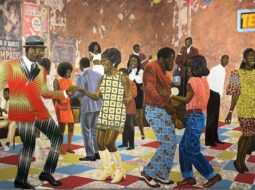
    Art reopens dialogue with history

  • October 6, 2026 • 325

    Karp Kamina: Where history meets creative imagination

  • October 5, 2026 • 430

    Zogbéadji opens Karp Kamina Residency 2026

  • October 1, 2026 • 399

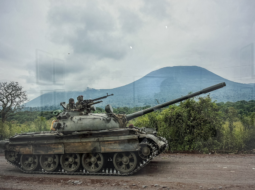
    Congo: Photographing life beyond war

  • September 30, 2026 • 384

    Persistence and permanence of memory

  • September 24, 2026 • 1375

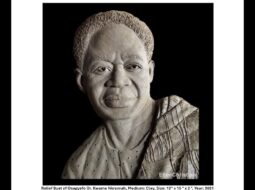
    Sculpting Power: Ghana’s heads of state in clay

  • September 16, 2026 • 421

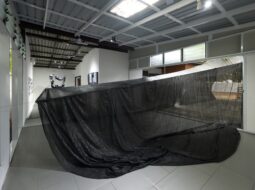
    Architecture in the rhythm of everyday life

  • September 15, 2026 • 476

    In Transit: When home becomes a dance journey

  • September 13, 2026 • 608

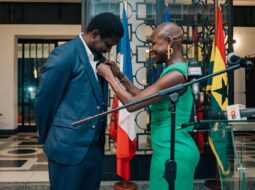
    France honors Ghanaian artist Ibrahim Mahama

  • Sonic mythologies + undulating figures / forms

    December 13, 2024 • FeaturedArticle, News • 2178

    By John Owoo

    (In Accra – Ghana)

    Paintings, murals and scultptures by London-born Barbadian artist Andrew Pierre Hart are currently on show at Gallery 1957, following a two month residency with the celebrated Gallery.

    Inspired by “Sonara” and “Blacqousti”, which appear to be metaphysical figures that possibly represent varying aspects of sound, healing and consciousness, his colour palette that emanate from the canvases are largely inspired by the colours of Ghana’s national flag – red, gold, green and a black star.

    The artworks equally tend to relate to a healing journey or spiritual awakening through sound, alongside larger themes in mythology and ancient spirituality while posing questions of what it means to listen and to hear rhythms of the earth and humans.

    Indeed, works on display move in sync with the undulating forms and figures that exist within his sonic mythology while expanding their lore with site specific murals that respond to people and spaces in which the works were created.

    Despite the conspicous absence of drums in Hart’s work, they are nevertheless all-pervading. Undeniably, his canvases and the sprawling murals which surround them are similar to  the Ghanaian “Tamalin” drum, which is stretched more or less like a canvass.   

    Titled “The Listening Sweet II Ghana”, the exhibition interweaves many conceptual parts including robust and rhythmic musical instruments sculpted from wood that are reflected in the instruments being played by the musicians within the colouful paintings.

    With his murals acting as a link between his paintings and sculptures, they are visualized as  freestyle improvizations that hit the walls without pre-sketches. These vehement bursts of lines and monochromatic spaces bend and wrap thereby triggering interference that is melodious and distractive at the same time.

    For Hart, the spaces between the diasporas of the United Kingdom, Barbados and Ghana are connected like knots in the past, present and future. These loops of history and relational narratives emerge in disparate ways throughout this effervescent body of work, invoking audiences to slip in and out of time.

    The exhibition ends on Saturday January 11, 2025.

    Read More »
  • Reverberating installations at Gallery 1957

    November 22, 2024 • FeaturedArticle, News • 1740

    By John Owoo

    (In Accra – Ghana)

    “Echoes of Mundane Mindfulness”, an exhibition by Lois Selasie Arde-Acquah that is characterised by replication alongside painting, drawing, cutting and sewing is on show at Gallery 1957 in Accra.

    Indeed, her practice purports that repetition – when meticulously executed – can lead to new ways of appreciation, collaboration, growth and creating space for reflection while questioning the impact of these reiterative actions on the body and mind.

    Curated by Ato Annan and Katherine Finerty, the exhibition boasts of over 30,000 black and white sheets of hand-cut paper put together in installations of varying sizes and shapes that turned the exhibition hall into a sort of forest thereby revealing the inner workings of her monochromatic mind.

    Exuding reminiscence of the black forests of Ramten Skov (Denmark), the artist inundated the exhibition hall with her installations on the walls, roof and floors thereby turning the space into one of elegance and wealth but also that of mourning, magic and darkness.

    Through the quiet power of repetition and seemingly mundane gestures such as mark-making, cutting and stitching were elevated into hypnotic works, which are both abstract and topographical. Undeniably, each piece meditates on the intersections of time, labor and resilience.

    Each mark made, line drawn, incision and stitch sewn are not merely mechanical actions. They are imbued with intention. Over time, the resonant movements shift from being enactments of manual labour to something more meditative. Indeed, the body becomes synchronised with the rhythm of the work and the mind moves into a state of heightened awareness.

    A proud winner of the 2023 Yaa Asantewaa Art Prize, Arde-Acquah’s work resonates with tradition, as her intricate patterns demonstrate how small and monotonous gestures can accumulate into something much more expansive.

    “Echoes of Mundane Mindfulness” is an invitation to look closer and to internalise the sacred potential of ordinary actions. The artists challenges us to reconsider the mundane and find beauty, meaning and depth in iteration.

    It ends on Saturday January 11, 2025.

    Read More »
  • Felix Dompreh – a choreographer who transcends time

    November 15, 2024 • FeaturedArticle, News • 2093

    By John Owoo

    (In Berlin – Germany)

    Acclaimed dancer / choreographer Felix Dompreh is noted for his dramatic fusion of elements of traditional, Afro-Fusion, Hip-Hop, Neo-African Dance and contemporary African Dance to create resonating pieces that masterfully combine dance, music and costume.

    Currently, the artistic director of Kuyum Tanzplattform, a Neo-African Dance Festival, which is held annually in the German capital Berlin, Dompreh’s training has connected traditional African dance with global and contemporary forms resulting in rooted and innovative pieces.

    “The next edition of Kuyum Tanz Plattform will be as inclusive as possible by dedicating one day to showcase Neo-African dance / dance battles by youngsters for young audiences. Again, we intend to expand our network outside Germany by cooperating with Dance Companies and Institutions in various African countries”, said Dompreh, who also works as a teacher for various Afro classes in Berlin.

    He obtained a Certificate and Diploma in Traditional and Contemporary African dance at the Noyam African Dance Institute in Ghana, which was under the direction of the late Ghanaian dance guru Prof. F. Nii Yartey and later at the Ecole Des Sable in Senegal, which is headed by Prof. Germaine Acogny.

    Dompreh, who has performed in various countries in African, Europe and Asia, also has an Arts and Cultural Management certificate from Leuphana University (Lüneburg – Germany). Indeed, he has equally received numerous scholarships for dance residency programs including Danceweb / Impulstanz Vienna (Austria) and CIP/SIDANCE Seoul (South Korea).

    “The dance scene in Ghana can be developed by creating a strong crop of dependent dance practitioners that are open for experimentation in Neo-African Dance forms (African Contemporary). This can be achieved by organising occasional dance workshops, residencies and an annual contemporary dance festival”, added the choreographer.

    With a Masters in Solo Dance and Authorship from the Inter-University Centre for Dance at the Berlin University of the Arts, he has a number of choreographic works to his credit. These include “Laborlaboratory Dance”, “The Time Mini Factory”, “The March / Djama” and “Waatiwi”.

    With stints as a choreographer in Zagreb (Croatia) and a dancer for Theater o.N and Tanztangente Festival in Berlin, Dompreh has added a great depth to his profile through skills and knowledge that were acquired from influential local and international mentors.  

    “Neo African Dance has been well received and is being practiced among the Afro Diasporans in Germany. Audiences are still being sensitised to understand, embrace and appreciate it like any other contemporary dance forms in the West”, he concluded.

    Kuyum Tanzplattform offers invited artists a platform on which they can present neo-African dance performances to a broader audience free from the attributions and clichés that often lurk behind them. It equally aims at helping to outline and create new narratives concerning African dance as an effective art form capable of contributing to the development of dance in the freelance scene of Berlin and beyond.

    Read More »
  • Feelings of strength and fragility on stage 

    October 4, 2024 • FeaturedArticle, News • 2627

    By John Owoo

    (In Berlin – Germany)

    The 2024 edition of Tantzplattform ended with an alluring performance of W.O.M.B, a piece that explored childbirth and the subsequent body changes experienced by women after successful deliveries. 

    Performed by Julienne Doko, Meire Santos and Naa Ayeley (all based in Denmark), the trio set the Theater Haus in Berlin alight with movemnts that called for an introspective and physical exploration of the female body’s connection to cycles of existence.

    Choreographed by Doko with Danish musician Gert Østerġard Pedersen playing live instruments, the dancers engaged in moves that alternated between moments of tension and release while evoking the process of creation birth and growth. 

    With busts of three women hanging precariously on stage alongside three dressing mirrors, the dancers often clustered together yet each appeared individually recognisable. Indeed, the movements appear different and similar at the same time.

    Doko employed use of the floor as well as slow and deliberate movements, which invited the audience to deeply contemplate each motion. Clearly, the dancers often connect with the ground, which further emphasized themes of fertility, earth and creation. 

    W.O.M.B (Worth of My Body), does not shy away from stillness either – the choreographer employed the use of silence as moments of pause, which inevitably allowed both dancers and audience to reflect on the power and vulnerability of the female body. 

    The piece further evoked feelings of strength and fragility – this enabled the audience confront the complexities of inhabiting a body – that is constantly changing, evolving and creating. It is not only a celebration of the female body, but an invitation to reflect on how bodies shape identities and experiences. 

    An elaborate and evocative work that combines thoughtful choreography, poignant performance and striking visual elements, W.O.M.B. is a celebration of life, identity and the feminine power of creation. It is an unforgettable piece that resonates long after the performance ends.

    The festival was sponsored by Hauptstadt Kultur Fonds and Theatre Haus Berlin with friendly support from HZT, Joliba, Berlin Mondiale and Tanz Fähig. Media partners include Berlin Art Link, Rausgegangen, Stadtkultur Berlin, Dinamix and www.artsghana.net. 

    Pix – thabo thindi

    Read More »
  • Neo-African dance forms in retrospect 

    October 1, 2024 • FeaturedArticle, News • 2217

    By John Owoo

    Theater Haus Berlin 

    Germany

    Togolese dancer / choreographer Kossi Sebastien Aholou-Wokawui stunned an enthusiastic audience during a magical performance at the ongoing Kuyum Tanzplatfform Festival.

    Clad in a black jacket and matching trousers, his hands, shoulders, head and torso ripple and sway as he contemplates about the present and future of the earth, which is facing all kinds of turbulence. 

    Titled “Die Frucht des Lebens”, he opened the show by systematically prying open bags full of sand, which he gradually pours on the stage signifying continuous damage to the earth. Frantic movements unfolded after all six bags of sand turned into a mound on the stage.

    Accompanied by a dancer in phantom-like costume with his face completely covered, another bag of sand was gradually poured on Aholou-Wokawui, who exhibited a raucous non-stop laugh for several minutes. 

    “Wound” – a dance ritual choreographed by Egyptian dancer Nora Amin made bold comments on the consequences of colonialism, wars and oppression by dictatorial regimes among others while offering a path to healing and reconciliation. 

    Performed by Ehab Abdellatif and Amin, the piece centred around fast-moving texts on a huge screen as she comments on issues facing the world at large. Largely employing the use of her arms, she encouraged the audience to dip their fingers into a bowl of water as a sign of unity and healing. 

    Staged under a huge tree with the audience gathered around the artists, “Equi Libre” commented on the current state of the world – upheavals, conflicts, hunger, inequalities, diseases and many others that are leading the earth into the brink of collapse.

    Co-choreographed and performed by Yahi Nestor Gahé (Côte d’Ivoire) and Sanga Ouattara (Burkina Faso) alongside Ikyeon Park (Korea), the conversation between the three dancers was quite visual as they employed the tree, ropes and huge glass bulbs with tubes or the performance.

    Inspired by the famous 19th Century Ghanaian warrior queen –  Nana Yaa Asantewa – Cintia Rangel (Brazil) and Doriane Mbenoun (Belgium) explored the rich and dynamic range of female voices, with a focus on the day-to-day activities of black women in a society dominated by exoticism, sexism and fascism.

    A rather inspiring /cutting edge show that grabbed the attention of the audience, the two dancers moved in unison with their sleek bodies as sequences moved into each other with ease. Titled “Black Chroni-Queens”, it is gloriously uncomplicated and a deeply felt performance.   

    Burkinabe dancer / choreographer Florent Sidnoma Nikiéma engaged an enthusiastic spectator in an open-air performance at the Theatre Haus. Using a huge tree as the focus of his performance and clad in a fire brigade uniform, he commented on revolts by populations owing to oppression. 

    Based on a text by the Haitian writer Eugene Woodkend, he hung two human figures on the tree that signified summary executions alongside a discarded car tyre. In the process, he was engrossed by his message as slow, supple backflips, dramatic turns and acrobatic moves on the tyre charmed the crowd.

    The festival is being sponsored by Hauptstadt Kultur Fonds and Theatre Haus Berlin with friendly support from HZT, Joliba, Berlin Mondiale and Tanz Fähig. Media partners include Berlin Art Link, Rausgegangen, Stadtkultur Berlin, Dinamix and www.artsghana.net. 

    Pix – thabo thindi

    Read More »
  • Intense / compelling dances rock Kuyum 2024 

    September 30, 2024 • FeaturedArticle, News • 1559

    By John Owoo

    (In Berlin – Germany)

    “Mutual Crossings” – a duet choreographed by Black Pearl proved to be a befitting opener for the 2024 edition of Kuyum Tanzplattform with its powerful message on the imbalance of diverse ecosystems. 

    Performing at the Theater Haus Berlin, Fetish Priesta and Pearl employed subtle and galvanizing movements while harnessing music, which played a significant part of the show.   

    With live musical gadgets on stage, which produced guttural sounds and melody, the two dancers moved in jerky synchronicity while fluorescent slides projected on screens behind them portrayed a planet that is beset with unsurmountable problems. 

    In a solo performance, France based Burkinabe dancer / choreographer Jérôme Kabore presented an impressive, riveting and fresh piece titled “Les Ombres Qui Chantent”, that was characterized by high energy from beginning to the end. 

    Rapid propelled movements whipped the air while questioning how we can re-enact the works by prominent African leaders such as Thomas Sankara, Aimé Césaire, Kwame Nkrumah, Nelson Mandela and Léopold Sedar Senghor among others. 

    With images zooming on the screen and music blaring out of loudspeakers, Kabore’s precarious moves uniquely reflected his politically tinged choreography, which has electrified audiences in Europe and Africa.

    “Cash Baby” by Franco-Senegalese dancer Yvonne Sembene, who explored the historical and contemporary issues of black female identity and its relationship to money,  unpacked a performance that was both uplifting and emotional at the same time.

    With cash scattered all over the stage, she expressed sensory movements that synchronised and projected an aura of internal power. This she made possible through an ambience that was uplifting while radiating emotions of tranquillity, hope and victory. 

    “A House of Peace” by Tanzanian dancer / choregrapher Tadhi Alawi comprised projection of historcal photos of the Tanzanian capital and the positive / negative changes that have beset this city of five million inhabitants. 

    Employing swift and subtle movements while criss crossing the stage, he was consumed by nostalgia as images of the city he has fallen in love with flashed on the screens revealing problems with governance and development. 

    The festival is being sponsored by Hauptstadt Kultur Fonds and Theatre Haus Berlin with friendly support from HZT, Joliba, Berlin Mondiale and Tanz Fähig. Media partners include Berlin Art Link, Rausgegangen, Stadtkultur Berlin, Dinamix and www.artsghana.net. 

    Pix – thabo thindi

    Read More »
  • Kuyum Tanzplattform 2024 opens in Berlin

    September 26, 2024 • FeaturedArticle, News • 1864

    By John Owoo

    (In Berlin – Germany)

    Kuyum Tanzplattform 2024 opened on Wednesday at the Theater Haus Berlin (Germany) with a cool performance by four musicians that heralded five days of varied dance performances, workshops, presentations and discussions. 

    Percussionists Nii Ashitey Nsotse (Ghana), Paraya Diallo (Guinea) and Janos Crecelius (Germany) alongside balafonist Moussa Coulibaly (Burkina Faso) lighted up the stage with a histrionic fusion of diverse rhythms. 

    The quartet sent the audience on a captivating musical journey through vibrant sounds of Africa that celebrated the diversity of African music as they weaved together traditional beats, contemporary grooves and innovative improvisations. 

    Energy emanating from djembes,  doundouns, shakers and the balafon seamlessly flowed through the stage in a mesmerizing soundscape. Indeed, it was a sonic exploration that transported the audience to different parts of the Africa while leaving patrons enthralled by the power of music to unite diverse traditions.

    Welcoming artists and other guests to the festival, the director of Kuyum Tanzplattform Felix Dompreh revealed that over thirty countries in Africa, Europe and South America will particpate in the 2024 edition, which will be largely held at the Theater Haus Berlin. 

    He stated that the aim of the festival is to offer invited artists a platform on which they can present neo-African dance performances to a broader audience – indeed, free from the attributions and clichés that often lurk behind them.

    Kuyum Tanzplattform aims at helping to outline and create new narratives concerning African dance as an effective art form capable of contributing to the development of dance in the freelance scene of Berlin and beyond.

    It will equally empower dancers and choreographers of African descent and others to acquire and advance their understanding of “Neo African Dance Forms” through advanced training programs, seminars, workshops and an annual dance festival in Berlin. 

    The festival is being sponsored by Hauptstadt Kultur Fonds and Theatre Haus Berlin with friendly support from HZT, Joliba, Berlin Mondiale and Tanz Fähig. Media partners include Berlin Art Link, Rausgegangen, Stadtkultur Berlin, Dinamix and www.artsghana.net.


    Read More »
  • Emotional Demolitions on display at Galleria Alli

    September 23, 2024 • FeaturedArticle, News • 1582

    By John Owoo

    (In Kerava – Finland)

    Abstract paintings of diverse sizes by Finnish artist Jukka Tapani Pesu are currently underway at Galleria Alli, which is located in the Finnish town of Kerava. 

    Largely based on emotions, his works are purely abstract alongside an interplay of colours with elements of landscape but firmly based on sentiments as well as mood – which is gradually developed – often with the help of a relatively sparse palette knife.

    Indeed, his works are deeply tied to his emotional expressions and natural influences. His paintings often blend abstract forms with subtle countryside topographies alongside muted color palettes that include earth tones like ochre, sienna and umber. 

    Titled “Emotional Demolitions of the Archetype Self”, his artistic approach is one of constant learning, treating each painting as an evolving process where trial and error guide him to unique outcomes that capture and sustain the interest of viewers.

    Partially trained at the University of Art and Design in Helsinki, Pesu, who does not necessarily paint nature is inspired by walks in forests, which are abundant in Finland – a trait that re-occurs in his work. 

    Originally working with oil paints, Pesu, who now prefers acrylics for their faster drying time joined Kerava Artists Group in 1976 and has participated in its annual exhibitions for several years. In 1993, he exhibited his works in a solo show in Kerava and Oulainen.

    Galleria Alli is located in a historic wooden villa built in 1914 by carpenter Karl Jacob Svensk. It has been preserved over the years and serves as an artistic hub. The gallery is operated by the local art association, KuumArt and has hosted exhibitions since 1990.

    The venue is used for rotating exhibitions, often featuring local artists and is widely known for its cozy atmosphere and vibrant art scene.

    Read More »
  • Kiasma Museum hosts “Feels Like Home” exhibition 

    September 19, 2024 • FeaturedArticle, News • 1852

    By John Owoo

    (In Helsinki – Finland)

    A group exhibition featuring works from forty-nine artists drawn from the  Finnish National Gallery’s collection, is curently underway at the Kiasma Museum of Contemporary Art in the Finnish capital, Helsinki.

    Titled “Feels Like Home”, the exhibition reflects on the theme of home and belonging through contemporary art, while exposing the fact that belonging is linked to identity – indeed, to who we are and where we come from. 

    Curated by Saara Hacklin, Satu Oksanen and Saara Karhunen, the featured artworks show that home can be a physical place, a community and / or a state of mind while reminding us that home can also be found in a language or culture.

    Featured artists are Titta Aaltonen, Petri Ala-Maunus, Ahmed Al-Nawas, Farah Al Qasimi, Elina Brotherus, Berlinde de Bruyckere, Otto Byström, Samira Elagoz & Z Walsh, Veli Granö, Marjatta Hanhijoki, Mona Hatoum, Maarit Hohteri, Henna Hyvärinen, Joonas Hyvönen and Inka-Maaria Jurvanen. 

    Others are Tellervo Kalleinen & Oliver Kochta-Kalleinen, Essi Kausalainen, Hertta Kiiski and Elle Klarskov Jørgensen, Jannis Kounellis, Mikko Kuorinki, Raakel Kuukka, Runo Lagomarsino, Jouni S. Laiti, Jouko Lehtola, Niina Lehtonen Braun, Henrietta Lehtonen, Susanna Majuri and Olof Marsja. 

    The rest are Cildo Meireles, Anneli Nygren, Frida Orupabo, Kalervo Palsa, Anu Pennanen, Emma Peura, Jaakko Pietiläinen, Tiina Pyykkinen, Sepideh Rahaa, Bita Razavi, Jani Ruscica, Azar Saiyar, Anastasia Sosunova, Kaarlo Stauffer, Nestori Syrjälä, Lesia Vasylchenko, Danh Võ and Laura Wesamaa. 

    Comprising paintings, sculptures, videos, photographs and installations, the exhibition equally shares experiences of how it feels when home is lost or far away, whether by choice or force of circumstance. Undeniably, war and exile can sever ties with loved ones and beloved places. 

    The artists, singularly and collectively show that loss and longing can be passed down through generations. The artworks also reveal that individual experiences are intertwined with social change and broader historical events.

    Notably, home and belonging are important topics of discussion in contemporary Finland. Many Finns are touched on a personal level by migrations and diasporic transitions. Finland has grown more diverse and Finnish artists now come from a growing variety of cultural backgrounds. 

    Subjects of the artworks are as varied as the materials – indeed, the works are brought together so that a visitor would notice similarities and differences between them. Nevertheless, there are very little tensions, encounters or implusive snowballing effects.

    The Finnish National Gallery’s contemporary art collection comprises around 8,800 works dating from the 1970s to date. Kiasma’s collection exhibitions are extensively curated displays that include newly acquired works within a broader historical context. 

    Themes chosen for these exhibitions reflect the issues of the day and highlight latest developments within the arena of contemporary art. “Feels Like Home” is set to run throughout 2024 and will also shape Kiasma’s Theatre offering and the museum’s public programming. 

    Read More »
  • Constellations 2 on show at Gallery 1957

    September 14, 2024 • FeaturedArticle, News • 1509

    By John Owoo

    (In Accra – Ghana)

    A group exhibition titled “Constellations 2: Figures in Webs and Ripples of Space” that enquires the notion of human interconnectedness and our place in trying to de-centre ourselves, is underway at Gallery 1957 in Accra. 

    Co-curated by Nuna Adisenu-Doe, Tracy Naa Koshie Thompson and Katherine Finerty, the artists engage elements of African mythology to re-imagine worlds beyond the human – indeed, the rational, authentic, comprehensible and terrestrial. 

    A sequel to “Constellations 1: Figures on Earth and Beyond”, the artists, singularly and collectively unite and seperate relations through an assemblage of machines, plants, religious / mythical objects, memorabilia and all forms of objects that connect and disconnect us. 

    Furthermore, they present the open possibilities of a multispecies world where our being as humans is very much based on co-existence. However, one that does not automatically imply harmonious and peaceful relations, but rather a dialectical balance with the paradox of existential crisis. 

    Participating artists inlude Clifford Bright Abu, Abdul-Salam Alhassan, Akosua Odeibea Amoah-Yeboah, Dela Anyah, Dzidzor Azaglo, Elolo Bosoka, Jasper Dafeamekpor, Rosemary Esinam Damalie, Victor Ehikhamenor, Samuel Baah Kortey, Rebekka Macht, Afrane Makof and Putin Ofori.

    Others are Frederick Ebenezer Okai, Na Chainkua Reindorf, Ghizlane Sahli, Nyahan Tachie-Menson, Jonathan Okoronkwo, Lois Selasie Arde-Acquah, Phoebe Boswell, Adelaide Damoah, Denyse Gawu-Mensah, Henry Hussey, Sarah Meyohas and Lisa C. Soto. 

    Through a spectacle of Earth and Heaven, Okai’s large scale installation of earthenware represents spiritual gateways in Ghanaian traditions. An apostle of ancestral wisdom, he often embarks on extensive journeys while delving into Ghanaian traditional repositories of knowledge.

    Another earthen-toned portal opens within the space, which is the classic portico of ancient Ashanti architecture by Clifford Bright Abu. The artist reconstructs these structures into digital avatars of extinct architectural histories in contemporary surrealist landscapes. 

    German artist Rebekka Macht, whose work relates to issues around gender and human connection,links us to the primal arrangement of the bond between a mother and child, which has historically grown as an archetype in theistic religions across the globe. 

    It meritoriously weaves into the Catholic rosaries of Nigerian-American Victor Ehikhamenor, whose tapestries figuratively reconstruct the traditional authority figures of the Benin Kingdom. This, he achieves with  cheap massified rosaries, which subtly comment on the complexity of colonisation, capitalism and religion. 

    Inspired by personal experiences and the exploration of West African folklore / religious cosmologies, paintings by Na Chainkua Reindorf on display touch on the contextual relation between women and textiles alongside encompassing African oral traditions. 

    Photographs by  Elolo Bosoka, whose work engage with notions of art as a place, economic exchange, materiality and history, usurp us into being gazed by the unassuming presence of redundant objects in their spontaneous material compositions of colour. 

    Afrane Makof’s practice, which explore the idea of augmentation and extensions between technological gadgets and humans, presents us with the burden of being bionic men and women. He keeps company with machines that estrange us or question our being as humans while confronting us with a reality in which we may digitally enslave ourselves to Artificial Intelligence. 

    Undeniably, Constellations 2 distinctly re-examines the way we understand the place of humans in the world while challenging us into re-thinking ecology without essentialist narratives of ‘nature’. 

    The exhibition ends on Thursday October 10, 2024. 

    Read More »
« 1 … 9 10 11 12 13 … 47 »

Subscribe to Arts Ghana News

Enter your email address to subscribe. Receive notifications of new posts by email.

RECENT VIDEOS

© 2026 Arts Ghana™

Website Managed by DelTin Technologies

imunify-bot-check