
Latest
  • visit www.artsghana.net for information on the arts
  • visit www.artsghana.net for information on the arts

Arts Ghana

MENU
  • Home
  • About Us
  • Upcoming Events
  • Latest News
  • Artistes Database
  • Archives
  • Links
  • Contact Us
  • Music
  • Dance
  • Theatre
  • Literature
  • Visual Arts
  • Film
  • Fashion
  • You Tube
  • Facebook
  • April 28, 2026 • 201

    Festival reaffirms Togo as a jazz hub

  • April 24, 2026 • 314

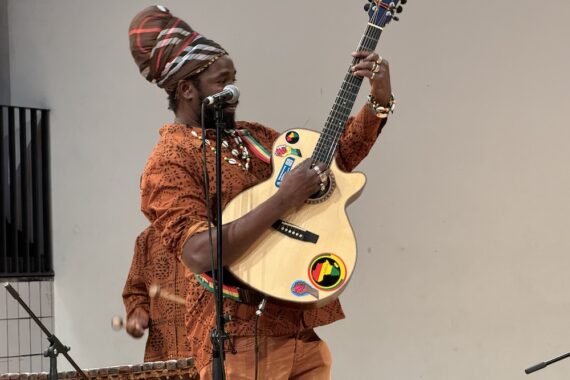
    Music shaped by ancestry, improvisation, and transcendence

  • April 23, 2026 • 279

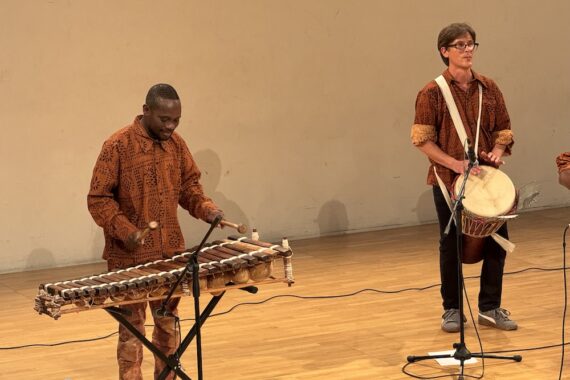
    Brass bands showcase tradition and experimentation

  • April 21, 2026 • 204

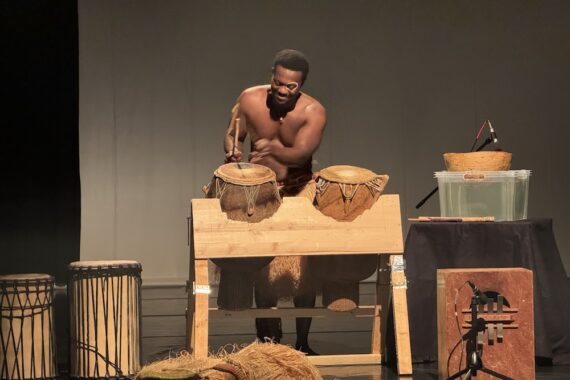
    Set design mirrors dynamism of contemporary African performance

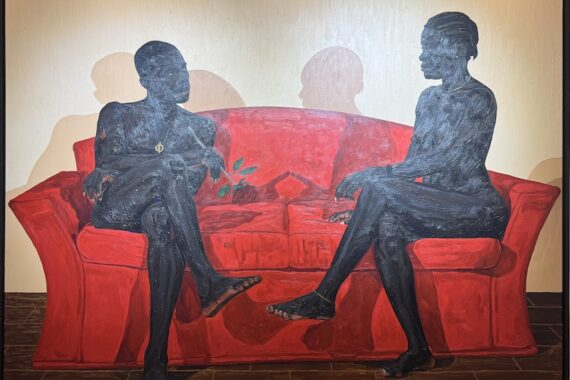
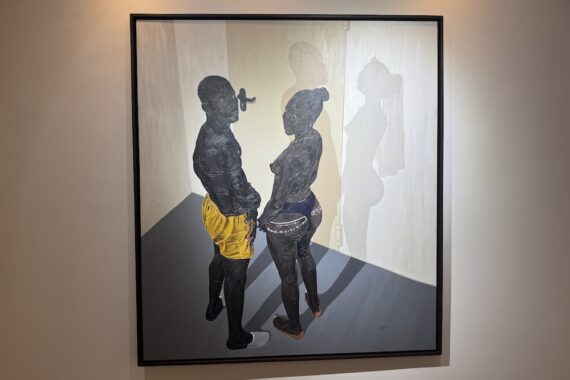
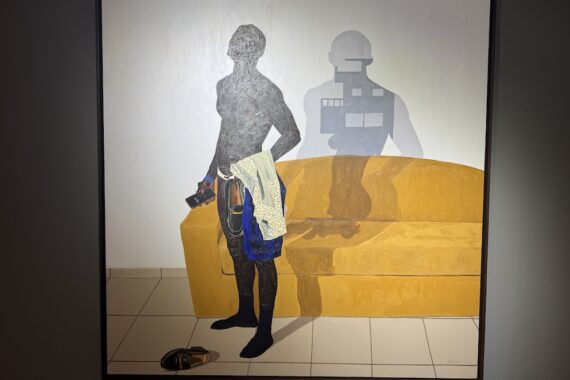
  • April 17, 2026 • 241

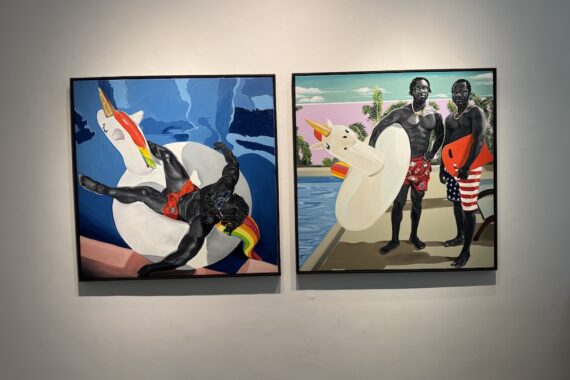
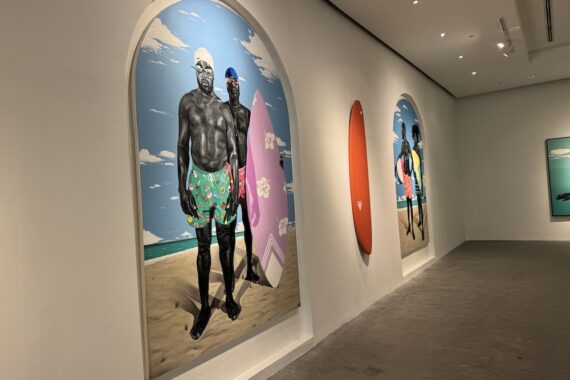
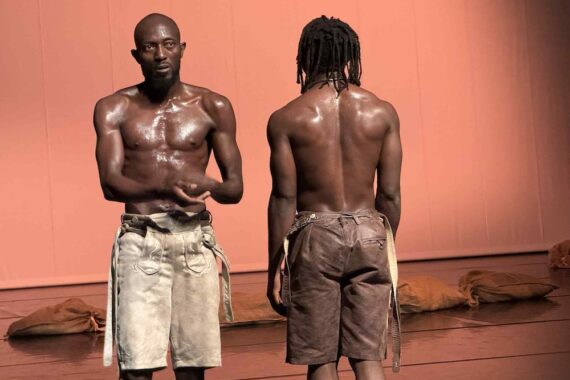
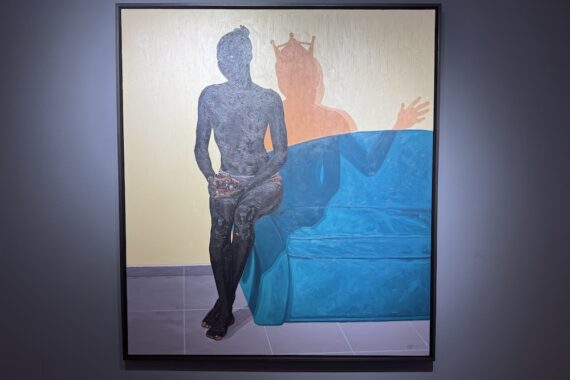
    Shifting portraits of the complexities of male identity

  • April 17, 2026 • 231

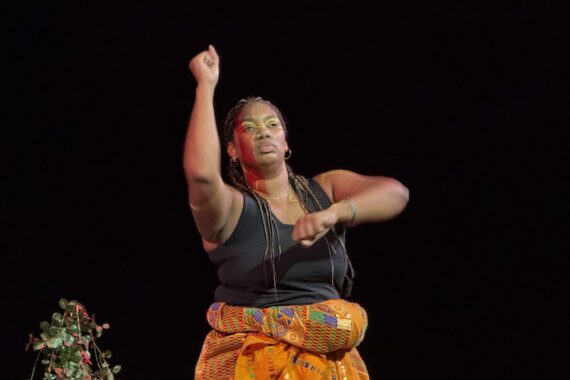
    Rhythmic footwork and grounded movements

  • April 16, 2026 • 544

    Raw physicality with spiritual introspection  

  • April 16, 2026 • 276

    Imposition, interruption, and provocation by LED screen

  • April 15, 2026 • 180

    Sonic meditation on tradition and transformation

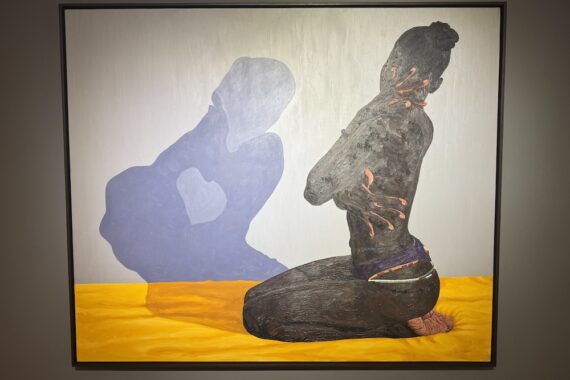
  • April 15, 2026 • 299

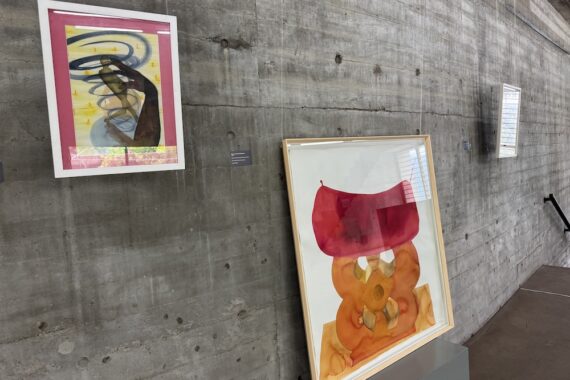
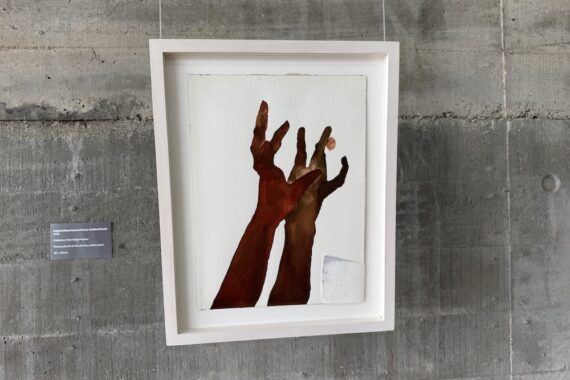
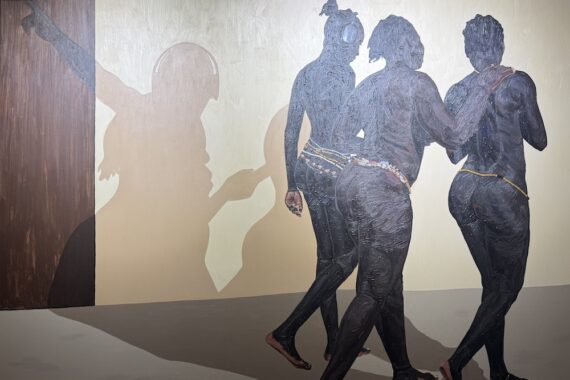
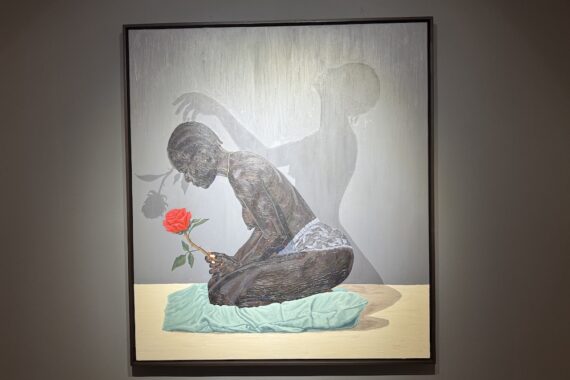
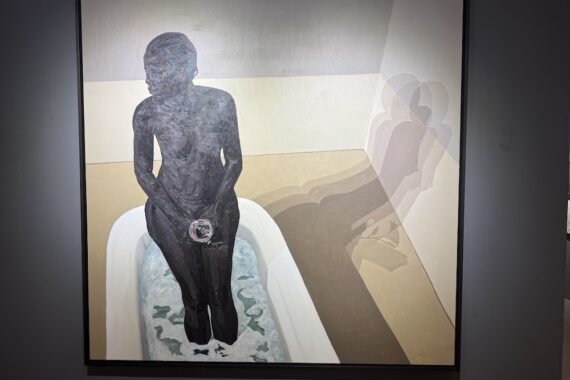
    Subtle exposure of constraints that shape female identity

  • Monochrome artworks on show at Goethe-Institut

    May 21, 2024 • FeaturedArticle, News • 1900

    By John Owoo

    (In Accra – Ghana)

    An exhibition of paintings by Ghanaian academic Dr. Joseph Oduro-Frimpong inspired by the confident motifs of African masks and irreverent styles of Ghanaian roadside art are currently on display at the Goethe-Institut in Accra.

    Comprising large scale works realized through black monochromatic style, Frimpong explored subjective and varied beauty aesthetics that showcase day to day scenes and non-acknowledged practices from diverse locations on the African continent.

    These works draw motivation from diverse sources such as barbershop signs, popular fashion trends, Igbo Insibidi visual sign language, Congolese Mangbetu head alteration practices, metal design works and lip disc modification practice associated with the Mursi / Mun ethnic groups of Ethiopia.

    Frimpong, who is the founder and director of the Centre for African Popular Culture (CAPC) at the Ashesi University in Berekuso (Ghana), equally explores diverse African artistic traditions while aiming at initiating deliberations that encourage positive (re-)evaluations around cultural practices.

    Indeed, his expressive and stylized forms, which are highly exemplified in this monochrome works, forcefully evoke the collective dynamism of aspects of popular culture in Africa while grabbing and sustaining the interest of viewers.

    A cultural anthropologist, Frimpong has collected many artefacts and pieces over the past decade. Indeed, CAPC represents a long-held passion for ensuring that African Popular Culture is better documented and taught.

    CAPC collections include hand-painted movie posters that captured audiences for Accra’s cinema industry in the 1990s to miniature xylophones crafted in the Northern Region of Ghana. Undeniably, its current collection represents the diversity in African popular culture conversation. 

    The exhibition, which is being supported by Goethe-Institut ends on Friday June 7, 2024.

    Read More »
  • Paint swatch boards / dreams at Gallery 1957

    March 19, 2024 • FeaturedArticle, News • 3786

    By John Owoo

    (In Accra – Ghana)

    An exhibition of paintings by Kelvin Haizel that appropriate aesthetics largely inspired from paint shops in Accra and beyond, is currently on show at Gallery 1957 in Accra.

    Titled “We Do Not Sleep to Dream”, Haizel effectively engages with theoretical aesthetics that emerge from diverse conductive processes, while borrowing from paint shop environments, wherein different surfaces exist as swatch board for paint samples.

    Consequently – the paintings propose an operational vista where touch, vision and interpretation among others converge – thereby inviting audiences to engage with the multiple layers of meaning beyond the customary confines of abstractions.

    Curated by Ato Annan, the artist employs complex forms / shapes as he applies a plethora of colours to the canvasses, which tend to be somewhat agitative and acquisitive while being permeated with a life-force of empirical analysis.

    Haizel obscures surfaces by incorporating encoded textual interventions in Braille onto the surfaces of some works thereby creating a collocation of tactile and visual markers as he invites touch-accessible language and random fictionalized textures.

    Without doubt, the title advances numerous propositions and questions. Indeed, he interrogates dream in its diverse forms including dreams while one is fully awake and asleep. He propounds that dreams occur in an active state with dreamers fully aware of their environs.

    Currently a doctoral candidate at the Kwame Nkrumah University of Science and Technology (Kumasi), Haizel is actively committed to understanding the image via received notions of the expanded field of the photographical alongside experiments in image that extend beyond the visual to include sonic and haptic forms.

    His installation titled “Things and Nothings” was showed at the 11th edition of Rencontres de Bamako (Mali) and participated in “Orderly Disorderly” exhibition (2017), organized by blaxTARLINES KUMASI at the Museum of Science and Technology in Accra.  In the same year, he served as guest curator to the inaugural Lagos Biennale.

    A winner of a prize for young contemporary photography “A New Gaze 2” presented by Vontobel Art Commission (Switzerland, 2018), he had his multi-sensorial solo exhibition in Zurich with an extension shown in the Stellenbosch Triennial (South Africa) in 2020 and a select few also exhibited at the Museum Belvédère as part of the 27th Nooderlicht Photo Festival “Generation Z” in 2020.

    His work was equally shown in the exhibition “This Is Not Africa: Unlearn What You Have Learned” which opened at the ARoS Aarhus Kunstmuseum (Denmark) in 2021 and was in residency at the MARKK Museum (Germany), where he developed work from their photographic archive towards the Hamburg Photography Triennial in 2022. 

    The exhibition ends on Thursday March 28, 2024.

    Read More »
  • L’artiste rebelle

    March 13, 2024 • FeaturedArticle, News • 2924

    Les origines plurielles d’Aïda Schweitzer, fusionnant ses héritages franco-égyptiens et chaouis, s’entremêlent de manière singulière avec son parcours occidental. Son œuvre transcende les frontières géographiques et culturelles, s’inspirant de ces multiples racines où se croisent diverses influences. Cette hybridité culturelle imprègne ses créations de questionnements et de perspectives métissées.

    En tant qu’artiste contemporaine, Aïda Schweitzer explore cette diversité culturelle pour sonder les subtilités de l’expérience humaine. Cette rencontre entre ses origines morcelées par l’adoption et l’influence occidentale remet en question les normes établies et dominantes, ouvrant ainsi de nouveaux champs d’une vision inclusive de la société contemporaine.

    À travers ses expériences de vie, ses voyages et ses rencontres, Aïda Schweitzer puise dans sa richesse culturelle et personnelle pour créer des œuvres célébrant la multiplicité dans toute sa complexité et affirmant la capacité de l’art à transcender les frontières, unifiant ainsi le langage universel de la créativité et de l’expression artistique.

    Dans la lignée des artistes féministes et militantes, animée par un profond engagement, Aïda Schweitzer utilise son art comme un outil de conscientisation et de mobilisation. Elle offre de nouvelles perspectives sur la féminité et révèle les réalités souvent négligées des femmes dans la société contemporaine. 

    Aïda Schweitzer agit tel une exploratrice des matières, revisitant des pratiques traditionnelles et mêlant symboles, matières et écritures pour panser les plaies des femmes et révéler les mécanismes de domination qui les assaillent. Son langage plastique, empreint de sensibilité et de courage, libère la parole et met en lumière les injustices auxquelles les femmes sont confrontées dans notre société contemporaine.

    Démêlant les fils de son propre récit, tissés à travers les fibres de ses installations textiles, de véritables œuvres vivantes nous transportent dans un ballet envoûtant où chaque matériau semble prendre vie pour exprimer les émotions et les expériences des femmes. La broderie, plus récemment des pièces en laine touffetée, le dessin et la vidéo.

    Dans son univers artistique, chacun de ces éléments contribue à créer une vision unique et poignante des forces féminines. Elle est d’ailleurs allée en Tanzanie, à la rencontre du peuple masaï, s’initiant auprès des femmes maasai à l’art du perlage. Les femmes maasai continuent de perpétuer leurs traditions ancestrales avec une grâce et une force qui ont profondément marqué son expérience.

    Les performances d’Aïda Schweitzer, explorant les enjeux sociétaux, offrent une profonde réflexion sur la condition de la femme. À travers des narrations complexes, elles dévoilent les diverses facettes de l’expérience féminine, constituant ainsi un appel à l’action et une voix défendant les droits et la dignité des femmes grâce au pouvoir transformateur de l’art. Cette vision transparaît dans ses performances, mais l’art d’Aïda Schweitzer est bien plus qu’une simple expression artistique : c’est un cri de ralliement, un appel à la révolution culturelle et sociale, une invitation à la réflexion et à la mobilisation, des manifestes d’empowerment et d’autonomisation.

    En s’immergeant dans ses vécus, Aïda Schweitzer sonde les abysses de son art avec une profondeur et une universalité saisissantes. Ses œuvres, témoins émouvants de la diversité et de la richesse de l’expérience humaine, nous invitent à sonder les mystères de l’âme dans toute sa complexité. Une exploration courageuse et poignante des réalités féminines, incitant à une introspection sur notre implication dans la construction sociale du genre et à une confrontation aux défis auxquels les femmes font face dans notre société contemporaine.

    En résumé, l’œuvre d’Aïda Schweitzer est un vibrant hommage à toutes les survivantes de toutes les flammes.”

    Read More »
  • Sunlife Reggae rocks Goethe-Institut

    January 30, 2024 • FeaturedArticle, News • 2085

    By John Owoo

    (In Accra – Ghana)

    Reggae icon Samuel Nukpese Quist alongside an eight-piece band last week turned the warm temperature around the Goethe-Institut into a cool one with captivating rhythms and soulful lyrics.

    Performing as part of a live music series dubbed “Kotosa”, the group treated the audience with reggae masterpieces that brought nostalgic feelings before venturing into his Sunlife Reggae compositions, which were complimented by rhythms from a saxophone, trumpet and trombone among others.

    A member of erstwhile Roots Anabo, a roots-reggae band formed in 1982 that achieved popularity with magical performances at the 1984 Reggae Sunsplash in Jamaica, Nukpese set the stage ablaze with his charismatic vocals and infectious positivity.

    Undeniably, the heartfelt messages and thought-provoking lyrics vibrated deeply with the audience, some of whom sang along with passion and admiration – indeed it was a memorable evening of reggae music.

    The stage was electrified through a rather a high-octane performance that had the audience applauding with excitement as tunes from his “Civilization” album including “Blofonyobi”, “Singing in the Name of the Lord”, “Atentenben Dub”, “Hedzole”, “Strange Land” and “Apostolic Jazz” flowed through the night air.

    Nukpese effortlessly played the atenteben flute as the three horns men, guitarists and percussionists and others enhanced his reggae sound thereby creating a unique blend that got the audience hooked from the start of the concert to the end.

    Ghanaian vocalist Fred Dred opened the show with evergreen reggae classics that echoed equal rights and justice while taking the crowd on a musical journey that brought memories of reggae in the 1960s and its impact on international pop culture.

    Nukpese left for Germany in the early 1980s after performing with bands in Ghana and Nigeria. In Germany he played with Highlife legend Pat Thomas as well as a group known as Hypertension, which performed in several venues all over the country.

    Read More »
  • Robert Wilson: A towering figure in theatre direction

    December 10, 2023 • FeaturedArticle, News • 1520

    By John Owoo

    (In Tunis – Tunisia)

    Acclaimed American playwright, director and producer Robert Wilson divides space into moments – not segments – and he tends to measure the length of stages in hours and not feet or metres.

    This has without doubt contributed to the success of his productions including “Jungle Book”, which received rave reviews and applause in various theatres at the ongoing Journées Théâtrales de Carthage Festival in the Tunisian capital, Tunis.

    In a chat with journalists at the elegant Cité de la Culture in the centre of Tunis, Wilson stated that his association with theatre was purely unintended adding that there were no theatre or performance spaces in the town of Waco (USA) where he grew up. 

    “We created a largely insignificant but harmonised community of artists without money and conventional places to perform. Consequently, we worked wherever we could, in factories, rooftops and street corners. Indeed, the artists came from all walks of life – housewives, workers, homeless people and we were not interested in becoming professionals”, said Wilson, who turned 82 this year. 

    After earning a degree in interior design from the Pratt Institute in Brooklyn (USA, 1966), Wilson formed a theatre group dubbed Byrd Hoffman School of Byrds, which operated out of his flat in Manhattan (New York – USA), which resulted in acknowledgement among some elites. 

    Undeniably, his productions have received admiration for their innovative use of lighting, space and sound as well as their provocative contradictions of time and place, which without doubt catapulted him throughout America and Europe.

    His 1995 premiere of “Hamlet: A Monologue” at the Alley Theatre in Houston (USA), was a major breakthrough. With various undertakings as writer, director, designer and solo performer, he presented Hamlet at the moment of his death, dashing backward through fifteen of the original’s scenes. 

    Wilson followed that success with a production of “Snow on the Mesa”, a dance work that paid tribute to Martha Graham at the Kennedy Center in Washington D.C. (USA) and a staging of Gertrude Stein and Virgil Thomson’s 1934 opera “Four Saints in Three Acts” for the Houston Grand Opera (USA).

    The renowned director continued to stage productions in addition to directing revivals of his works. In 2004, he premiered “I La Galigo”, which was based on an Indonesian poem that recounts the creation of humankind. 

    He employed gestures and signals to construct messages, which eventually metamorphosed into a play based on children’s language in 1971. Unbelievably, a seven-hour play with 68 actors staged in New York toured the United States, France, Germany and Italy with over two thousand people coming to see it every night for five solid months.

    Pix – Courtesy of Journées Théâtrales de Carthage 

    Read More »
  • Family, ethnic and societal conflicts on stage

    December 8, 2023 • FeaturedArticle, News • 1322

    By John Owoo

    (In Tunis – Tunisia)

    A rather familiar yet unfamiliar story was relayed on stage by Moroccan group Cie Corp Scène at Salle 4eme Art Centre as part of the ongoing Journées Théâtrales de Carthage Festival in the Tunisian capital Tunis.

    Directed by Dr. Amin Boudrika – the plot, which is set in Northern Morocco – is a story of a young couple, whose relationship is under extreme pressure owing to emotional, psychological, family and societal conflicts.

    Indeed, the woman is torn apart between the past and present as her frustrations of patriarchy and the illusions of a macho husband torment her as she fights off the notion of roles for wives and another for husbands insisting that both roles are equally important. 

    “The question that pops up is whether the existence of such a disparity in power within a relationship is a positive or negative phenomenon. Does it improve cohesion within the relationship and results in better cooperation”, asked François Tribot, a designer from France. 

    With scenography by Yassine Elhour and Boudrika that take on the shape of a wall, which created a cool blend of interior and exterior scenes on the set, the actors expressed bouts of depression and irritation as they yell at each other over roles and their importance. 

    Indeed, Cie Corp Scène, which comprised Hasna Tantaoui, Harjar Chargui, Ismail Alaoui and Zeinab Alj projected what appeared to be fiction – but it’s a sceneraio that cuts across diverse communities, tribes and ethnic groups – and the play will surely ignite discussions. 

    After graduating in stage design at the Institut Supérieur d’Art Dramatique et d’Animation Culturelle in Rabat (Morocco), Boudrika began a Master’s degree in stage design at the Ecole Nationale Supérieure d’Architecture in Nantes. 

    His desire to perfect his knowledge didn’t stop there and continued with PhD research into general and comparative literature, which he obtained from the University of Rouen (France) in 2018.

    Alongside his academic career, he devotes himself to creativity, mainly as a stage director and set designer while leading and sometimes collaborating on national and international projects.

    Pix – Courtesy of Journées Théâtrales de Carthage 

    Read More »
  • Exhibition marks 40 years of Journées Théâtrales de Carthage

    December 8, 2023 • FeaturedArticle, News • 1159

    By John Owoo

    (In Tunis – Tunisia)

    The 40th anniversary of Journées Théâtrales de Carthage is being marked with a photo / poster exhibition that is full of history, nostalgia, perseverance and dedication at the Salle 4eme Art in the Tunisian capital Tunis. 

    It takes viewers on a mute journey through past decades of hard work that has led to the current situation, where over sixty theatre groups and experts from the Middle East, Africa, Europe and beyond are participating in the current festival. 

    Titled “Douroub”, the show uncovers magnificent productions that have been mounted over the years while revealing the faces and names behind these theatre pieces that have rocked local and international audiences over the past 40 years. 

    The exhibition equally dilates on the history of photography by showing how it has evolved and contributed to what is available today in terms of equipment and tools. It forcefully reveals how stories can be told through photos while enabling viewers to interpret them on their own volition. 

    Owing to lack of space, photos on display have been cramped together – nevertheless, they tell the story of a genre that has survived and thrived over a very long period – while inferring on the positive forays into the future. 

    Undeniably, the exhibition manages to articulate the different narratives that have marked these forty years of theatre – its techniques, aesthetics, metamorphoses and the vestiges that remain as well as the consequent intellectual and cultural issues. 

    Indeed, these photographs, which tend to immortalize and celebrate the theatrical act, seems to find their way back onstage while bringing to life old productions, their directors, actors, actresses, editors, cameramen and women and many others who contributed to its success. 

    Without doubt, these photographs have left their mark in the wake of rich history that cannot be erased and will forever be remembered and cherished by academics, historians, theatre practitioners and lovers alike.

    Read More »
  • Hédi Chérif on show at Maison de la Culture Ibn Khaldoun

    December 7, 2023 • FeaturedArticle, News • 1473

    By John Owoo

    (In Tunis – Tunisia)

    An exhibition of paintings by Tunisian artist Mohamed Ben Hédi Chérif inspired by life and ambiances is underway at the the Maison de la Culture Ibn Khaldoun in the Tunisian capital, Tunis. 

    Born in the Tunisian town of Sfax, which overlooks the Mediterranean Sea, his works abound with Arabic history and literature while conveying messages of love and hope through paintings that boast of diverse shapes. 

    A noticeable figure in the Tunisian visual arts scene, his works are rich in verbal poetry,songs and dances alongside a creative spirit and youthful dynamism that has inspired dozens of young artists in Tunisia and beyond.

    Employing distorted human figures and abstract forms, Chérif’s work comprise mostly earth colours with bits of blues, yellows and reds that form part of seemingly unending pieces that show a constant sense of movement. 

    Largely a self-trained painter, he was simply armed with a passion and motivation, which resulted landscapes, sketches, real and imaginary portraits, which he never believed will be on display in galleries. 

    Chérif’s choice of themes and the interaction of colors / light portray canvases that radiate an intense emotional energy, which keeps viewers glued to his pieces as they try to decipher his messages.  

    Indeed, some of his works are large scale formats (two metres high) as well are circular canvasses, which are largely considered as symbols of unity and infinity owing to the fact that regular polygons are fully embraced by circles. 

    His first exhibition was in 2013 when he appeared in a group exhibition in Tunis, which included acclaimed painters and academics. The show attracted dozens of people and immediately placed him in the public eye. 

    Read More »
  • Alluring performances at Carthage Theatre Festival 2023

    December 6, 2023 • FeaturedArticle, News • 1541

    By John Owoo

    (In Tunis – Tunisia)

    A Kuwaiti production titled “Mute” created a semblance of refection and deep thought on the audience after a wonderful performance by a three-man cast at the 4ème Art Theatre in downtown Tunis. 

    Directed by Sulayman Al Bassam, the production opened with a moving commentary on the massive explosion that rocked a Beirut (Lebanon) port in August 2020 that killed hundreds and resulted in 300,000 being made homeless. 

    Performed by Hala Omran, Abed Kobeissy and Ali Hout, the performance brought to light diverse issues in social and political life through shrewd poetic devices that captured the interest of the audience, who listened with rapt attention.  

    Interspersed with drum and oud rhythms, the artists equally lamented on the escalating violence all over the Arab world while calling for the need for a resistance – especially a cohesive one by artists through their craft – as they equally questioned their silence. 

    In a related performance at the Mondial Theatre, a Spanish production titled “Afrikan Party” treated the audience to a futuristic performance through dance, which depicted Africa in the 2090s while showcasing the life of the African child from cradle to grave. 

    With three performers, Yemi Osokoya, Tebza Diphehlo and Ambrose Tjark clad in boxing-like costumes and powder smeared on the bodies, they portrayed the richness and diversity pf African traditions and culture through various inventive movements.  

    The performances forms part of the 2023 edition of Journées Théâtrales de Carthage Festival, which opened on Saturday December 2, 2023. It will feature 62 performances from 28 countries in various venues throughout Tunis and beyond.

    Pix – Courtesy of Journées Théâtrales de Carthage 

    Read More »
  • Bob Wilson’s Jungle Book charms Tunis audience

    December 5, 2023 • FeaturedArticle, News • 1298

    By John Owoo

    (In Tunis – Tunisia)

    Théâtre de l’Opéra – which is located in the elegant Cité de la Culture – was literarily set ablaze with a performance of “Jungle Book”, a piece by the American visual director Robert Wilson.

    Performing as part of the 2023 edition of Journées Théâtrales de Carthage Festival in the Tunisian capital Tunis, this musical theatre / opera managed to keep the audience at the edge of seats with constant movement and action on stage. 

    Comprising diverse elements of the arts – architecture, music, dance, poetry alongside an amazing use of light that often turned the bodies of the artists into silhouettes – the artists presented a charming natural retelling of Rudyard Kipling’s book – “The Jungle”.

    “Undeniably, the scenography, acting, singing, rhythms and dancing appear separate and together at the same time. The artists moved severally and jointly thereby arousing the curiosity of members of the audience”, said Pierre Martin, a teacher in France. 

    Obviously featuring dozens of light cues, it’s amazing how the technicians managed it, as “human / animal” bodies, shadows and diverse items flowed freely on stage and a giant screen. 

    With voices of singers soaring through the air like birds in flight – virtuosity and evil, aggressiveness and hilarity reigned on stage – as formidable poetry engaged the audience in deep thoughts while collective struggles unite some animals in the jungle.

    Wilson, who turned 80 last October, focuses on the dangers that threaten nature. “Jungle Book” abounds with songs and stories that intertwine with the performance of the actors, dancers and singers.

    Indeed, his set design reaches a crescendo where texts fade into the background in the face of the power of images, colors and geometries in space while his bodies dance as if in weightlessness alongside a choreography that is both rhythmic and frenzied.

    Pix – Courtesy of Journées Théâtrales de Carthage 

    Read More »
« 1 … 7 8 9 10 11 … 44 »

Subscribe to Arts Ghana News

Enter your email address to subscribe. Receive notifications of new posts by email.

RECENT VIDEOS

Simple Slideshow

  • Goethe Institut
  • Alliance Française
  • Arterial Network

© 2026 Arts Ghana™

Website Managed by DelTin Technologies