Latest
  • visit www.artsghana.net for information on the arts
  • visit www.artsghana.net for information on the arts

Arts Ghana

MENU
  • Home
  • About Us
  • Upcoming Events
  • Latest News
  • Artistes Database
  • Archives
  • Links
  • Contact Us
  • Music
  • Dance
  • Theatre
  • Literature
  • Visual Arts
  • Film
  • Fashion
  • You Tube
  • Facebook
  • August 19, 2026 • 237

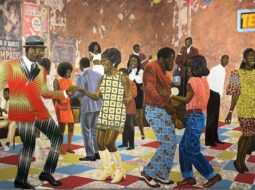
    Memory finds a home at Gallery 1957

  • August 15, 2026 • 259

    Five emerging lights in a shared constellation

  • August 4, 2026 • 503

    Landmark festschrift honors El Anatsui’s legacy

  • July 29, 2026 • 410

    Everyday objects, extraordinary meanings

  • July 23, 2026 • 405

    Stain as transformation: reimagining purity

  • July 20, 2026 • 6124

    Artist unmasks hidden architects of galamsey

  • July 19, 2026 • 396

    Explorations into memory and human presence

  • July 10, 2026 • 524

    Artist turns urban wanderings into textured acts of reinvention

  • July 2, 2026 • 568

    Abstract worlds speak through texture and emotion

  • June 25, 2026 • 584

    Echoes of slavery resound at Christiansborg Castle

  • Poets expand dialogue on Spoken and Written word

    September 22, 2018 • FeaturedArticle, News • 2035

    By John Owoo

    (In Accra – Ghana)

    The maiden edition of “Let’s Talk Poetry”, a monthly forum that seeks to bring together poets, writers, critics and lovers of literature took off last week at the library of the Goethe-Institut in Accra.

    Facilitated by poet / arts development consultant Crystal Tettey, a panel comprising poet Apiorkor Seyram Ashong Abbey and writer / poet Nana Nyarko Boateng dilated on issues relating to “Spoken Word” and “Written Word”.

    The panelists lamented on the ever-dwindling reading habit among Ghanaian youth tracing the problems to the change in curriculum, which virtually removed reading as a subject in primary schools with the lack of libraries and inception of smart mobile phones among others compounding the problem.

    Undeniably, Spoken and Written Word compliment each other although the written text tends to eliminate an important context such as body language, tone of voice and even background noise – elements that aid in physical engagement.

    Certainly, Ashong Abbey and Boateng, who have severally and jointly made huge efforts through workshops and regular reading programmes to promote the culture of reading among pupils and students in various parts of the country, are upbeat about gains being made to get the youth to read.

    Indeed, with spoken word, one can add emotions in the speech and influence the audience – a feat that is possible but obviously not easy with the written word. However, it appears both genres have been able to compliment each other through the activities of Ashong Abbey and Boateng in the struggle to improve the reading habits of young Ghanaians.

    Singer / songwriter Eli A. Free and keyboardist Kojo Free delighted the enthusiastic audience, who equally shared their experience with both spoken and written word with heart warming acoustic music that appeared to flow directly from a continuous stream.

    The programme, which was interspersed with readings by Ashong Abbey who presented a poem titled “The Honey Pot”, while Nyarko read extracts from “The Jonah Fast” – one of three books she recently authored – was sponsored by Goethe-Institut Ghana.


    Read More »
  • Exchange. Exchanger. Ibrahim Mahama confronts architects

    August 22, 2018 • FeaturedArticle, News • 2765

    By John Owoo

    Museum of Science & Technology

    Accra – Ghana

    Internationally acclaimed Ghanaian artist Ibrahim Mahama, last week explained the complexities, contradictions, politics, social links and other issues that confront the assemblage of his vast sacs that have draped diverse buildings in Ghana and beyond.

    Making a presentation at a panel discussion in Accra moderated by artist / academic Dr. Bernard Akoi-Jackson, which forms part of events marking an exhibition dubbed “African Modernism – Architecture of Independence”, he gave a point by point narrative of how these sacs are processed before ending up on giant structures.

    Titled “Exchange. Exchanger. Before, After and Hence. Ibrahim Mahama Confronts Max Gerlach, Drew, Fry and Owusu Addo”, the programme attracted diverse people from all walks of life in Accra and beyond, who have been captivated by the installations by Mahama.

    Indeed, Mahama’s unconstrained installations and wrappings engage public spaces, while altering ordinary sites into awe-inspiring photographic experiences. They are sporadically embellished by the insertion of mass-produced Chinese/African print patches, which complements an additional layer of interpretation of the global movement of goods.

    Sac-draped buildings and monuments by the artist, invite viewers and passers by to experience sublime and highly inspirational artworks, parts of which have been documented in a book titled “Exchange – Exchanger”, which was published by Verlag der Buchhandlung Walther König (Germany) in collaboration with White Cube Gallery and blaxTARLINES KUMASI.

    Imported by the Ghana Cocoa Company from India and Bangladesh and re-purposed by charcoal, fertilizer and other merchants, he purchases “millions” of these new sacs and exchanges them for old ones before commencing his economic, political and socially charged works.

    Mahama, who is currently a PhD student at the Department of Painting and Sculpture, Kwame Nkrumah University of Science and Technology (KNUST), Kumasi, said the preparation process requires effective interaction alongside traversing complicated and multiple publics while forging distinct relationships along the production line.

    Touching on the issue of sensitivity during production, he revealed the use of traditional and gender partitioning of labour adding that there are two types of workers – paid ones and collaborators, some of whom have been on several projects while others were simply transient.

    His co-panelist, curator Kwasi Ohene Ayeh, who also a PhD student at the Department of Painting and Sculpture (KNUST), dilated on issues confronting Mahama and his practice including visa denials for his collaborators during biennales in Europe – a move, which hampers the globalization of free movement and undeniably his gigantic installations.

    He stated that Mahama’s work involves a rather deep interaction with diverse cultures and climates – including shoe-shine boys, refugees, students, porters and many others, who assist in works that uncovers the shipments / ownerships of sacs while rendering visible the mechanisms of trade which define the world’s economy.

    Ohene Ayeh equally referred to the commodification of the sacs by Mahama, which obviously initiates communication while mentioning the issue of symbolism, which differs from building to building covered by the colossal Mahama sacs, while uncovering the remarkable transitions of ownership.

    Mahama’s work has been displayed in international exhibitions including Documenta 14 in Athens (Greece) and Kassel (Germany) as well as several venues in Accra, Kumasi and elsewhere, where it simply woos the viewing public with its socio-political enquiries.

    The exhibition, which ends on Monday August 27, is being presented by Goethe-Institut Ghana in collaboration with the Ghana Museums and Monuments Board and blaxTARLINES KUMASI, a contemporary art space at the Kwame Nkrumah University of Science and Technology, Kumasi.

    It was first shown at the Vitra Design Museum in Weil em Rhein (Germany) and is currently touring a number of countries in Africa. It will also be displayed at the blaxTARLINES KUMASI space in September 2018.

    Pictures – Goethe-Institut Ghana / Vome

    Read More »
  • African Modernism – Uneasy Questions & Answers

    August 13, 2018 • FeaturedArticle, News • 2669

    By John Owoo

    (In Accra – Ghana)

    A huge exhibition, comprising eighty symbolic photographs by Alexis Webster (South Africa) and Iwan Baan (The Netherlands) that vividly illustrate post-colonial structures in five African countries is currently underway at the Museum of Science and Technology in Accra.

    Titled “African Modernism – Architecture of Independence”, it follows a scholarly work by the award wining German architect / academic Manuel Herz alongside Ingrid Schröder, Hans Focketyn and Julia Jamrozik that categorized architecture in Ghana, Senegal, Ivory Coast, Kenya and Zambia.

    Constructed in the 1960s and 70s with designs largely by European architects, the buildings evoke diverse issues relating to politics, culture, liberation, shades, climate, societal norms and identity as well as the challenges and paradoxes faced by the then new states.

    Largely designed by French and English architects, the images equally offer a trail of the different approaches to growth and economic development undertaken by various independence leaders, who were bent of proving their capacity / ability to govern and effectively manage the affairs of their various countries.

    Undeniably, the exhibition fundamentally succeeds in getting the viewer to understand the architecture and the mind set that commissioned these structures, which are replete with inconsistency, complexity and yet full of creativity and sophistication.

    Although, there were not many local architects at the time of construction, one Ghanaian architect John Owusu Addo was involved in the designs of some of these modernist structures. It is sad to note that the legacy of these buildings have been questioned owing to the apparent lack of interest in the continuation and development of this style of architecture.

    “African Modernism – Architecture of Independence” equally raises the question of architectural training in Africa and the aspirations of both young and established architects for the future, which is full of high expectations owing to the apparent growth of several economies on the continent.

    These questions will be tackled by a series of panel discussions and presentations being curated by the Ghanaian artist / academic Dr. Bernard Akoi-Jackson. Topics slated for presentation and discussion include “Between the High Sea and a very Hard Rock: Modernization. Modernism”,

    Others are “Revisiting the threat and manifestation of neo colonialism in Africa”, Better off in the bush: On slavery, colonialism and truncation of development in Africa” and “Exchange. Exchanger: Before, After and Hence, Ibrahim Mahama confronts Max Gerlach, Drew, Fry and Owusu Addo”.

    Panelists include Prof Owusu Afram (Lecturer, KNUST) Bärbel Müller (Lecturer, University of Applied Arts, Austria), Nontombeko Ntombela (Wits University, South Africa), Prof. G.W. Ntsiful (Lecturer, KNUST), Nat Nuno Amarteifio, Joe Osae Addo, Augustus Richardson (Architects – Ghana) and Ibrahim Mahama / Kwasi Ohene Ayeh (Artists / PhD students, KNUST).

    The exhibition, which ends on Monday August 27, is being presented by Goethe-Institut Ghana in collaboration with the Ghana Museums and Monuments Board and blaxTARLINES KUMASI, a contemporary art space the Kwame Nkrumah University of Science and Technology.

    It was first shown at the Vitra Design Museum in Weil em Rhein (Germany) and is currently touring a number of countries in Africa. It will also be displayed at the blaxTARLINES space in September 2018.

    Pictures – Goethe-Institut Ghana / Vome 

    Read More »
  • Epic jazz compositions rock Goethe-Institut

    August 5, 2018 • FeaturedArticle, News • 2178

    By John Owoo

    (In Accra – Ghana)

     A dramatic fusion of harmonic complexity and spiraling melody alongside a magnificent voice last week delighted jazz fans at the Goethe-Institut in Accra.

    In a rather powerful concert featuring Luxemburg based Beninois guitarist, Lionel Loueke and the French / German singer Céline Rudolph, patrons were treated to epic compositions that resemble open panoramas inundated by climaxes of sound.

    With tunes form their recent album titled “Obsession” – the jazz duo went into their own world and dished out masterpieces that are full of tremendous emotional power, depth and sensitivity that appeared to move in a continuous stream.

    “It was a breathtaking performance – they managed to capture the attention of the audience from beginning to the end. This is definitely one of the best jazz concerts I have seen in this country for a very long time”, said David Owusu, a jazz enthusiast in Accra.

    Undeniably, the tunes managed to send the multi racial audience, which included several members of the Jazz Society of Ghana into a solemn musical journey – indeed, an expedition where high quality jazz flowed through an endless watercourse.

    Employing astounding rhythms and sounds from Rio de Janeiro (Brazil), Cotonou (Benin), Berlin (Germany) and Memphis (USA), the crowd was enchanted with lyrics on a wide range of subjects as a variety of vocal techniques and extended guitar skills from Rudolph and Loueke respectively filled the cool night air.

    “I enjoyed every bit of the concert. Indeed, I was swayed by the voice of Rudolph, which circled the air like a whirlwind. I learnt a lot form her and hope to perform like her in the near future”, added Naa Kwaley, a singer in Accra.

    In a related event, a workshop with local musicians comprising Bernard Ayisa (trumpet), Victor Dey (keyboard), Nii Quaye Aryee (guitar) and Quayba (vocals) among others, dilated on chord progressions, pentatonic scales, guitar techniques and improvisations, which resulted in spontaneous compositions.

    Goethe-Institut supported the performance in Accra, which formed part of a wider tour of several West African counties including Benin, Cote d’Ivoire and Nigeria.


    Read More »
  • visit www.artsghana.net for information on the arts

    July 30, 2018 • Latest • 1435

    Read More »
  • visit www.artsghana.net for information on the arts

    July 30, 2018 • Latest • 1523

    Read More »
  • Monochromatic paintings submerged in drips and dots

    July 15, 2018 • FeaturedArticle, News • 2315

    By John Owoo

    (In Accra – Ghana)

     When it comes to showcasing some of the most innovative, provocative and stimulating contemporary art in Ghana – Gallery 1957, located in the swanky environs of Kempinski Hotel in Accra – immediately springs to mind.

    Currently on display are large-scale paintings by the Nigerian / German artist Chidi Kwubiri that comment on the power, influence and dominance of music, dance and the arts in general on creative souls and the public at large.

    Titled “motionEmotion”, the exhibition encompasses fifteen remarkable acrylic works on canvass that reflect the essence of festivity, joy, gloom, vigor, hope and other emotions that are aroused in people when they hear music or watch dance performances.

    Largely in monochrome, it features images of female dancers, which obviously accomplishes something quite essentially simple – proof of the fact that the human body is a living thesaurus – and when in motion are perceptibly unconstrained by any language barrier.

    With images of musicians including the legendary Fela Anikulapo Kuti, the exhibition is utterly saturated with rap, hip hop and pop culture that have been juxtaposed against a calculated pace of live music that is compelling and imaginative.

    Curated by Sandra Mbanefo Obiago in collaboration with SMO Contemporary Art, Kwubiri’s work embodies a multi-layered, almost opaque world of visual consciousness. Submerged in a myriad of dots and drips, his works reveal expertly rendered hazy outlines of figures that appear to be in perpetual coordination.

    Unquestionably – his paintings, which include low-spirited looking portraits, emphasize the influence of agreement against socio political tensions arising out of the dramatic increase in migration – especially through perilous forays on the Sahara desert and the Mediterranean – which is gradually becoming a sea of death.

    Trained at the Art Academy of Düsseldorf (Germany) – Kwubiri, who grew up in Nigeria and relocated to Germany, equally makes succinct analyses of cross-generational rhythms that recall the works of iconic musicians and artists from various parts of the world.

    Kwubiri’s selected group and solo exhibitions include – LebensWert Arbeit, Museum Am Dom, Trier (Germany 2018); Ich Bin, Weil Du Bist, Museum Am Dom, Trier (Germany 2017), Italia Docet and the 56th Venice Biennale, Venice (Italy 2015).

    Others are Casablanca Biennale, (Morocco 2014), Mother Tongue, Temple Muse, Lagos (Nigeria 2013), Theme Africa, Phillips de Pury, New York (USA 2010), and The Internationals, Millenia Gallery, Orlando (USA 2004).

    Obiago is an art collector and curator, photographer and an award winning filmmaker. She runs SMO Contemporary Art, which promotes the best of African creativity through exhibitions and events in non-traditional gallery spaces.

    The exhibition, which follows a two-week residency in Accra by Kwubiri, ends on Monday July 30.


    Read More »
  • Provocative installation of female underwear at Gallery 1957

    July 8, 2018 • FeaturedArticle, News • 2032

    By John Owoo

    (In Accra – Ghana)

    Gallery 1957 in Accra is closing a display of provocative installations of female underwear by Va Bene Elikem Fiatsi (crazinisT artisT) that form a sequel to his 2017 exhibition titled “Rituals of Becoming”.

    Fiatsi has since 2012 embarked on a rather long voyage of investigating and questioning social constructivism of human existence and its relationship with the “culturality” of gender and sexual misrepresentation.

    Titled “Passing Through – Acts of Radical Empathy”, the show forms part of transitional exhibitions and performances, which offer a grand opportunity into durational performances in and outside Ghana by Fiatsi, who has carved a niche for himself in recent years.

    Over the past five years, the project has equally been characterized by him dressing and presenting himself as a woman – a move that has captured the imagination of art lovers and stupefied onlookers and the general public – who are completely oblivious of his research.

    The exhibition equally featured footage of films that have been shot from his numerous performances including experiences at European airports. They form part of a body of work collectively known as “Invisible Body Series”, which obviously highlight his “transitional” state.

    Also on display in the form of a brick wall, are “millions” of photos of previous ritualistic performances from his personal studio and pictures of other installations of female costumes and underwear, which he has worn and collected since 2013.

    Large-scale performance photos of Fiatsi by the British artist Fagot Koroviev, which draw heavily on 20th Century European paintings, adorned the walls of the gallery. Indeed, the artist allows a great deal of light in the photos thereby enabling them to sparkle.

    A multidisciplinary artist, Fiatsi’s work explores the relationship between politics, identity and gender constructs through immersive performances. Using his body as a material, he seeks to provoke his audience to question their sense of identity thereby creating indecisive moments that blur the lines between public and private space.

    An exclusively collaborative artist, Koroviev is interested in the development of narratives by drawing inspiration from a range of pan-historical and pre-existing channels of communication.


    Read More »
  • Brilliant fusion of artistic creativity buzz audience

    July 6, 2018 • FeaturedArticle, News • 2050

    By John Owoo

    (In Accra – Ghana)

    Expectations are extremely high when an artistic production involving Prof. Paschal Younge and Prof. Zelma Badu-Younge is about to unfold – and when the production includes other acclaimed artists from Ghana and beyond – the anticipation intensifies.

    Consequently, the audience at the National Theatre sit calmly in the totally dark auditorium as they anxiously await the performance of “Agoro” – a charismatic blend of choral / classical music, contemporary / Sufi dance movements and theatre with griot undertones.

    Presented by the National Theatre, Azaguno Inc and the Ohio University with Prof. Paschal Younge (composer), Prof. Zelma Badu-Younge (choreographer), Mawuli Semevor (Director of Drama), Isaac Annor (Conductor) and Nii Tete Yartey (Artistic Director), “Agoro” is undeniably an epic production that is deeply focused and grandly beautiful.

    With an overall cast of 120 artists from Ghana, Canada and the United States, “Agoro” is simply a brilliant mixture of visual creativity and artistry, indeed an imaginative brand of expressive dances that are set against the well-calculated speed of Sufi inspired movements.

    “One successful production after the other – I salute all the artistic directors involved in this project who have surprised us with masterful productions over the past three years. In the process, they have forcefully revealed the power and beauty of cross cultural collaborations”, said Nii Tackie Tawiah, a dancer in Accra.

    With contemporaneous compositions by Prof. Paschal Younge, music of tremendous emotional power from the National Symphony Orchestra, Bi-Tonic Singers, National Fire Service Central Band and percussionists from all three countries inundated the auditorium as the audience cheered and applauded.

    In a rather tranquil atmosphere, Canadian multi-disciplinary artist Sashar Zarif and five Ghanaian dancers presented a choreographed piece of Sufi rituals (first in a non-religious setting in West Africa) that consisted of poetry, music and Dervish movements, which captivated the audience who sat and watched in utter silence.

    With internationally acclaimed artists, academics and students including Dr. Erik Forst, Keith Moone, Dr. Kristofer Olsen, Tom Berich, Gcinile Shongwe and John Meriwether, “Agoro”, equally showcased a cool fusion of indigenous / contemporary Australian, Pan African, South African, Caribbean and American movements and music forms.

    Along emotional scenes, late directors of the National Theatre including Prof. N.Z. Nayo, Prof. Komla Amoaku, Prof. F Nii-Yartey and Efo Kojo Mawugbe were honored with a rendition of popular spirituals and compositions that date back to the period of the slave trade.

    Enterprise Group, Ohio University, Prestige Hotel, GTP, PGEES Catering and Azaguno Inc. supported the production, which formed part of activities marking the 25th Anniversary of the National Theatre of Ghana.

    Read More »
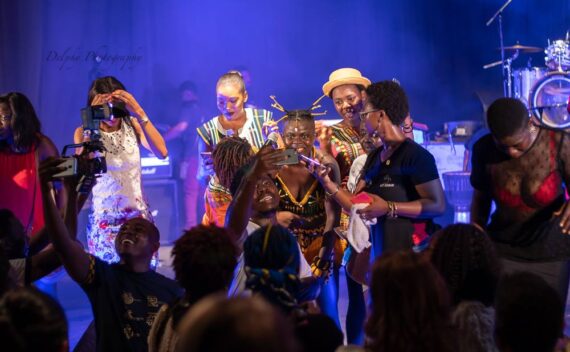
  • Visually stimulating dance at Alliance Française

    July 2, 2018 • FeaturedArticle, News • 2181

    By John Owoo

    (In Accra – Ghana)

    A peculiar silence engulf the outdoor stage at the Alliance Française in Accra – as a rather cold breeze – a product of low lying clouds that moved into the city from the Gulf of Guinea create a cool atmosphere.

    Alongside highly dimmed lights, six dancers move on stage with controlled precision, probably just as prescribed by the choreographer. They gradually engage in monologues that remind mankind or our duties to mother nature.

    Choreographed by French dance connoisseur Valerie Miquel, “Back to our Roots” employs a dramatic fusion of movement, text, music, video effects and sound that effectively evolve into a production that comments on one of the critical issues facing the world at large.

    “Miquel seduced us with “Wake Up”, now she has mesmerized us with “Back to our Roots”, which is conveying a vey important message to world – I am looking forward to yet another production from this wonderful choreographer”, said Naa Kwale Quartey, an artist / fashion designer in Accra.

    Undeniably, “Back to our Roots”, is tenderly moving and compelling. It is a dance theatre with so much energy, emotion and interwoven layers of well-structured imagery that managed to keep the cheering audience on the edge of their seats.

    Interspersed with energizing solos and duets, the six dancers comprising Miquel, Fatima Fadel, Cherryl Nortey, Omoyemi Davies, Pucky Lucky and Emma Amerwornu revealed their talent and expertise as this intellectually satisfying and visually stimulating production progressed.

    With colorful costumes, some of which have fanciful designs, they move in coordinated precision – fore arms flaying, heads turning, legs shooting high in the air – alongside gestures that question our respect to nature and the consequences that seem eminent if we fail to do so.

    With video effects by Delphy Photography, they equally employ traditional drums and giant calabashes that effectively blend with smart variations from the choreography. In the process, the dancers move in and out of the stage with swiftness that tends to go in sync with the rather strong and consistent dancing.

    An acclaimed choreographer/ dancer, Miquel who is the vice president of CID-UNESCO, has received many awards for her work and is respected for diverse productions including “Kadogos”, “The Power of Hope”, “Cry for Women’s Dignity”, “Solidarity” and “Wake Up”.

    Alliance Française in Accra supported the production.


    Read More »
« 1 … 29 30 31 32 33 … 45 »

Subscribe to Arts Ghana News

Enter your email address to subscribe. Receive notifications of new posts by email.

RECENT VIDEOS

Simple Slideshow

  • Goethe Institut
  • Alliance Française
  • Arterial Network

© 2026 Arts Ghana™

Website Managed by DelTin Technologies

    imunify-bot-check