Latest
  • visit www.artsghana.net for information on the arts
  • visit www.artsghana.net for information on the arts

Arts Ghana

MENU
  • Home
  • About Us
  • Upcoming Events
  • Latest News
  • Artistes Database
  • Archives
  • Links
  • Contact Us
  • Music
  • Dance
  • Theatre
  • Literature
  • Visual Arts
  • Film
  • Fashion
  • You Tube
  • Facebook
  • May 1, 2026 • 121

    Poems by Dr. Anas Atakora in retrospect

  • April 28, 2026 • 235

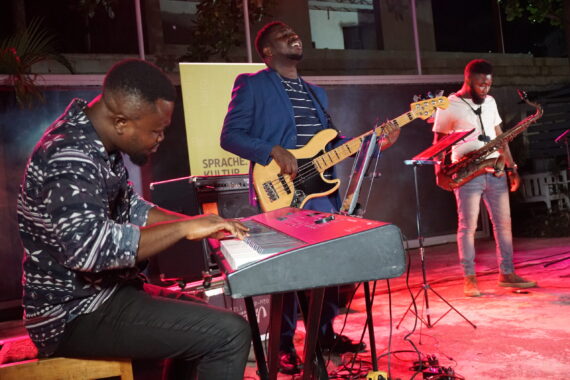
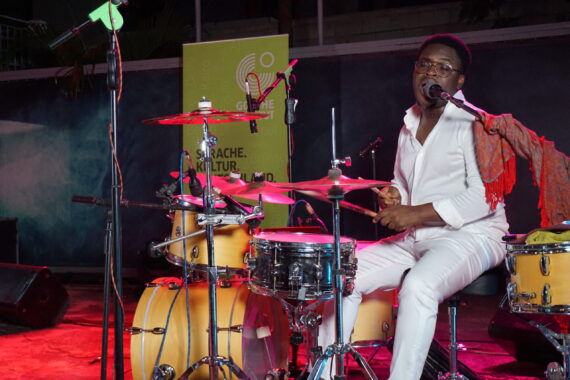
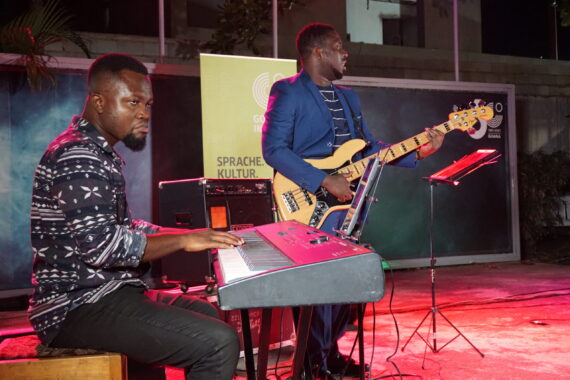
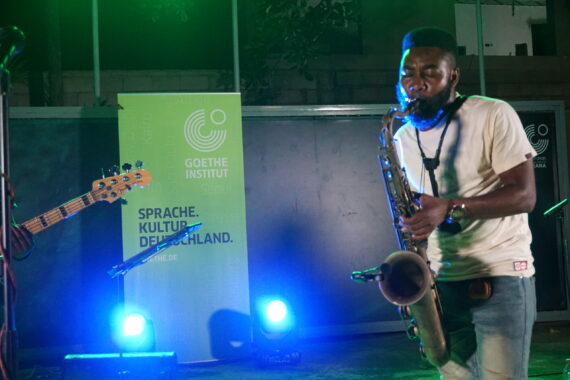
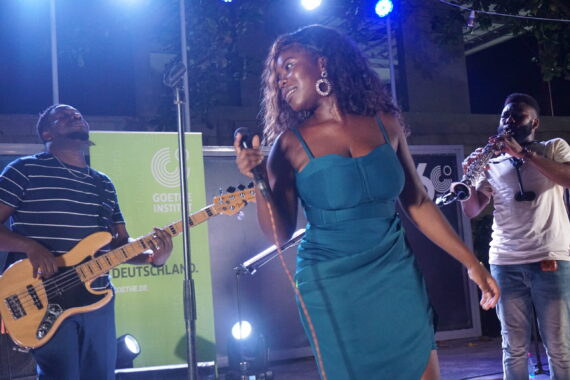
    Festival reaffirms Togo as a jazz hub

  • April 24, 2026 • 347

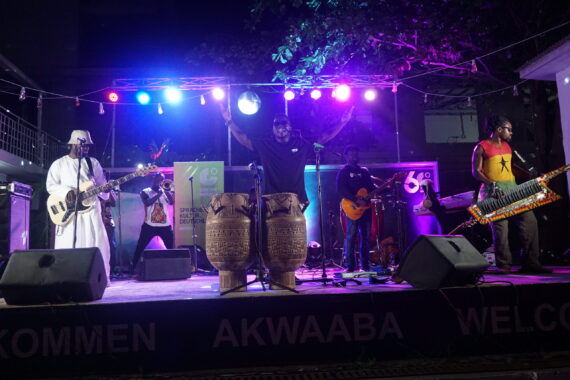
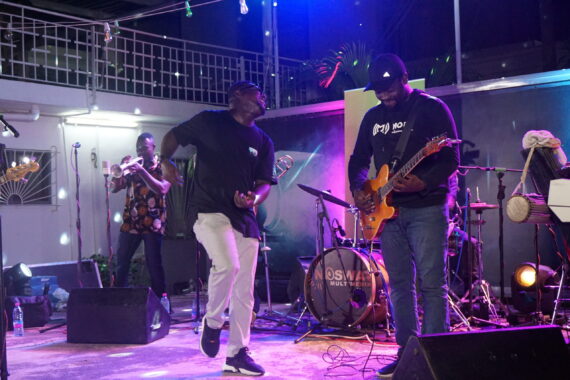
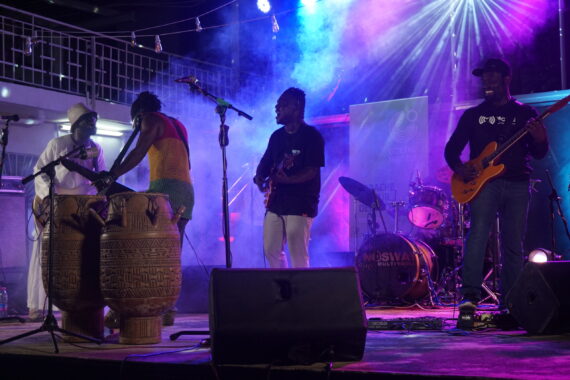
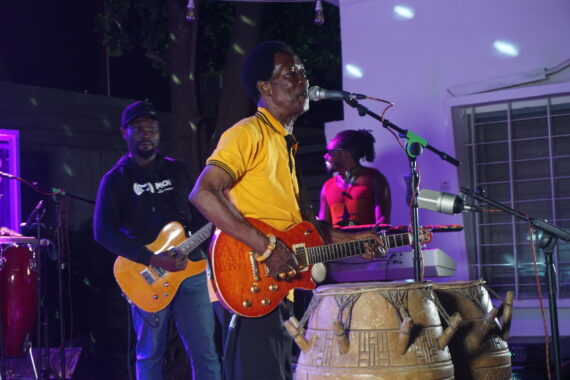
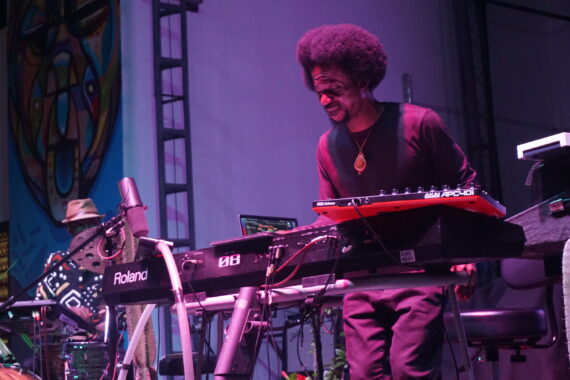
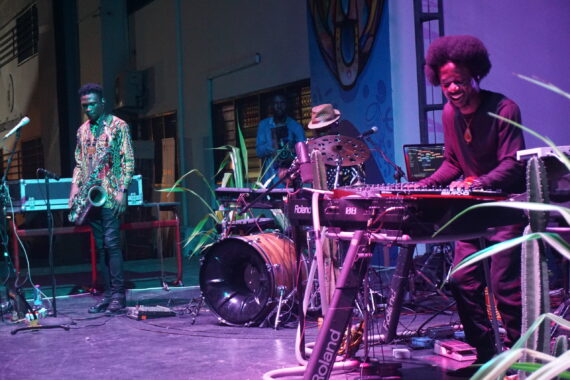
    Music shaped by ancestry, improvisation, and transcendence

  • April 23, 2026 • 313

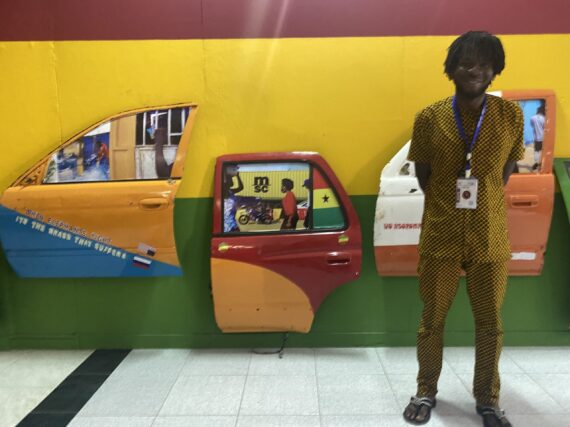
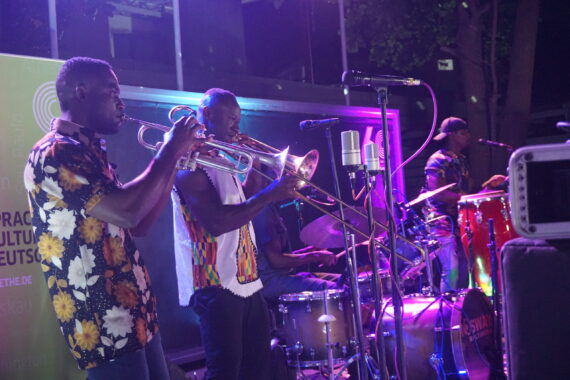
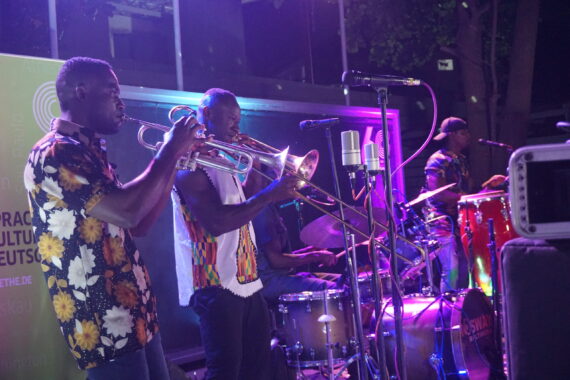
    Brass bands showcase tradition and experimentation

  • April 21, 2026 • 215

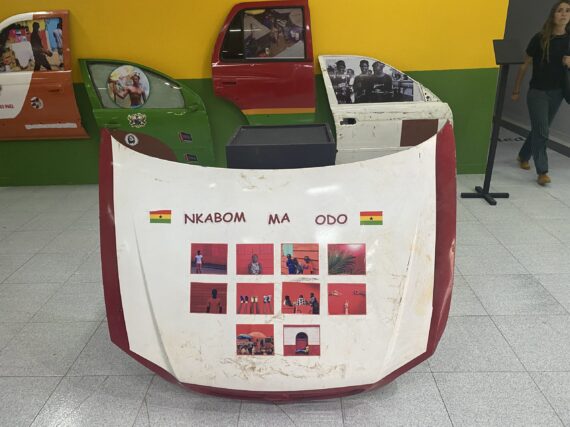
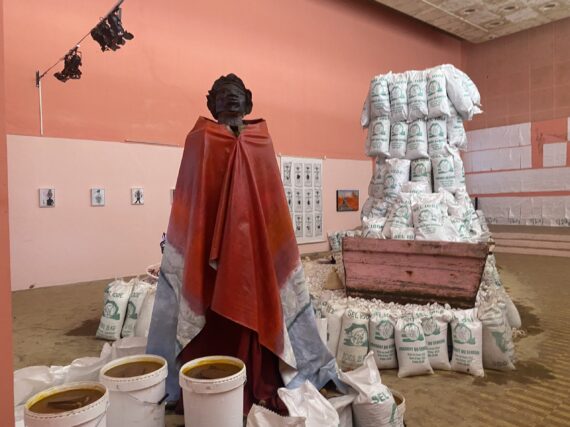
    Set design mirrors dynamism of contemporary African performance

  • April 17, 2026 • 252

    Shifting portraits of the complexities of male identity

  • April 17, 2026 • 235

    Rhythmic footwork and grounded movements

  • April 16, 2026 • 572

    Raw physicality with spiritual introspection  

  • April 16, 2026 • 291

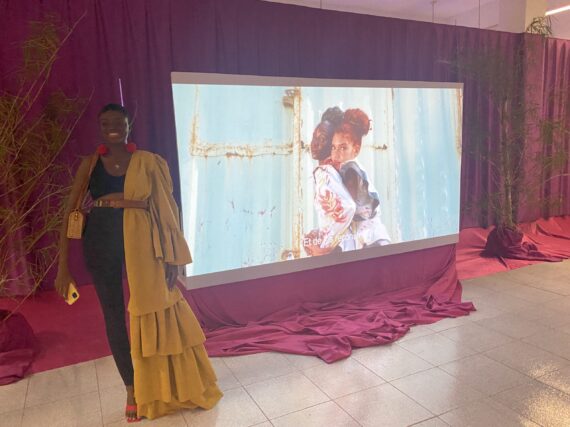
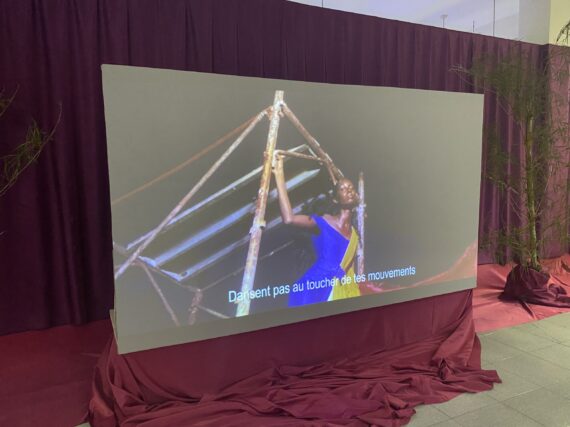
    Imposition, interruption, and provocation by LED screen

  • April 15, 2026 • 189

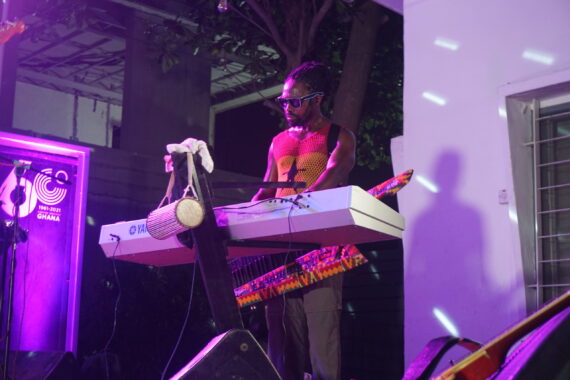
    Sonic meditation on tradition and transformation

  • Slavery in retrospect at Gallery 1957

    June 13, 2021 • FeaturedArticle, News • 1229

    By John Owoo

    (In Accra – Ghana)

    An exhibition of works by two British artists, Ben Langlands and Nikki Bell that explore the complex web of relationships, which connect people and architecture is ongoing at the Kempinski Hotel in Accra.

    The artists, who have collaborated since they met in Art School in 1978, also employ coded systems of communication and exchange that has become a means of negotiation in a fast moving technological world.

    Titled “The Past is Never Dead”, art pieces on display explored the architecture of Slave Castles and Forts in Ghana through a cool blend of slave boats, chairs, Asafo flags, dungeons, lines, geometric shapes and spider-web like images that remind us of the despicable nature of slavery.

    Through a sublime use of design, they capture castles and forts as places of torture and imprisonment while zooming on the fact that these structures have become monumental symbols of evil, malevolence and one of the worst crimes committed against humanity.

    Curated by Jonathan Watkins, the artists created a replica of the infamous “gate of no return” through a video installation while an elaborately carved state chair, which was used by the last Dutch governor of the Elmina Castle adorned the centre of the exhibition hall.

    The artists equally employed a gigantic Asafo flag on which they painted images of several forts – these include Amsterdam (Abandzi), Good Hope (Senya Bereku), Hollandais (Elmina), Nassau (Moree), Bateinstein (Butre), St. Sebastian (Shama), Orange (Sekondi), Metal Cross (Busua) and St. Anthony (Axim) alongside the Elmina Castle.

    The basic architectural design of these forts was in the form of simple shapes – squares and rectangles – and the outer components consisted of towers while the inner parts comprised two or three storey-buildings with or without towers and a courtyard.

    Langlands & Bell have shown internationally including Serpentine Gallery, Whitechapel Gallery, British Museum, Tate Britain, Tate Modern and V&A (United Kingdom), Kunsthalle Bielefeld, Haus Der Kunst, Hamburger Bahnhof (Germany), MoMA, Yale Center for British Art (USA), Venice Biennale (Italy), Seoul Biennale (South Korea) and CCA Kitakyushu / TN Probe (Japan).

    In 2002, they were commissioned by the Imperial War Museum in London (UK) to visit Afghanistan and research “The Aftermath of September 11 and the War in Afghanistan”.  The duo were nominated for the Turner Prize and won a BAFTA for “The House of Osama bin Laden”, a trilogy of artworks they made after their return to London.

    Major permanent art works in the public realm by Langlands & Bell include “Moving World” (2008, London Heathrow Terminal 5), “Call & Response” (2012, Porte de Vincennes, Paris) and “Beauty / Immortality” (2016, Piccadilly Circus Underground Station, London).

    Ghana (then known as Gold Coast) was the center of the British slave trade whose remnants are still visible today. During the period, American traders did business had trading posts in coastal towns and constructed Castles and Forts in Cape Coast, Elmina which were operated by the British, French, Dutch, Germans, Spanish and Portuguese.

    The exhibition ends on Friday July 2, 2021.

    Read More »
  • Intricate weaving / monochrome patterns encircle Nubuke

    June 6, 2021 • FeaturedArticle, News • 1636

    By John Owoo

    (In Accra – Ghana)

    Nubuke Foundation in Accra is currently hosting inventive artworks by two female artists -Lois Arde Acquah and Theresah Ankomah that re-index craft work and stretch intricate monochrome patterns.

    Both artists have over the years been generating emotions, liberating personal interrogations, encouraging solo and collective acts while asserting radical new approaches to contemporary art.

    Undeniably, they equally explore identity, self-expression, authenticity, geo-politics, trade and gender through a combination of diverse materials that recall the skills of ancient African craftsmen while opening up new paradigms of representation.

    Noted for hand drawings of intricate monochrome patterns on various surfaces to explore monotonous actions, Arde-Acquah created a pristine forest in the new gallery of the foundation. She cut “millions of soft black materials in similar forms, which virtually inundated the walls, ceiling, floors and staircases.

    In a performance that followed the opening ceremony, Arde-Acquah engaged art lovers present with diminutive movements which were replaced by hysterical movements and frenzied ones as she swirls and virtually drowns in swathes and mounds of synthetic leather.

    She placed herself under pressure, monotony and difficulty while posing many questions to viewers as they consciously or unconsciously joined in this vulnerable exercise that ended with the artist pushing herself to the limits of self-punishment.

    Employing kenaf baskets from the onion traders at wholesale markets in Accra and elsewhere, Ankomah’s interaction with these materials and the ecosystems that produce them is an expedition that have been exploring gender issues, geo-politics, trade tensions and power.

    Her works are the direct result of a voyage of curiosity and exploration that are progressively evolving around the intricacies rooted within the weaving practice. Indeed, the process of creating complexities and exposing embedded meanings by the interlocking of raw materials enable her to transmit messages that are spearheaded by weaving.

    In recent years, her encounters with the public / installations explore the infinite possibilities of craft object and processes within a contextual discourse of dual-citizenship and cross-cultural relationship on the basis of trade.

    Titled “Look at We”, the exhibition ends on Sunday August 15, 2021.

    Pix – Elolo Bosoka

    Read More »
  • MST hosts politically-charged computer games

    May 30, 2021 • FeaturedArticle, News • 1133

    By John Owoo

    (In Accra – Ghana)

    A total of sixteen games and four videos that show the power of computer games as a politically and socially significant medium are currently on show at the Museum of Science and Technology (MST) in Accra.

    Set on twenty computers embellished with balloons, the exhibition equally examines how computer games unfold their political potential while conveying practical experiences and ideologues in an educational, populist or propagandist manner. 

    It explores the scope and limits of the computer game genre as it constructs a counter-position within the arts and entertainment industry. A move that is achieved through a subtle use of a repertoire of politically ambitious games from 2009.

    Indeed, visitors will become players and experience at firsthand how the games, which deal with topics such as media criticism, migration, power relations, gender roles and militarism on an artistic level affect them.

    Complemented by documentaries on the subject, the games make vivid allusions to political decisions alongside explicit illustration of social conditions and grievances including working conditions, gender, revolutions, refugees and authoritarian governments.

    Players of these games will experience political decision-making, social injustices, labor conditions, surveillance state tactics, consequences of armed conflicts and revolutions against totalitarian systems among others.

    A round table discussion on the exhibition comprising Rainer Hauswirth (former head of Visual Arts at the Goethe-Institut Headquarters in Munich, Germany), Afranie Akwasi Bediako (Artist) Francis Brown (Animator), Eyram Tawia (Computer Games Developer) and Prince Andrew Ardayfio (Gamification Strategist) will take place on Saturday June 5 at the MST in Accra.

    Information Technology Consultant, Kobby Spiky Nkrumah will moderate the discussion, which will among others focus on how computer games can be used as an artistic reflection of contemporary issues and its suitability for complex political themes.

    Goethe-Institut Ghana is sponsoring the exhibition, which ends on Saturday June 5, 2021.  

    Read More »
  • Dark skin and shady black strokes at Gallery 1957

    April 27, 2021 • FeaturedArticle, News • 1542

    By John Owoo

    (In Accra – Ghana)

    Bold and stunning portraits by Holland based Ghanaian artist Lord Ohene Okyere-Bour that are reminiscent of black culture and power are currently on display at Gallery 1957 in Accra.

    Titled “Collecting Afro Memoirs”, the artist, who combines figurative and portraiture techniques, paints gallant and striking depictions, which he tags with beads and stones. Singularly and collectively, they forcefully tell the story of the black man and woman.

    He masterfully incorporates elements from life which are inspired by people and experiences of the past while providing hints of challenges and victories that are associated with life on earth. Indeed, Okyere-Bour appears to take the works beyond physical realism.

    Painted dark skin characterized by black shady strokes are embellished with Afro hair alongside facial expressions, style, patterns and clothe designs that contest and defy stereotypes surrounding black people.

    Indeed, Okyere-Bour’s paintings, which include nudes, are quite dynamic and tend to overwhelm the viewer through a blitz of cool colours, which inevitably enforce an incisive cultural reference and a sharp focus on identity – this he expresses through designs, hats and texts on T shirts.

    Undeniably, the artist makes a calculated appeal against the deterioration of pride and self-esteem of dark skinned people and calmly calls for an end to post-colonial indoctrination and respect for all cultures, beliefs and traditions.

    The exhibition ends on Thursday May 6, 2021.

    Read More »
  • Wishing Well installation unveiled in Accra

    April 13, 2021 • FeaturedArticle, News • 1400

    By John Owoo

    (Accra – Ghana)

    A replica of a sculptural installation by Serge Attukwei Clottey, which is currently on show in Coachella Valley, California (USA) was recently put on show at La, a suburb of Accra that overlooks the Gulf of Guinea.

    Titled “Wishing Well”, the installation, which comprise cutting and stitching of yellow jerry cans (aka Kufour Gallons), the display forms part of a larger project dubbed “Afrogallonism”, which has persistently and consistently explored the relationship between these containers and consumption.

    The Wishing Well installation alludes to wells, which most rural communities in developing countries rely on for their daily activities while making subtle references to colonialism, global movements for environmental justice and the infamous practice of galamsey (illegal mining).

    Clottey, who works in a variety of media that cut across installation, sculpture and performance that deal with the broader influence of colonialism in Africa, equally elevates these jerry cans into a powerful symbol of Ghana’s informal economy and its classification by Bretton Woods institutions and commerce.

    Through a complex web of cutting, drilling, stitching and melting discarded jerry cans, Clottey’s sculptural installations are bold collections that also act as a means of analysis into the languages of form, constructs and abstraction.

    While upholding the status of plastic as an important artistic medium and provoking reflections about consumption patterns, his stunningly composed wall installations made up of plastic pieces and copper wires also make references to the issue of recycling.  

    Undeniably, Clottey’s artworks are transformed into the annals of cultural archives, which effectively recall the long drawn out period of water shortages that compelled the use of these cans.

    Read More »
  • Blackness on display in Accra

    April 5, 2021 • FeaturedArticle, News • 1317

    By John Owoo

    (In Accra – Ghana)

    The use of elements of traditionally acknowledged portraiture, which are characterized by diverse facial expressions that reveal intrinsic narratives is currently in vogue and is being adopted by some artists.

    Currently on show at Gallery 1957 in Accra are works by three Ghanaain artists, Amoako Boafo, Otis Quaicoe and Kwesi Botchway, who powerfully portray their perceptions of Africans and for that matter people with dark skin colour.

    These paintings are equally visible owing to relaxed and erudite bodily gestures, various temperamental expressions and highly centralized subject matters that tend to leave a void as regards to backgrounds.

    Noted for his shaping of black forms, Austria based Boafo’s paintings are quite appealing in their luminousness while showing personalities in a global context amidst turning their bodies into highly perceptible abstract shapes.

    Educated at the Academy of Fine Arts in Vienna (Austria), his unruffled images are placed on an extremely high level thereby forcefully expressing their physicality and spiritually in diverse ways. 

    Currently based in the United States, Quaicoe’s figuration hovers around personal and socio-political issues. Undeniably, they centre around empowerment and redemption, sophistication and humility, curiosity and calmness.

    Trained at the Ghanatta College of Art in Accra, his artworks serve as a medium for self-reflexive commentary while engaging with the history of the medium itself. Rendered in an approachable scale, the resulting portraits are intimate, inviting and friendly.

    Paintings by Botchway capture and interpret emotions / moods of blacks in a manner that grabs and sustains the attention of the viewer while revealing the spirit, essence, struggles and heritage of his subjects.

    While narrating the richness, diversity and complexity of blackness, the artist, who was also trained at the Ghanatta College of Art, equally reveals emotions of pride or shame, honor or disgust, humor and significance. 

    The exhibition ends on Sunday May 9, 2021.

    Read More »
  • Momentous photos engulf Science Museum

    March 21, 2021 • FeaturedArticle, News • 1438

    By John Owoo

    (In Accra – Ghana)

    Antique photographs in small, large and high-contrast formats taken by small-scale photo studios and free-lance photographers from the mid-20th century and beyond are currently on display at the Museum of Science and Technology in Accra.

    Noticeably, there is a sense of joy and curiosity in these photos, with people posing together in harmonizing decorative clothes, showing off new appliances including cars, radio sets, motorbikes, coats, hairstyles, shoes and sunglasses among others.

    Undeniably, these photos, which are in diverse sizes, immediately capture the attention of the viewer and momentarily generate multiple dialogues around culture, history, representation, technology and photography among others.

    Curated by Dr. Bernard Akoi-Jackson, a lecturer at the Department of Painting and Sculpture, Kwame Nkrumah University of Science and Technology (Kumasi), these largely black and white photos equally reveal cozy moments of musicians, actors / actresses, buses, trucks, couples and canoes with people posing in dreamlike manners.

    Unique haircuts, hairdos and fashion, some of which have resurfaced in the past few years as well as a couple of baby photos with subjects elegantly dressed and probably trying to pose as matured kids, provide an insight into the past while recalling the tradition of dressing kids in full traditional gear for memorable photos.

    Photography often reveals a lot by capturing subjects unawares – however, most of the pictures on show reveal subjects willingly offering themselves to be photographed – and in some cases actually posing as they showcase who they are and who they aren’t.  

    Akoi-Jackson complimented the baby photos with a mixed media piece by Frederick Botchway, whose work with a baby picture portrayed both flat and sculptural displays while Malik Adjetey / Vera Obeng “constructed” a replica of a photo studio that was in vogue during the period.  

    The exhibition has generated interest in historical photos in Accra – indeed, African studio photography has over the past decade become an established sector in the insatiable art market following its embrace by academics – mainly those of the post-colonial influence.

    The exhibition is being organized by Heritage Photo Lab, which is currently being hosted by the J.H. Nketia Archives in a bid to create initiatives aimed at mapping and sharing heritage photography from Ghana’s early independence era to the 1070s.

    Supported by the Franco-German Fund, Goethe-Institut Ghana and Institut Francais in Accra, the main objective of the project is to create awareness about photo conservation in Ghana while collecting, preserving and making accessible Ghana’s heritage photos deposited on negatives, diapositives and prints.

    Contributors to the project include Exit Frame Collective (Felicia Abban Archive), Information Services Department, Prof. Esi Sutherland-Addy / Mmofra Foundation (Willis Bell Archive), Prof. John Collins (Bokoor Archives) and Kate Tamakloe (Deo Gratias Archive).

    Others are Nat Pobee (Modern Photos Company), veteran photographer Nii Yemo Nunu, cultural journalist Nii Laryea Korley and Allotey Bruce Konuah, a photo archivist noted for digitizing the works of internationally acclaimed Ghanaian photographer James Barnor.

    The exhibition ends on Friday April 16, 2021.

    Read More »
  • Fantastical posters on show at Nubuke Foundation

    March 18, 2021 • FeaturedArticle, News • 1496

    By John Owoo

    (In Accra – Ghana)

    A display of movie posters and hair salon sign boards from the collection of Ghanaian academic Dr. Joseph Oduro-Frimpong that comprise fantastical images and diverse hair styles is underway at the Nubuke Foundation in Accra.

    Designed and painted with the principal aim of grabbing attention of the public in order to ensure high ticket sales, the images equally showcase hand to hand combats, blood, guts, muscle and muscle mass, some of which are grossly exaggerated.

    Interspersed with the supernatural alongside super heroes, female warriors and heroines, the posters also depict dreadful and lurid scenes as well as tensions between Christianity and practitioners of traditional religion.

    Undeniably, some of these posters have been marshalled for imaginative interpretations of specific scenes from films – and they reveal stunning colour amalgamations – as well as eye-popping adaptations of embellished body physiques and popped out veins. 

    Largely comprising films from China, Ghana and the United States, these posters have without doubt become increasingly sought-after by art collectors owing to their paucity, painting techniques and their historical significance. 

    Encompassing works by Alpha and Omega, Awal Shetty, Billy, C.A Wisely, D.A Jasper, Faith Art, Leonardo Arts and O.A. Heavy-J, the posters, which are noted for infusion of local imagery became popular and easily accessible following the onset of the digital revolution.

    Often painted in glowing commercial paint on plywood, hair cut / hair dressing salon sign boards on display are repetitively colorful and amusing while reflecting traditional and contemporary haircuts and braiding.

    While identifying businesses as well as advertising them, these boards have become mobile in recent years as young men and women roam the streets of Accra and other Ghanaian cities looking for clients.

    Educated in Ghana and the United States, stand-up comic pedagogy informs the teaching of Dr. Oduro-Frimpong, who is the director of the Centre for Popular Culture at the Ashesi University in Ghana.

    It entails having a relaxed but serious classroom setting, where the use of seemingly mundane experiences to underscore class discussions, illuminate theoretical concepts and connect with key issues are vital.  

    Titled “Suɔmɔ Hi Fe Shika“, a Ga phrase that translates as “Love is Better than Money“, the exhibition ends on Sunday April 17, 2021.

    Read More »
  • Ghana’s History on display at Gallery 1957

    February 28, 2021 • FeaturedArticle, News • 1905

    By John Owoo

    (In Accra – Ghana)

    Multi-dimensional murals by self-trained artist Nana Danso Awuah-Asante, which evoke African visual symbolism while effortlessly floating into the past, present and the future are on display at Gallery 1957 in Accra.

    Works by Awuah-Asante (aka Artsoul Kojo), which unveil the history of Ghana employ diverse shapes and forms, which he effectively borrows from the known to the unknown while stretching our imagination.   

    Characterized by features of storytelling and abstract poetry combined with an impressionist and pop-art visual expressions, artworks on display interact and create a point of contact through esoteric and astral activities by the artist, who is constantly monitoring events and occurrences around him.

    Employing cartoon-like characters some of which have exaggerated eyes, mummy-like figures, faces, boats, winding rivers, animals, totems and surreal landscapes inspired by Ghanaian history, he explores possible scenarios of the future that relate to failure and success.

    With the use of cool colours, the artist bemoans the fact that rich Ghanaian history has been contaminated and the true nature of its history has not been told as he attempts to provide a true narrative through diverse techniques including simple shapes and forms.

    Naïve strokes in black set against white backgrounds equally recall the simple yet complex ingenuities of human endeavor as Awuah-Asante outlines the dissimilar and inexhaustible probabilities of how one can observe and perceive the world. 

    Walking through the multidimensional murals, viewers will be surrounded by dreamlike paintings depicting history that may look alien but feel familiar – undeniably, visions of what Ghana is yet to be and how this dream can come into fruition.

    Titled “History of Ghana”, the exhibition ends on Friday March 19, 2021.

    Read More »
  • “In Dialogue” exhibition ends at Alliance Française

    February 18, 2021 • FeaturedArticle, News • 1290

    By John Owoo

    (In Accra – Ghana)

    An exhibition comprising twelve artists which seeks to enhance the cultural dialogue between Ghana and the European Union (EU) ended on Wednesday February 18 at the Alliance Française in Accra.

    Comprising paintings, photographs and installations, the works do not only shed light on the work of the EU in Ghana, but also aim at generating conversations around new and innovative ways of collaboration in a bid to create mutual benefit.

    Dubbed “In Dialogue”, participating artists include Andrews Torsu, Ian Kwakye, Lesley Semackor, Negyem Adonoo, Simon Bowman, Theresah Ankomah (Ghana), Tjasa Rener, (Slovenia), Anne-Laure Gueret (France), Clarissa Rotzel (Ghana / Germany), Isabel Abreu (Portugal), Natalija Gormalova (Latvia) and Ulla Deventer (Germany).

    Ankomah activated some discrepancies in multi-lateral trade, consumption and socio-economic issues in diverse forms by stitching together onion baskets dyed in the colours of Ghana’s national flag. It leverages on the delicate and calculative nature of weaving as a way of expanding the conversation about the EU and its development agenda in Ghana.

    A piece by Adonoo titled “Upgrade” dilated on the upgrade in the grey areas of Ghana, which was and will be made practicable through the relationship that exists between Ghana and the EU while an artwork dubbed “Into The Maze” by Abreu depicts the feminine energy in Accra. This is evident of her painting that show women balancing their many roles with grace and strength – mothers, workers, family providers and community members among others.

    Gormalova showcased a piece from a project “Man for Chop”, a collaboration between herself and AfroDistrict, a collective that aims at breaking stereotypes and changing perceptions of Africa through visual storytelling whereas Deventer, a PhD candidate at the Kwame Nkrumah University of Science and Technology (Kumasi), exhibited a piece on how social norms interrelate with our ideas of love, sexuality and freedom.

    Titled “Accra Academy – Hand Washing”, photos by Bowman generate conversations and bring to light some of the EU’s work in the society – in essence highlighting cooperation between Ghana and the EU delegation. Equally, a work titled ‘Brown Lines’ by Semackor dwelt on the interaction / relationship between the EU and Ghana.

    Curated by Esse Dablah-Attikpo, the exhibition was presented by the EU Delegation to Ghana in collaboration with the Kuenyehia Trust for Contemporary Art.

    Read More »
« 1 … 16 17 18 19 20 … 44 »

Subscribe to Arts Ghana News

Enter your email address to subscribe. Receive notifications of new posts by email.

RECENT VIDEOS

Simple Slideshow

  • Goethe Institut
  • Alliance Française
  • Arterial Network

© 2026 Arts Ghana™

Website Managed by DelTin Technologies