Latest
  • visit www.artsghana.net for information on the arts
  • visit www.artsghana.net for information on the arts

Arts Ghana

MENU
  • Home
  • About Us
  • Upcoming Events
  • Latest News
  • Artistes Database
  • Archives
  • Links
  • Contact Us
  • Music
  • Dance
  • Theatre
  • Literature
  • Visual Arts
  • Film
  • Fashion
  • You Tube
  • Facebook
  • May 1, 2026 • 121

    Poems by Dr. Anas Atakora in retrospect

  • April 28, 2026 • 235

    Festival reaffirms Togo as a jazz hub

  • April 24, 2026 • 347

    Music shaped by ancestry, improvisation, and transcendence

  • April 23, 2026 • 313

    Brass bands showcase tradition and experimentation

  • April 21, 2026 • 215

    Set design mirrors dynamism of contemporary African performance

  • April 17, 2026 • 252

    Shifting portraits of the complexities of male identity

  • April 17, 2026 • 235

    Rhythmic footwork and grounded movements

  • April 16, 2026 • 572

    Raw physicality with spiritual introspection  

  • April 16, 2026 • 291

    Imposition, interruption, and provocation by LED screen

  • April 15, 2026 • 189

    Sonic meditation on tradition and transformation

  • Artist creates performative figures in diverse scenarios

    February 13, 2021 • FeaturedArticle, News • 1590

    By John Owoo

    (In Accra – Ghana)

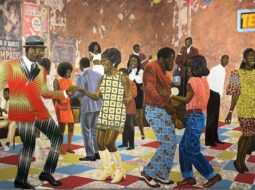
    An exhibition of figurative paintings by Cornelius Annor, which comprise striking depictions of real family gatherings that dwell harmoniously together, is underway at Gallery 1957 in Accra.

    Titled “Family Affair”, the multi-figured works explore his family history while drawing heavily from childhood memories that depict scenes nostalgic daily life.

    He assembles performative characters in diverse scenarios where figures emerge and become one with backgrounds. Undeniably, recurring motifs such as headgears, hats, footwear, flying / bow ties, beverages, television sets, tables and hairstyles that recall Ghana in the 1960s and 70s, are quite vivid on his canvasses.   

    With distinctively Ghanaian domestic settings and figures that have been embellished with locally designed textiles, the paintings provide a peek into highly cozy moments of get-togethers, leisure, romance and amusement.

    Inspired largely by his childhood memories, the artist vividly paints bedtime stories, multiple viewers of TV, dining, socializing and relaxing, while ensuring that his figures lean on each other with warmth and generosity.

    These routine moments of day-to-day activities actually encourage the viewer to move from the black figures to diverse designs on the fabrics while paying attention to the details of his skills on material allocation.

    Indeed, Annor effectively combines the past and present by skillfully creating works that evoke a dialogue between tradition and contemporary as well as older and younger generations.

    Annor, who was educated at the Ghanatta College of Art and Design, has a keen sense of observation and possesses the ability to embellish the human figure, which he adorns with highly visible costumes.

    The exhibition ends on Sunday February 28, 2021.

    Read More »
  • Gallery 1957: Artists redefine global artistic landscape

    January 24, 2021 • FeaturedArticle, News • 1566

    By John Owoo

    (In Accra – Ghana)

    An exhibition dubbed “Collective Reflections: Contemporary African and Diasporic Expressions of a New Vanguard” comprising artists representing a new international vanguard, is closing at Gallery 1957 in Accra.

    Curated by Danny Dunson, works on display include paintings, mixed media works on canvas / paper and collages, which are reactions from a year of individual and collective critical evaluations of universal humanity – particularly with regards to race.

    While contravening perceived artistic boundaries from traditional African abstraction and figuration to spiritual expressionism, indigenous rituals, sacred practices and cultural retention, the artists equally disrupt Western arts canon whilst celebrating Africa’s undeniable contribution with particular reference to the movements of surrealism, mannerism and portraiture.

    Artists, whose works are on show, include Juwon Aderemi, Oliver Okolo, Chiderah Bosah, Luke Agada, Oginjiri Peter (Nigeria), Aplerh-Doku Borlabi, Adjei Tawiah, Musah Yussif (Ghana), Patrick Eugène (United States) and Gustavo Nazareno (Brazil).

    Luke Agada presented “The Kindred Project”, a body of paintings, which address interpersonal connections that exist amongst the transglobal black community through Ghanaian Adinkra symbols alongside Ghanaian artist Adjei Tawiah, who exhibited works utilizing his self-titled “sponge martial” technique.

    Chiderah Bosah showcased “Grey”, a new body of self-portraits that contemplate and grapple with the daily life of a young Nigerian, indeed a triumphant personal response to the END SARS movement and consequent violence in the country.

    The son of Haitian immigrants, Patrick Eugène incorporated African Diasporic connections between Haiti and North America within an intuitive practice that connected him to everyday people in the streets of Atlanta, Georgia (USA).

    “Portraits of the Life of Elizabeth Freeman” by Oliver Okolo, centre on the abolitionist figurehead and neglected social discourses while self-taught Nigerian artist Oginjiri Peter renders the naturalistic features of his subjects within traditional ritualistic masks as he focusses on expression beyond the materiality of skin and skin color.

    Inspired by the nightmarish visions of Francisco Goya, though infusing them with geometric abstractions found in Islamic art, Musah Yussif’s work analyzed personal fears and concerns. The works on show acknowledge the inherent fragility of the human condition as somewhere between a beautiful dream and a horrific nightmare.

    Brazilian artist Gustavo Nazareno presented recent charcoal works on paper based on the origins of “Exú”, a shape-shifting god of multidimensionality, which traverse gender, age and animal forms while Juwon Aderemi’s works explored intellectual discourses in blackness, West African folklore and literature.

    From a distance, the mixed media works of oil paint and coconut husks by Aplerh-Doku Borlabi on canvas, appear as richly toned brown skin. The intrinsic properties of coconut husk’s multiple layers, long hairs and varying shades of brown whimsically purifies skin texture and bone structure while emulating the way natural light surfaces on skin.

    Danny Dunson is an independent art historian, art advisor, curator and writer. A founder of Legacy Brothers LLC, which prepares emerging and underrepresented artists to transition within the contemporary art market, Dunson is also the co-founder and Editor-In-Chief of ArtX as well as a contributing writer for Sugarcane Magazine.

    Read More »
  • Penetrating performance at Goethe-Institut

    December 23, 2020 • FeaturedArticle, News • 1167

    By John Owoo

    (In Accra – Ghana)

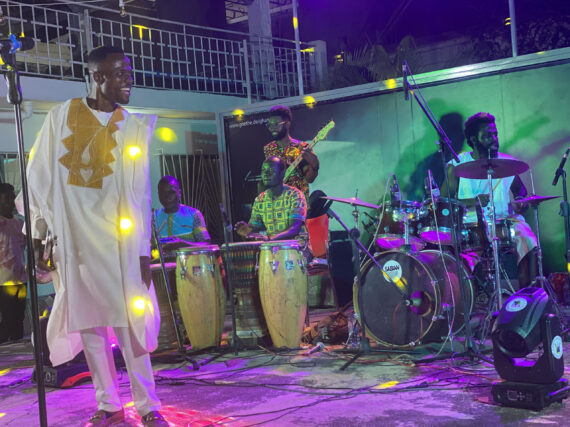
    Beiko Band, a contemporary music group last week ended the Covid 19 virtual concerts organized by the Goethe-Institut with a visually eloquent performance at the premises of the Institut in Accra.

    Led by Austria based Ghanaian percussionist Kofi Quarshie, the band delivered a penetrating performance that recalled the skills of Ga musicians, who recorded classic songs and performed in Accra and other parts of Ghana in the 1950s and 60s.

    With Kofi Quarshie (donno / vocals), Mark Essien (bass), Sammy Superstar (guitar / backing vocals), Gideon Anthony (keyboard), Love Mensah (backing vocals), Isaac Ansong (trumpet), Thomas Botchway (drums) and Samuel Addo (percussion), they severally and jointly showcased a cool but intensely charming stagecraft.

    Through a cool mixture of highlife, afro jazz and world music, tunes such as “Nyomo Oyi Wala Don”, “Agoo”, “That’s all for Now”, “Nyeh Ka Taashie”, “Mama Africa”, “Beiko”, “Maaba”, which were composed by Quarshie, appeared to flow like a fast-moving stream.

    Lyrics that commented on unity, peace, harmony, love, culture, tradition and the economy were supported by an array of local and western instruments that turned the evening into a highly entertaining and memorable one.

    Quarshie is definitely among a few Ghanaian musicians who are apostles of Ga musical traditions – and his music encompass inflections from this convention alongside rhythms, beats and styles from other musical traditions.

    He has closely worked with Lizzy Hammond, a West African dancer / singer and has been a member of the jazz group KDR Society for over a decade while playing at Jazz Festivals in Romania, Lithuania, Poland and Sweden.

    ​In October 2017 Quarshie released his album “I Remember (Mama I Love You)”. Easily one of Ghana’s best drummers, his passion has always been the development and promotion of traditional music of Ghana, thereby making regular visits to the country.

    Goethe-Institut Ghana sponsored the concert.

    Read More »
  • The collector as compulsive mythologist – Wole Soyinka’s “Beyond Aesthetics”

    December 10, 2020 • FeaturedArticle, News • 4031

    By Dr. Joseph Oduro-Frimpong

    In 2013, the Hutchins Center for African and African American Research, Harvard University, initiated the annual Richard D. Cohen Lectures. A key goal of the series focuses on “scholars who address the vast expanse of African diasporic art communities through the study of contemporary works, specific historical concerns, or traditional art considerations in communities in Africa and elsewhere”. Professor Wole Soyinka delivered his version of the Lectures in 2017.

    The choice of Professor Soyinka for the lecture is perhaps due to his reputation, aptly described by the African Humanities Program of the American Council of Learned Societies as someone who passionately promotes “the role of the humanities in contemporary life, [and whose] distinguished career [has] championed writing that inspires individual self-examination and collective self-understanding”. Titled “Beyond Aesthetics: Use, Abuse, and Dissonance in African Art Traditions”, Yale University Press published his lectures under the same title in the US in January and the UK in March, 2020.

    Beyond Aesthetics — which extends Soyinka’s known reputation as an essayist – explores his experiences with the arts and passion collecting art from different parts of the world. In the ‘Preface’, the author begins with two anecdotal narratives saturated with the essence of “Renaissance fervor” (p. 17). The first revolves around one of Soyinka’s experiences in Senegal where he encountered the famous African Renaissance Monument.

    This colossal public art installation, constructed by North Koreans, and inspired by “the aesthetics of neo-fascist public art masquerading as proletarian realism” (p.11), nauseates Soyinka for a justifiable reason: “not one single aspect of [the] sculptural figuration bears the slightest resemblance to anything African [in general or Senegalese in particular] – certainly not in concept, style, form, not even gesture” (p. 10). The extent of Soyinka’s disgust is due to his later understanding that President Wade had rejected a model for the monument by highly regarded Senegalese artist Ousmane Sow.

    The second story focuses on an international arts festival in the United Kingdom and dubbed ‘AFRICA 92’, where Soyinka plays a mediating role, and through which one becomes aware of his “compulsive trait toward artistic anthropomorphism” (p.18) when it comes to the visual arts. Here, Soyinka is keen on how assembled artworks, notwithstanding their geographical/cultural origins, should speak to each other as such works are not “passive or inert object[s] of contemplation” (p. 19). In giving us these personal stories, the author’s goal is to “lead us into the realms of African creative muses” (p.10) which he goes on to explore in the three chapters that form the bulk of the book.

    In Chapter One, ‘Oga, Na Original Fake, I Swear’, Soyinka explores two layers of what he terms “the peace of aesthetic wisdom” (p. 24). One layer explores culturally influenced notions of what constitutes taste or beauty through “an aesthetic voyage” (p. 24). The first of Soyinka’s two key examples here occurs in Venice. A colleague, W. H. Auden distracts Soyinka’s attentiveness from Peggy Guggenheim’s collection to refocus Soyinka on Peggy’s peculiar aesthetic choice to surgically slice her buttocks so as to be able to wear designer clothes.

    Soyinka then presents former military dictator and later democratically elected president of Nigeria, Olusegun Obansanjo’s criteria of who a beautiful woman is. This benchmark, also Soyinka’s, vastly contrasts that of English men, such as Auden. As in the ‘fashion arts’ where emaciated-looking models are tacitly fronted as beautiful, within Yoruba arts, the ideal beauty is visibly generous, visualized through, for example, wooden fertility art pieces. 

    Soyinka furthers this exploration through the “acquisitive lust” (p. 36) of the art collector. In this journey, where the narrative swings between the past and the present, Soyinka introduces us to some of his own antique collections from Nigeria, Japan and South Korea. Nested in these stories about ‘art’ and ‘beauty’ are subtle but powerful critiques that concretely reject a narrow understanding of ‘aesthetics’.

    When Soyinka insists that “there is an inherent beauty in ancient objects, a leisurely but penetrative distillation of material, form, and history, one that we struggle vainly to capture and define, but that remains elusive under the rubric of “aesthetics”” (p. 78), what I hear is this: that the normative theoretical thrust of and approaches to ‘aesthetics’ is currently inadequate. Thus, a holistic ‘aesthetic experience’ of artworks needs to also acknowledge the tangible/material dimensions of such works. 

    In Chapter 2, titled Procreative Deities: The Orisa’s Triumphal March, the overarching discussion focuses on religion and its relationship to artworks in pre-and post-colonial Africa. Soyinka draws attention to the negative role of the “twinned alien religions” (p. 82) of Christianity and Islam which, since the missionary era, and up till now, have contributed to the destruction of African religious artworks.

    Here, he shows how in Nigeria, fundamentalist African Christians and Muslims with their attendant “puritanical conventions” (p. 81) almost never disagree in leading the charge to destroy priceless African religious artworks, but that they cannot eliminate the creative and imaginative energies which in one form or another will continue to help create cultural/religious artifacts. Soyinka’s conviction about the generative capabilities of the human imagination is grounded in the phenomenon of abiku – a belief and practice in most African societies related to transmigration of souls.

    In the final chapter, From Aso-Ebi to N****wood, this directional and geographical focus is sustained as Soyinka deals with two main artistic practices related to fashion and media in Nigeria. With fashion, Soyinka examines female practices around aso-ebi, which literally means “family or relations attire” (p. 133). Here, the author is interested in how the practice raises questions about what and how it means to be feminine without patriarchal imposition, as well as how the aso-ebi practice sartorially instantiates the philosophical value of communitarian ethics.

    With regards to Yoruba femininity as witnessed in the aso-ebi , Soyinka points to the women’s agency which manifests in “selecting and creating from internal options, within [their] own community of self-conscious females”(p.133). The discussion on media focuses on the contemporary popular movie industry in Nigeria, officially known as Nollywood. Drawing on sacred Yoruba (African) naming practices, which are based on careful and creative considerations, Soyinka argues against such a “deleterious name” (p.143) and instead proposes “Afrowood” (p. 159).

    In all, I find Beyond Aesthetics very refreshing. The work invigoratingly engages with certain key notions such as creativity, (in-)authentic(ity) and aesthetics in ways that go beyond normative approaches, nudging us to reflect and engage more deeply with these ideas than perhaps we currently have in the humanities and social sciences. Implicitly then, Soyinka reminds and encourages us to avoid unproductive and modernist binary approaches and armchair theorizing of concepts – such as suspicion, fake(ry) and imagination – so as to allow for grounded analyses of these ideas. 

    My only critique of Beyond Aesthetics relates to the last chapter where Soyinka feels the movie industry’s branding of itself through ‘Nollywood’ is silly in its imitativeness, engendering a state of “imaginative retardation” (p. 144), dooming it away from “a tendency of adventurousness, experimentation and originality” (p. 143). This willingness to be innovative through the power of constructive imagination that Soyinka mentions was a key marker of the early phase of postcolonial African cinema whose film producers had either state or foreign funding for their productions. Thus, making a profit or a loss from film-making seemed not to concern these ‘conscious’ filmmakers.

    The situation is now different. Nollywood producers directly finance their films. To recoup funds and/or make profits requires an imaginative inventiveness which these producers have rightly identified as being embedded in “Nigerian social actualities” (p. 146). Thus, in as much as I agree with Soyinka that Nollywood should make as socially engaging/conscious movies as their predecessors, this goal remains, at this stage, an ideal. The practice does not guarantee profits. It is this state of affairs which makes producers settle for what Soyinka aptly terms as “lowest common denominator” (p. 144). 

    Beyond Aesthetics clearly calls for grounded experiences and the senses as equally critical to one’s meaningful engagement with appreciating and critiquing artistic works. More importantly, in this work, we encounter Soyinka as both a mythologist and philosopher of (fine) art who strongly advocates, to borrow Francis Nyamnjoh’s words, for ‘convivial scholarship’ in the appreciation of the arts. Here, Soyinka encourages us to move ‘beyond aesthetics’ to see the wisdom to pluralize our gaze or lines of vision in order to move past a reductionist lens that one so often hears from and in the West.

    Wole Soyinka is a Nigerian playwright, poet, essayist, and political activist. He was awarded the Nobel Prize for Literature in 1986. His many publications include You Must Set Forth at Dawn and Of Africa. Soyinka is also a longtime art collector. Beyond Aesthetics: Use, Abuse, and Dissonance in African Art Traditions, offers a glimpse into the motivations of the collector, as well as a highly personal look at the politics of aesthetics and collecting. Detailing moments of first encounter with objects that drew him in and continue to affect him, Soyinka describes a world of mortals, muses, and deities that imbue the artworks with history and meaning (bio. c. Yale UP).

    Joseph Oduro-Frimpong is a media anthropologist. He currently directs the Center for African Popular Culture at Ashesi University. Two of his works on Ghanaian cartoons respectively appear in the volumes: Popular Culture in Africa: The Episteme of the Everyday (Stephanie Newell and Onokoome Onome, eds), and Taking African Cartoons Seriously: Politics, Satire, Culture (Peter Limb and Tejumola Olaniyan). 

    Pictures – Yao Ladzekpo

    Read More »
  • Historical film recalls Ghana’s cocoa story

    November 20, 2020 • FeaturedArticle, News • 1925

    By John Owoo

    (In Accra – Ghana)

    “Heroes of Africa”, a historical film that explored the activities of Tetteh Quarshie, the legendary father of Ghanaian cocoa, was last week screened to a special audience at the Goethe-Institut in Accra.

    The film, which won the first prize in the Ghanaian Films Category of Black Star International Film Festival 2020, revisited the story of Quarshie, who is said to have stolen cocoa seeds from the Island of Fernando Po in the second half of the 19th century.

    A former Spanish colony located off the coast of Equatorial Guinea, Fernando Po was noted for slavery, oppression and huge cocoa, coffee and timber plantations, which generated large sums of money through exports.  

    Although aggressively historical as regards to its subject – the illegal importation of cocoa to Ghana – the approach is rather a modern way of storytelling with willfully stingy explication alongside an assumption that viewers have some knowledge of the Quarshie saga.

    Staring Van Vicker, Ian Flemming and Agya Koo, the film is a myriad of history, bravery, slavery, tradition and culture – the tone was set when an elder of a village predicted a glorious future for a new-born baby, who grew up to be the famous Quarshie.

    “Heroes of Africa” took viewers on a journey to Fernando Po, where Quarshie grabs a job at one of the plantations and witnesses at first hand the horrors of daily life on the plantations including summary executions of slaves who stole or attempted to steal cocoa pods or beans.

    With historical facts intricately fused with fleshy fiction, director Fiifi Gharbin created a story that spanned periods between 1850 and 1879, when Quarshie returned to Ghana with the cocoa beans, which today constitutes one of the major export crops of the Ghanaian economy.

    Despite challenges with costumes, locations, cultural and religious, the film disseminated an important historical narrative through motion pictures supported by technical and theatrical innovations in recent years.

    Goethe-Institut Ghana supported the prize and screening.

    Pix – Black Star International Film Festival

    Read More »
  • All female band show class

    November 17, 2020 • FeaturedArticle, News • 1596

    By John Owoo

    (In Accra – Ghana)

    Lipstick Band, an all-female group last Tuesday proved the capabilities of Ghanaian female instrumentalists during a captivating concert at the Goethe-Institut in Accra.

    In a recorded performance, the band showcased music that is richly woven between the various instrumentalists while harmonies appeared grinding together with glorious friction and calmness.

    With a direction towards jazz, the band delivered a poignant opener with “Lipstick”, an infectious tune composed by Sita Korley, which has widely been regarded as its signature tune.

    In a rather slow-moving and all-enveloping show, the group showcased diverse arrangements which featured epic sequences thereby evoking sensitive, moving and emotional feelings.   

    Undeniably, the performance was totally engaging with its delicate harmonies and rhythmic charm that will inevitably find their way into the grooves of their forthcoming album – and fans will be eager to hear it on record as well in a live environment.

    With Sita Korley (Keyboard), Vida Ofoli (percussion), Winfred Thompson (bass), Abena Pomaah (guitar) and Abigail Aniapam (drums), Liptsick Band is without doubt the promising all-female band to emerge in Ghana over the past several decades.

    Although music lovers are missing the live gig experience in a very big way, pre-recorded concerts such as this, which is being spearheaded by the Goethe-Institut, will enable fans enjoy live music from the comfort of their homes and elsewhere.

    Lipstick Band, which won an award for women in creative arts industry in 2012 has participated in local and international festivals – these include “Nuit Atipiques de Koudougou” (Burkina Faso), “Stars de I’Intergration Culturelle Africaine” (Benin) and the 50th independence anniversary celebration of Ivory Coast (Abidjan).

    Goethe-Institut Ghana supported the concert.

    Read More »
  • Gratifying & lucid songs from Blay-Ambolley

    November 8, 2020 • FeaturedArticle, News • 1921

    By John Owoo

    (In Accra – Ghana)

    Legendary Ghanaian musician Gyedu Blay-Ambolley recently turned the stage at the Goethe-Institut in Accra into a musical groove during a virtual performance that forms part of a series dubbed Covid 19 concerts.

    Noted for his gratifyingly and lucid singing, his fingers moved with amazing ease and precision on the saxophone as an unruffled mixture of highlife, Afro jazz and other musical genres generously flowed from the stage.

    Accompanied by hilarious lyrics, Blay-Ambolley alongside Young Enim (keyboard), Kwesi Arko (bass guitar), Shikome (congas), Kuuku Ansong (trumpet) and Colonel Faat (saxophone), severally and mutually delivered a magical performance that spiraled into the cool night air.  

    With tunes such us “Ose Yie”, “Amponsah”, “Blue Moon”, “Black Man Dey Suffer”, “Awar Kakra”, “Maplay”, “Adwoa Emissah” (Blay-Ambolley), “Enyidaso” (Kwasi Arko Donkor) and “Round Midnight” (Thelonius Monk), the performance was not only original but largely stimulating and intellectually satisfying.

    Through a cool combination of voices, piano, guitars, drums, percussive instruments, two saxophones and an ageless deep voice from Blay-Ambolley, the performers delivered a memorable concert while exhibiting all the elements of musical communication.

    He has toured throughout West Africa, Europe, Canada and the United States and has performed on the same stage with some of the world’s most celebrated artistes including Miriam Makeba and the Afro Beat King, Fela Anikulapo-Kuti.

    Others are George Howard, Angela Bofill, Norman Connors (USA), Manu Debango (Cameroon), Chikuzan Takahashi (Japan), Ricardo Estrada (Cuba), Mayuto Correa (Brazil) and later toured Ghana with Oscar Brashear and Michael Session from the United States.

    Owing to the originality of his music, Blay-Ambolley’s performances have left audiences raving and shouting for more as was the case at the world-famous Apollo Theater – New York, USA in 1992.

    The celebrated musician has also received several prestigious awards including a Congressional Certificate of Special Recognition by Congresswoman Juanita Millinder McDonald, a lifetime achievement award and was inducted into the music hall of fame by Charles R. Drew University of Medicine and Science in California – all in the USA.

    On his return to Ghana from the United States in 1997, he was honored with a standing ovation from former President, Jerry John Rawlings at the Ghana Music Awards.

    Goethe-Institut Ghana supported the concert.

    Read More »
  • Most Def Foundation launched in Accra

    November 6, 2020 • FeaturedArticle, News • 1479

    By John Owoo

    (In Accra – Ghana)

    Most Def Foundation, a group dedicated to the deaf was on Wednesday launched at the Antique Lemonade Art Space in Accra. 

    Founded by Franka-Maria Andoh, author and CEO of Josie’s Cuppa Cappuccino in Accra, Most Def Foundation is aimed at using education as a tool to ensure a change in the lives of the hearing-impaired. 

    In a brief speech, Andoh stated that yearly summer camps and short courses that will be organized are geared towards exposing deaf students to a range of skills while building on their faith, confidence and self-esteem.

    “This laudable idea has been on my heart for sometime now, indeed I was sparked into action earlier in the year after listening to a talk by Shaka Senghor, an American ex-convict, whose writings have touched the hearts of many people around the globe”, she added.

    “He was invited by Oprah Winfrey to speak to her audience and one of the things he said that struck me was how society wastes people.  This gentleman, by re-inventing himself is now a bestselling author and a fellow in one of the top universities in the United States”, she continued. 

    She revealed that she was deeply moved by how different his life could have gone and it made her think seriously about hearing-impaired children in Ghana and how many of them would and could fall by the side if we don’t intervene and hold their hands towards a better future.

    The Foundation’s hospitality project, which will be based at the Gracias Lodge in Cape Coast, is set to provide on-site training as well as future income generating and employment skills for the children. 

    It equally aims at partnering corporations and organizations to push for the inclusion of the deaf community in the work force and the arts sector in Ghana.

    Most Def Foundation has executive and programmes committees, whose main objective is to roll out the its summer school sessions for deaf students as well as short courses for those who have completed some form of formal education.

    The Principal of Cape Deaf and Blind School in Cape Coast, Abraham Yemoson and his assistant Regina Essilfie, who were guests of honour, lamented on the lack of opportunities for further education for deaf students and pledged the support of their institution.

    Rosalin Abigail Kyere Nartey, president of the executive committee pledged that Most Def Foundation will make a difference in the lives of the deaf community in Ghana. 

    Pictures – Marie Ipaud

    Read More »
  • Volta Region musicians sing for peace

    November 5, 2020 • FeaturedArticle, News • 1426

    By Kouame Koulibaly

    (In Ho – Ghana)

    Elections to political office often raise tensions in many places across the globe and music has become one of the tools for cooling those tensions in some places.

    In Ghana, it is not uncommon for musicians of all shades to travel across the country playing concerts that preach against electoral violence. Singles as well as complete albums of peace songs have been put out over the years all in a bid to help promote peaceful and credible elections.

    Musicians in the Volta Region of Ghana are known for joining forces to support worthy causes and they have hit the road again with a series of concerts dubbed Volta for Peace. Organized by Tosh Media and Trans4orm Network Ghana, the concerts are being held in principal towns in the region to raise awareness of the need for all to contribute towards a violence-free general election on December 7.

    “We make our living creating music to make people happy.  There is obviously no work for us in times of conflict.  COVID-19 has already dealt us a damaging blow and we all have to ensure there’s no other hindrance to our welfare by way of unnecessary conflict,” said Tony D, CEO of Tosh Media and Chairman of the Volta Region branch of the Musicians Union of Ghana (MUSIGA).

    “We know we musicians have a big role to play to play in raising awareness about violent-free elections. We are urging that campaigns be based on relevant issues and politicians must refrain from insulting each other language,” Tony D pointed out at the Volta for Peace concert held at the Woezor Hotel in Ho, the regional capital a fortnight ago.

    The musicians, this time joined by some comedians from the region, held another peace event at the White Dove Hotel at Dzodze on October 31. Performers at the show included Tony D, Rap Ziggy, Sister Beauty, Everyday, Saunter S2, Anasco, Mozato, Chilling Mama and China Man. They all presented songs and comedy acts that called for a peaceful Election 2020.

    There were also peace messages from representatives of political parties, security services, chiefs and queen mothers, youth group and other relevant interest groups at the concert. Mama Awoamefi,  Queen mother of Afife, spoke on behalf of Queen mothers in the Ketu North Traditional area.  She advised the youth to learn to identify good politicians from bad ones.

     “The good politicians the ones who seek your welfare and progress at all times. The bad ones give you a few cedis and hard drugs and ask you to commit violent acts while their children stay protected in the comfort of their homes. Please expose those bad ones,” she noted. 

    Togbe Akutu II of Dzodze Afeyieme, also spoke on behalf of chiefs in the traditional area. He called on the media to be circumspect in their reportage in order to maintain the peace Ghana is enjoying and pledged the support of the chiefs in the area to the Volta for Peace initiative.

    Vincent Azumah, founder and Chairman of the Board of Trans4orm, also said recent violent events in the Volta Region required the establishment of response mechanisms to help prevent any escalation of violence.  “We are using music as a universal language and a response mechanism to communicate peaceful coexistence,” he stated.

    “There are many-good-hearted musicians in the Volta Region willing to do things for the common good. The Volta For Peace Project is a manifestation that we are each other’s keeper and we’ll continue to seek progress for our people at all times,” said Tony D.

    After Dzodze, the Volta for Peace train will make stops at Akatsi, Sogakope, Hohoe and Kpando before voting day on December 7.

    Read More »
  • Europhone / Afrophone literatures headline PaGya 2020

    November 3, 2020 • FeaturedArticle, News • 1322

    By John Owoo

    (In Accra – Ghana)

    The 2020 edition of PaGya Literary Festival, which ended last week at the Goethe-Institut in Accra, has undoubtedly sparked interest and appetite in writing and publishing in local Ghanaian languages.

    Indeed, the opening discussion between Prof. Kofi Anyidoho (University of Ghana) and Prof. Danabang Kuwabong (University of Puerto Rico), which centered on “Preservation of Ghanaian Languages through Literature”, also touched on the upgrading of Ghana’s linguistic heritage.

    Both academics, who have several books in both English and local languages to their credit, examined the relevance of literature in indigenous languages such as Ga, Ewe, Twi, Dagaare and Dagbani as a way of promoting Ghanaian languages, literature and national development.

    They were of the view that literature, when adopted in all levels of education in the areas of prose, drama and poetry, can play a critical role in informing and orienting the population on actions to take that will result in human development. 

    Undeniably, African literary studies have for decades been rooted in a distinction between Europhone literatures and Afrophone literatures. Each of these two genres was associated with a detailed set of qualities resulting in European language traditions being described as global, written and modern, while those of Africa were often labeled as local, oral and traditional.

    They acknowledged the challenges inherent in writing in local languages but added that these are not unsurmountable while stating that enhancement of the teaching of local languages in schools is not only about enriching these languages but also augmenting knowledge about our culture, traditions and history. 

    German poet, translator and essayist Jan Wagner, who read from his poems participated in a virtual discussion on “Translating Poetry” with Ghanaian poet Nii Ayikwei Parkes, which heralded a poetry fiesta that encompassed several members of Ehalakasa poetry collective.  

    They dilated on how rhyme, which constitutes one of the features of poetry, is particularly challenging in translation. Both poets equally touched on the issue of rhythm which is often achieved with the use of rhyme as well as other stylistic devices such as assonance, consonance and onomatopoeia, which are difficult to reproduce in another language.

    Equally insightful was a discussion between the internationally acclaimed Ghanaian artist Ibrahim Mahama and musician / activist Wanlov the Kubolor on the subject “Art on the Edge”. Moderated by the Dutch / Ghanaian creative mastermind Ama van Danzig, the two artists expatiated on issues relating to the expansion of art parameters in Ghana while zoning in on new and alternative voices and the issue of colonial ghosts.

    Another talk involved two former Ambassadors – D.K Osei and Kabral Blay-Amihere who disused the topic “Traversing the Globe – A Diplomatic Conversation”, they engaged themselves with a lively discussion on a wide range of issues relating to the diplomatic front.

    Various activities that took place during the three-day event include presentations, book readings / signings, workshops, publisher interactions, panel discussions and book launches and others that were largely held through video link ups and live-streaming.  

    With dozens of authors, poets, editors and publishers on site alongside members of the general public participating virtually and physically, this year’s festival was a huge success, despite minor challenges with internet and technical equipment.

    Goethe-Institut Ghana sponsored PaGya Literary Festival 2020.

    Read More »
« 1 … 17 18 19 20 21 … 44 »
Subscribe to Arts Ghana News

Enter your email address to subscribe. Receive notifications of new posts by email.

RECENT VIDEOS

Simple Slideshow

  • Goethe Institut
  • Alliance Française
  • Arterial Network

© 2026 Arts Ghana™

Website Managed by DelTin Technologies