

By Alice Heyward
(Berlin – Germany)
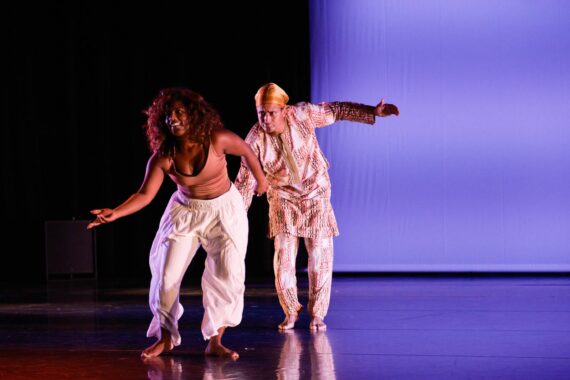
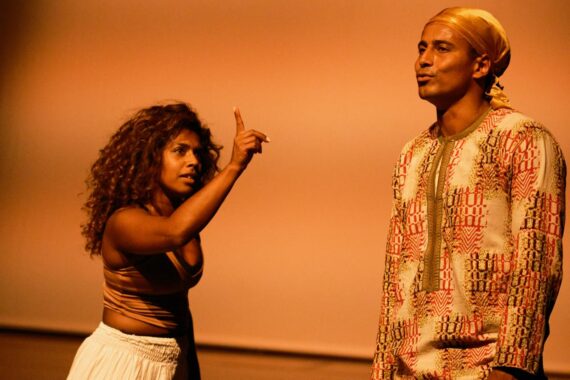
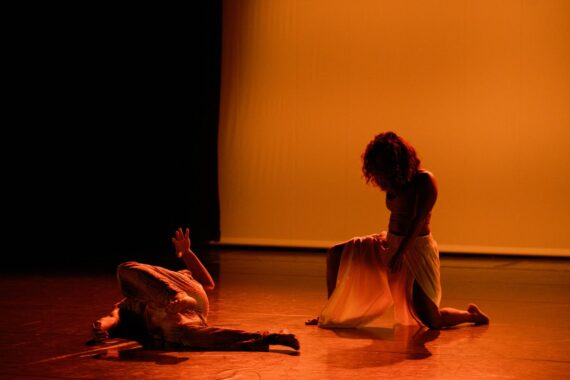
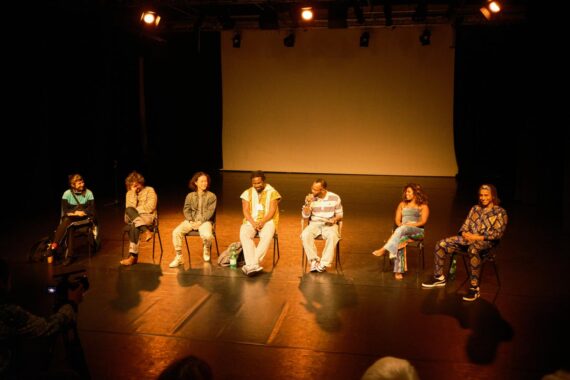
Between the Oceans is a hip-hop dance-theater duet by Tiffani Achilleas and Raphael Moussa Hillebrand, presented at Uferstudios as part of KUYUM Tanzplattform 2026.
In their first collaboration, Achilleas, whose work blends contemporary, urban, and traditional forms, and Hillebrand, the first urban dancer to win the German Dance Prize, draw on their journeys to places tied to their ancestral histories and ask what their bodies carry across distances and generations.
In the foyer, a musician plays the kora, the West African harp-lute. Notes tinkle like marbles tumbling from its large, intricate form, pattering over laughter and chatter. The rich aroma of homemade West African food wafts through the room. The large crowd gathered to celebrate the festival creates a vibrant, joyous spirit that flows into Uferstudios’ Studio 14.
As we take our seats, a projection on the stage’s back wall flicks through a slideshow of travel photos and footage: selfies of the two artists against natural landscapes and buildings, some showing large groups, musical instruments, and restaurants.
This personal archive of imagery provides a literal and evocative backdrop for the performance that follows, in which Achilleas and Hillebrand tell stories, through dance and speech, of traveling through Salvador da Bahia, Benin, Mali, and Sri Lanka. These places live in the artists’ ancestries and, so, in their bodies, even though the two grew up in Germany, each in a different local context.
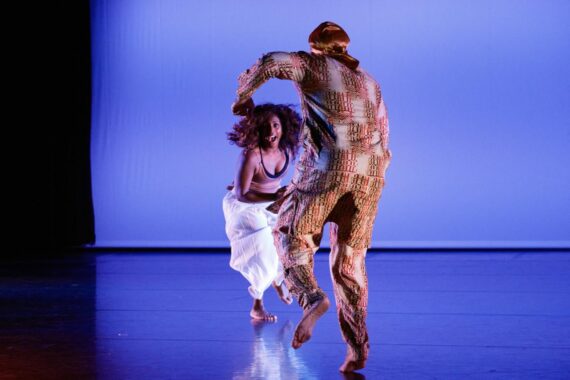
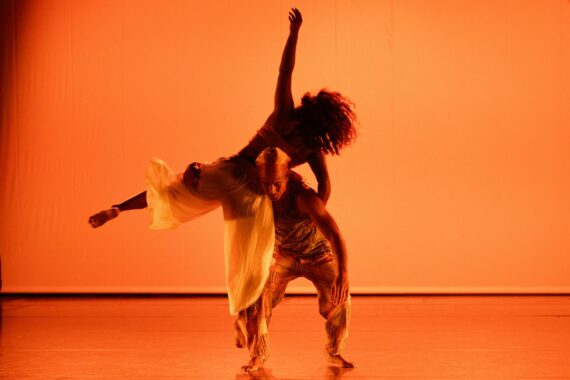
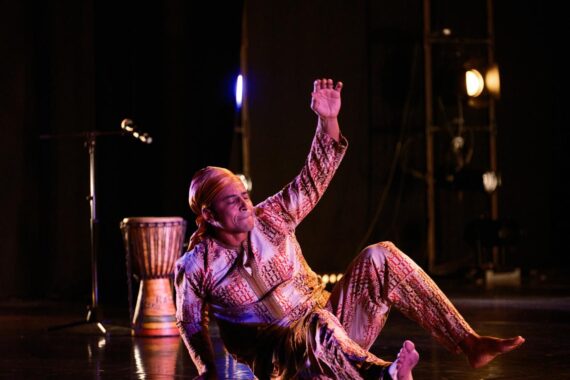
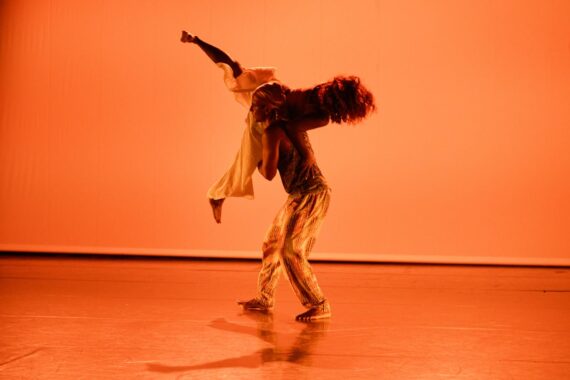
I’m enraptured by their dance movement: popping, locking and flowing in countless rhythms. Their feet press into and rebound from the floor as if drawing music up from its abundant depths and converting it into electric dance.
I recognize many of the moves, from freezes and tutting to floor spins, torso ripples, and high kicks, which, through hip-hop’s global circulation, not least online, have become so ubiquitous that they risk reading as stock steps, detachable units of a commodified Black dance.
Yet they don’t arrive here as citations. A ripple through one dancer’s torso responds to the other’s spoken words as readily as to the audience’s claps and cheers. Likewise, they turn to speak to us straight out of a burst of power moves, still panting, their words carried on the same breath as their dancing, drawing the audience into rapt silence. These forms are carved out through listening, as dispositions the dancers bring forward from within themselves.
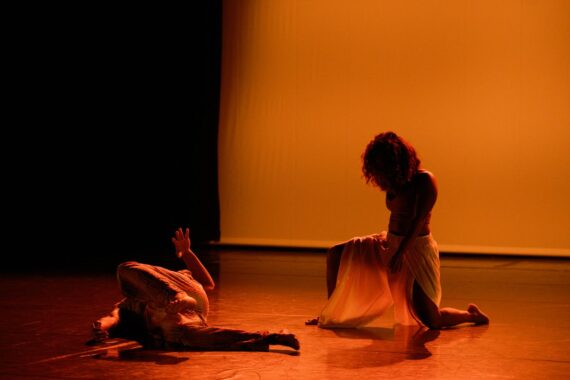
As Achilleas and Hillebrand move through the work’s alternating structure of dance and text, their dancing extends beyond their two bodies onstage, toward inheritances transmitted across generations, communities, and contexts, while their spoken storytelling offers personal vignettes of lived events we can imagine.
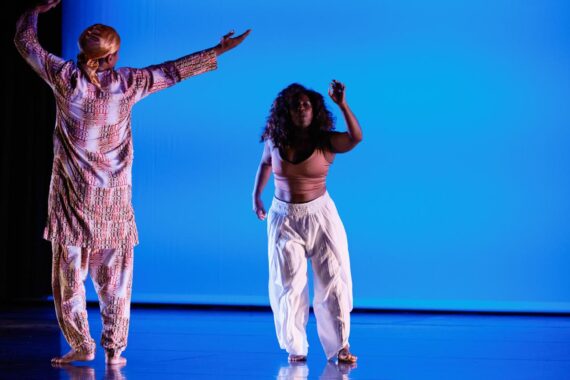
Though the work is staged in a frontal black box rather than in the cypher—the circle at the heart of breaking, where spectators are participants—their performance keeps the cypher’s logic alive. The two performers often face and circle one another, trading solos and stories and dancing short duets.
The alternation between dance and speech, addressed both to one another and to us in the stands, subtly echoes the cypher’s turn-taking rhythm and circular process. They move easily between modes of embodiment and relation, neither dance nor text dominating the other, but rather co-energizing through their cycles of repetition and change.
Their spoken stories captivate me both for the warm, emphatic spirit in which they are told and for their implications. They describe being read as European, even associated with whiteness, abroad, while in Germany they are routinely profiled for their brown skin. They explain how others’ perceptions reveal to them what they hadn’t seen in themselves and how this learning helps them move beyond identities imposed on them.
At one point, Achilleas tells us that “culture is only experienced because it’s carried in your body,” a phrase I’ve often remembered since; a simple encapsulation of how only through one’s own embodiment of something, whether land, rite or thing, can one come to know, feel and learn from it, unlike the passing encounter of a tourist, whose distance as a visitor often means they leave with nothing embodied deeply enough to carry on.
In “Hip-Hop Habitus v.2.0” (2014), Thomas F. DeFrantz draws on PierreBourdieu’s notion of habitus—the bodily dispositions absorbed from one’s social world—suggests considering hip-hop as an embodied inheritance rather than a repertoire of steps.He is wary of what happens when that inheritance circulates globally: in competitions and on concert stages, hip-hop dance risks shedding its local social function in favor of a cool aesthetic. One might call this a tourist’s relation to culture, the opposite of what Achilleas describes.
Yet Between the Oceans doesn’t need to resist the reduction DeFrantz warns against; it emerges joyfully from the artists’ generative collaboration. Its storytelling and reflection are honest, unpretentious and clear, seeking no validation, and its virtuosic tricks are part of the conversation rather than a substitute for it.
Pix – thabo thindi


