

By John Owoo
(Accra – Ghana)
In the restless visual economy of Accra, where billboards compete endlessly for attention with political slogans, telecom campaigns, and consumer fantasies, Ghanaian artist Emmanuel Aggrey Tieku interrupts the city’s advertising rhythm with something far more reflective.
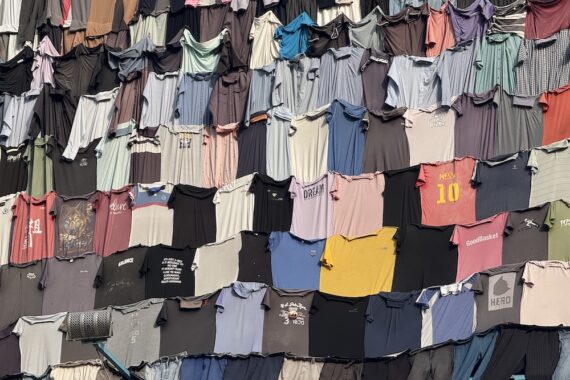
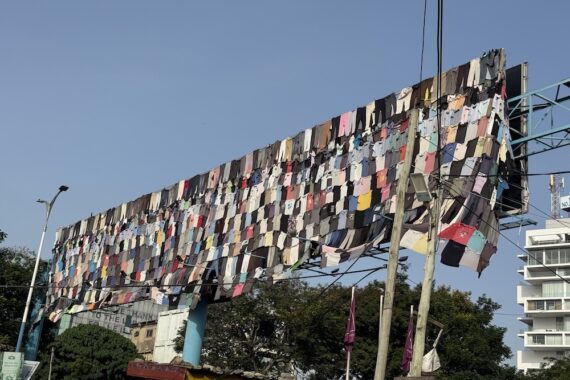
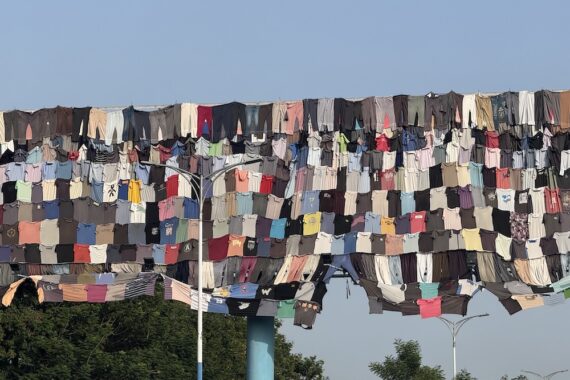
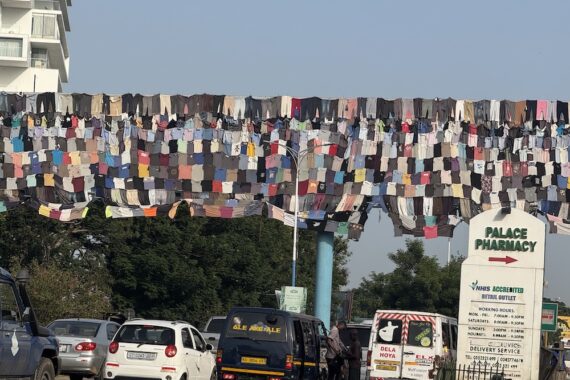
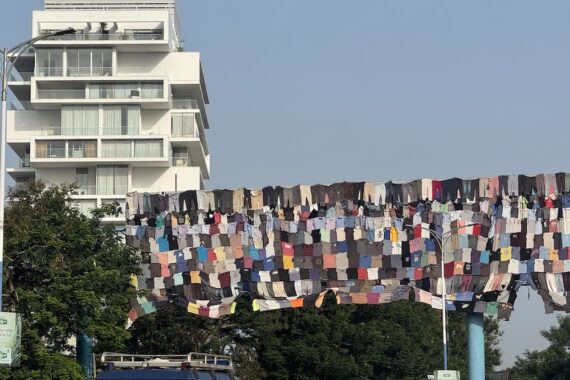
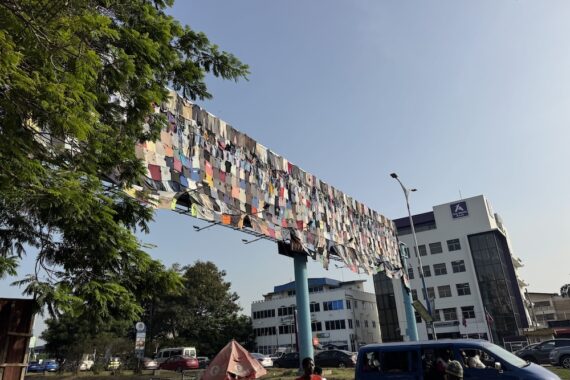
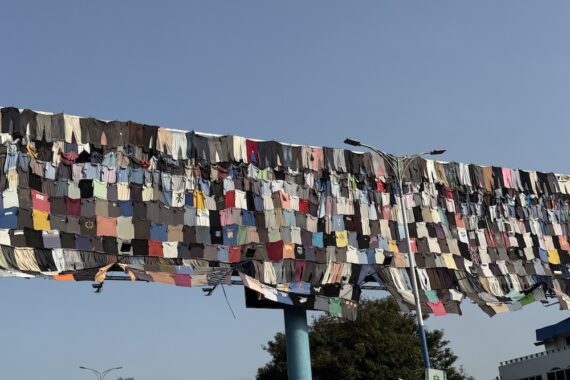
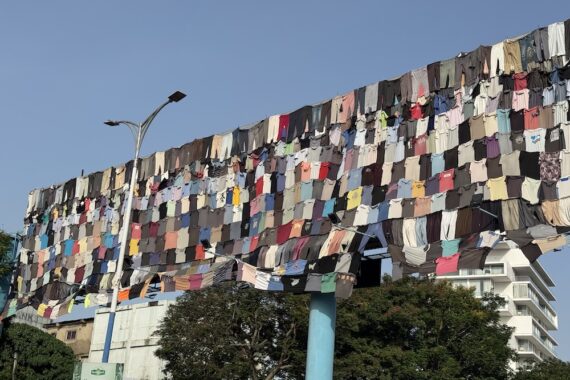
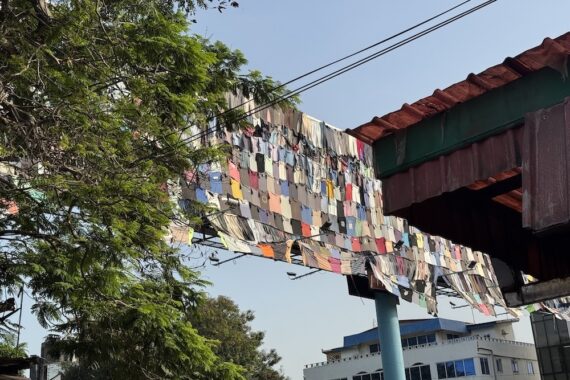
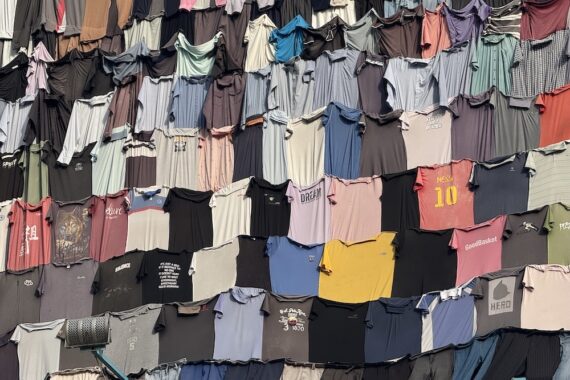
His public installation project, Baleboards, transforms discarded secondhand clothing into monumental urban gestures, draped across billboard structures that typically serve as platforms for commerce and persuasion.
Indeed, the rise of fast fashion has had a deeply damaging impact on the environment, driven by the mass production of cheap clothing designed for short-term use and rapid disposal. The industry consumes enormous amounts of water, energy, and raw materials, while textile factories release harmful chemicals and dyes into rivers and ecosystems.
Synthetic fabrics such as polyester also contribute significantly to microplastic pollution, with tiny plastic fibers entering oceans during washing. In addition, the constant demand for new trends encourages excessive consumption, leading to mountains of discarded clothing in landfills, where many garments take decades to decompose.
Tieku’s intervention is simple in material yet powerful in implication. Using bale clothes — the secondhand garments imported into Ghana in overwhelming quantities — Tieku repositions what is often dismissed as economic residue at the center of public discourse. The result is an exhibition that feels less like decoration and more like a confrontation with the realities of consumption, identity, and global exchange.
Installed high above Accra’s streets, the works immediately alter the city’s visual atmosphere. Instead of polished advertisements promising aspiration, viewers encounter hanging fabrics that carry traces of anonymous lives, migration routes, and economic inequalities. The clothes appear almost ghostly against the urban skyline, fluttering with a quiet insistence that resists the loud certainty of commercial branding.
What makes Baleboards compelling is its ability to merge sculpture, activism, and street intervention without becoming overly didactic. Tieku does not merely criticize the secondhand clothing economy; he also acknowledges its integration into everyday Ghanaian life.
Undeniably, bale clothes are deeply woven into local markets, fashion cultures, and survival economies. By elevating them onto billboard structures, he reframes them as a burden, an archive, and a symbol of resilience.
The scale of the installations is central to their impact. Billboards are traditionally spaces of authority and visibility, designed to dominate public attention. Tieku effectively hijacks that language, turning advertising infrastructure into a site for reflection. In doing so, he questions who gets to occupy public space and which stories deserve amplification in the urban environment.
There is also a poetic tension in the works. The garments, stripped of their original owners, become suspended identities — fragments of global movement that hang over the city like unfinished narratives. Passersby are compelled to look upward, not toward consumer desire but toward histories of circulation, labor, and cultural dependency.
With Baleboards, Emmanuel Aggrey Tieku shows how public art can disrupt routine perception and prompt collective introspection. In a city saturated with commercial imagery, his installations reclaim visibility for overlooked materials and conversations, transforming Accra into an open-air site of cultural inquiry.


