





By John Owoo
(In Accra – Ghana)
Works by Ghanaian artist Al Hassan Issah that are currently on display at the Museum of Science and Technology in Accra appear utilitarian – indeed recognizable and unrecognizable at the same time.
However, a close encounter and observation appositely reveals the depth of research conducted by Issah on the rich history to Kumasi and by extension the Ashanti, whose past is replete with battles, unity, philosophy, norms and an intricate system of traditional authority / governance.
Titled “Kum Ase – A Field Filled with Golden Spikes” and curated by Tracy Thompson, Issah’s exhibition powerfully reveals the integration of different cultures through art, architecture, trade, conflict and clothing among others, which tend to border on tradition and modernity.
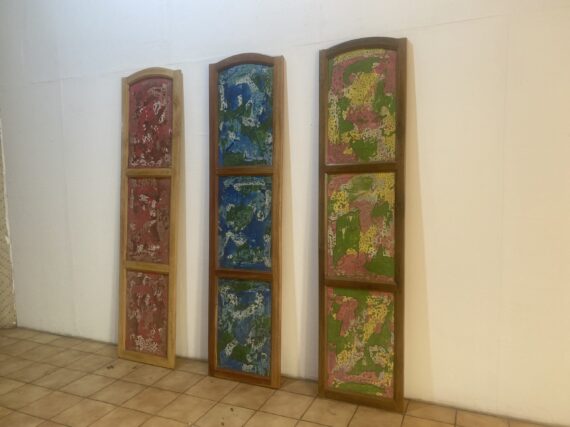
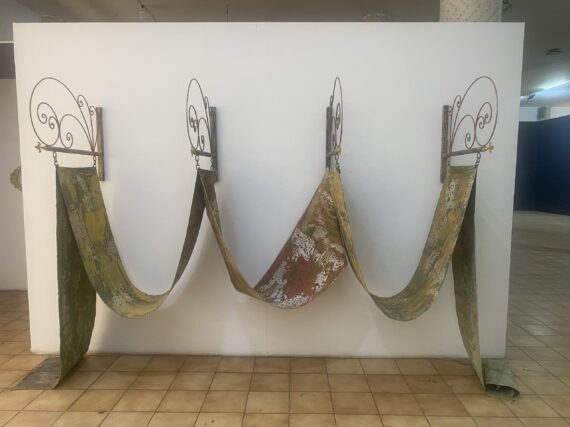
Indeed – window frames, drawings, paintings mounted on designer metal frames, flags decked with gold and silver totems, fork shaped metals straddled on wooden stands among others – evolved from the densely layered history of Kumasi.
He reminds us of ironic cultures that have existed from the 6th Century BC – these include sculptures of the Nok, Bronze forges from the old Benin Empire (some of which have recently being restituted and are back in Nigeria), Hausa / Moorish architecture and Ashanti Gold Weights among others.
Issah equally recaps the mixture of cultures through an intelligent use of Chinese Scuba Cloths, Gothic Architecture Frames, Arabesque Forms and Victorian Floral Wallpapers alongside diverse hybrid forms that capture the imagination of viewers.
His frame is not the end or a negative empty space – indeed, he traps viewers into photographic repetitions of metal frames that do not end with symbolic representations of scrolls – but also the material breakdown of un-mixable vegetable oils and water-based acrylics.
“Kum Ase – A Field filled with Golden Spikes” is a trilogy exhibition by Issah, which is running concurrently at the KNUST Jubilee Mall (Kumasi) and Red Clay Studios (Tamale). It ends on Monday April 17, 2023.


Hi,
The mix of designs from the Chinese culture, architectural forms and some African “distinguishable” forms creates an interesting interaction and “‘exchange of cultures.