









By John Owoo
(Accra – Ghana)
An exhibition featuring Ghanaian coffin designer Eric Kpakpo and Swiss anthropologist/art historian Dr. Regula Tschumi, offering a compelling meditation on death, memory, and artistic ingenuity within Ghana’s funerary culture, is underway at Nubuke Foundation in Accra.
Far from morbid, the show reveals how colorful designer coffins transform funerals into vibrant sites of storytelling, symbolism, and aesthetic expression, where art becomes a final act of communication between the living and the dead.
Tschumi’s long-term photographic practice anchors the exhibition, bringing an anthropological sensitivity shaped by decades of engagement with Ghana’s religious festivals and funeral rituals.
Drawn into the country’s “visually inspiring” landscape, she has documented more than one hundred figurative coffins over the years, photographing them at a fleeting yet critical moment—just before they are delivered, used, and ultimately buried.
Titled For Ending the Beginning, she presents three striking large-format photographs of funerals alongside a series of twenty coffin images. The photographs capture not only the coffins’ sculptural brilliance but also their ceremonial contexts.
Indeed, moments of mourning are infused with color, movement, and communal presence. Tschumi’s work serves as both documentation and preservation, freezing in time artworks designed to disappear into the earth.
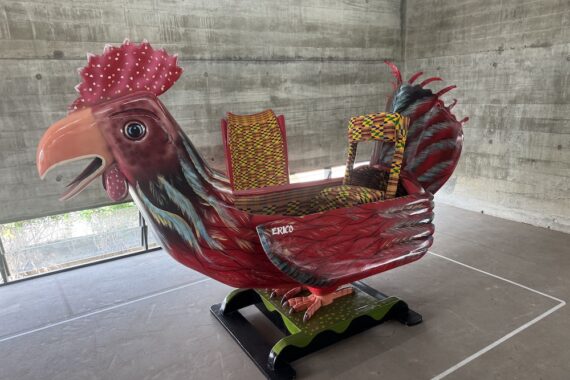
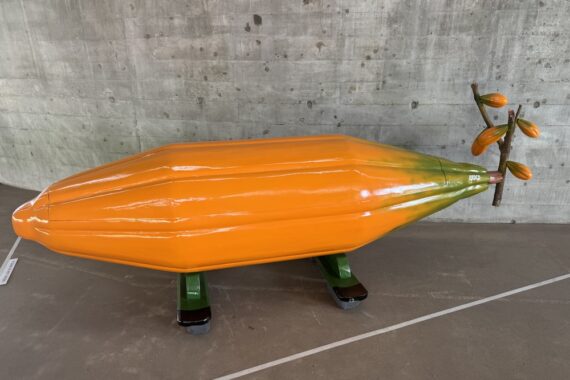
Complementing these images are the sculptural coffins of Eric Kpakpo, a master carpenter whose practice continues and expands the Ga tradition of figurative coffin-making.
He transforms wood into eloquent forms—fish, tools, animals, and tetomic and symbolic objects—that speak for the deceased when words are no longer possible. Rooted in Ga cultural symbolism, each coffin becomes a narrative vessel, reflecting the occupant’s life, occupation, clan, social status, and even unrealized ambitions.
While rooted in tradition, Kpakpo’s work is unmistakably contemporary. By combining inherited woodworking techniques with innovative design, he has pushed the form beyond ritual utility into the realm of global contemporary art. His internationally recognized “octopus” coffin exemplifies this synthesis of craftsmanship, symbolism, and bold imagination.
Together, Tschumi and Kpakpo present designer coffins not as curiosities but as influential cultural texts. The exhibition reframes funerary art as a living practice—one that honors ancestry while evolving through artistic vision. In doing so, it invites viewers to reconsider death not as an end but as a moment when art, identity, and remembrance converge with profound clarity.
The exhibition ends Saturday, February 28, 2026.


